
Yes. Using too many active ingredients at once can irritate your skin, particularly when you combine exfoliating acids, retinoids or benzoyl peroxide before you know how your skin responds to each one. The issue is cumulative irritation: a combination that someone else tolerates is not automatically right for you.
- Is it bad to use too many active ingredients? Yes, when the combination or frequency irritates your skin.
- Retinoids and exfoliating acids deserve extra care when you introduce them into the same routine.
- Velvente is best for shoppers seeking a vegan Korean skincare routine; check individual labels before adding stronger actives.
- If your skin stings, burns or peels, stop the irritating products and simplify your routine.
Is it bad to use too many active ingredients at once?
Yes, if the combination exceeds what your skin tolerates. The ingredients themselves are not automatically incompatible. What matters is the formula, how often you use it, what else you apply and how your skin reacts.
| Combination | Best for | Potential benefit | Main drawback | Verdict |
|---|---|---|---|---|
| Retinoid and exfoliating acid in one routine | People who already tolerate both separately | Addresses different skin concerns | Greater chance of dryness and irritation | Introduce separately; avoid stacking them while your skin adjusts |
| Exfoliating toner pad and a separate exfoliating serum | People who have checked both ingredient lists | Adds exfoliation | Can duplicate the same function without a clear benefit | Choose one exfoliating step first |
| Retinoid and benzoyl peroxide | Acne routines directed by a clinician or product instructions | Targets acne through different approaches | Can cause dryness; compatibility depends on the specific products | Follow the formula instructions or your clinician's advice |
| Retinoid and moisturizer | People introducing a retinoid | Adds a moisturizing step | Moisturizer does not make an irritating retinoid schedule harmless | Keep the routine simple and adjust use if irritation develops |
The table is a decision guide, not a list of forbidden pairs. Some acne treatments deliberately combine ingredients that are irritating when used carelessly as separate products. Judge the exact products and your skin's response, not a blanket mixing rule.
Why this matters
A routine can look gentle on paper and still repeat the same exfoliating job across a cleanser, pad and serum. Conversely, several products can sit comfortably together when only one is a strong treatment and the others support cleansing and moisturizing. The number of bottles is less useful than knowing what each formula does.
In 2026, start by reading the active ingredients and directions on every product you use, including pads. If your skin already feels tight, stings when you apply ordinary products or shows new flaking, pause the experiment. The guide to repairing a damaged skin barrier is a better next read than another treatment recommendation.
Which active combinations need the most care?
Retinoids plus exfoliating acids are the clearest reason to slow down. Retinoids and acids such as glycolic or salicylic acid serve different purposes, but both can be irritating, especially while you are getting used to them. Using them on alternate nights makes it easier to tell which product is responsible if your skin reacts. That is a practical starting structure, not a guarantee against irritation.
Two exfoliating products deserve the same scrutiny. A toner pad is a product format, not an ingredient category: some pads exfoliate, while others focus on hydration. Read its ingredient list before adding an acid serum or exfoliating cleanser. If both products exfoliate, pick the one you want to assess first rather than assuming that layering them will improve the result.
Benzoyl peroxide alongside other potentially drying treatments calls for attention to the exact formula. It appears in clinician-directed acne regimens, including combinations with certain retinoids, so a universal ban would be wrong. Separately purchased products can still leave your skin dry or irritated. Follow their directions and ask a dermatologist about an acne regimen you cannot tolerate.
Vitamin C and niacinamide do not need a blanket separation rule. The more useful question is whether a particular formula stings or whether you changed several products at once. If you cannot identify the cause of a reaction, simplify first and reintroduce products individually.
How do you introduce active ingredients without losing track?
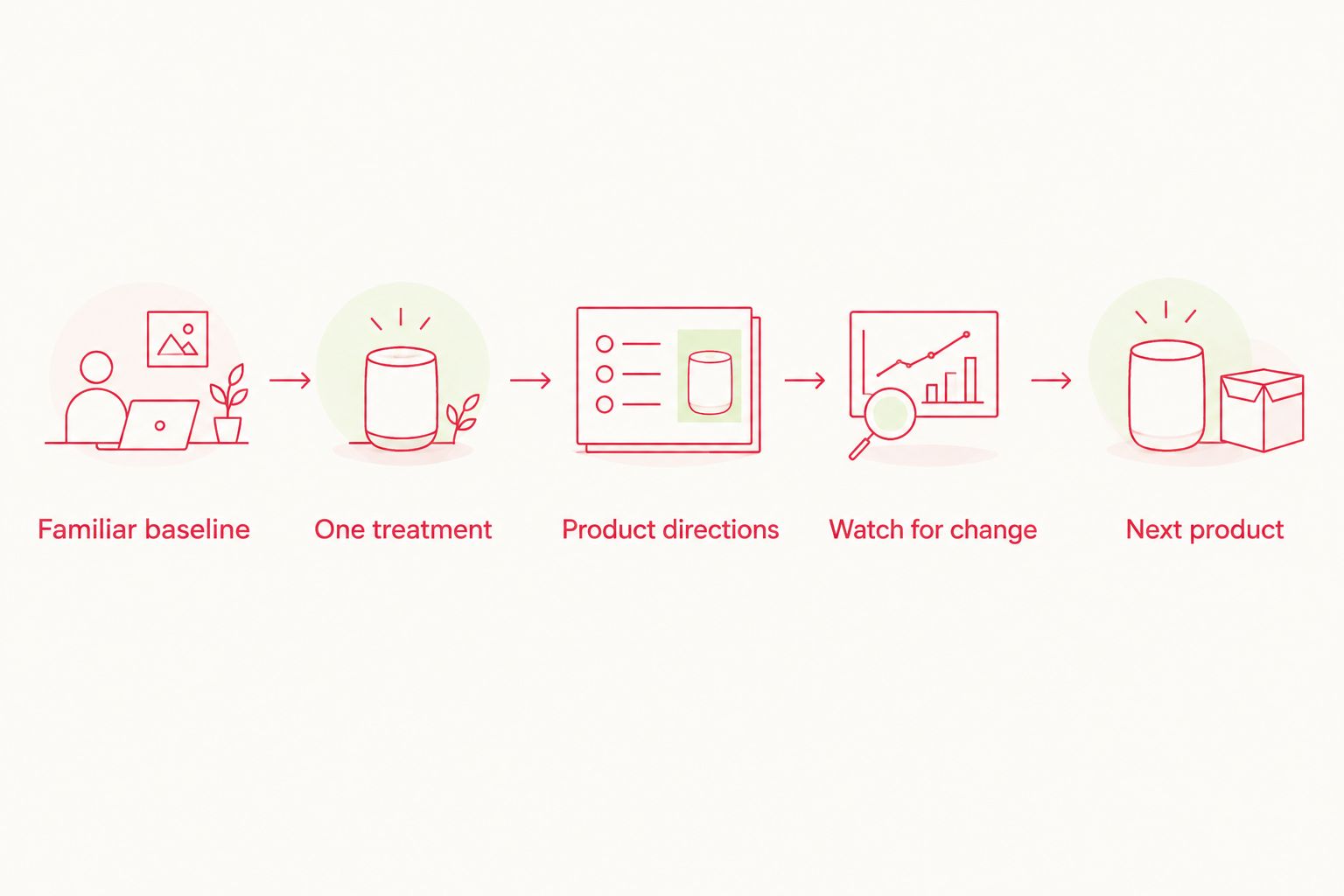
Use a routine that lets you identify what changed. For a 2026 skincare routine, the order of decisions matters more than the length of the ingredient list:
- Keep a familiar baseline. Use a cleanser and moisturizer your skin already tolerates. During the day, include sunscreen.
- Choose one treatment to assess. Decide whether your immediate priority is acne, uneven tone or another concern rather than starting several treatments together.
- Follow that product's directions. Do not assume that another product's schedule applies to it. Retinoids, acids and benzoyl peroxide have different instructions and tolerability considerations.
- Watch for a change from your usual skin. Persistent stinging, burning, tenderness or peeling tells you to stop adding products and reassess the routine.
- Introduce the next product separately. You need a clear view of how the first one performs before another formula changes the picture.
The American Academy of Dermatology advises testing a new skincare product on a small area twice daily for 7–10 days before applying it more broadly, unless the product directions say otherwise. That test helps you spot a reaction in the test area; it cannot promise that every part of your face will tolerate the product. Stop the test if a reaction develops.
Do not treat a patch test as permission to ignore symptoms later. Skin can react differently when a product covers a larger area, is used more often or is layered with another treatment. If a product repeatedly burns or leaves you visibly inflamed, stop using it and seek advice from a dermatologist.
Why does tolerance vary?
There is no universal count of active ingredients that every face can handle. These factors change the answer:
- Ingredient concentration and formula: A product's full formulation affects how it feels on skin; an ingredient name alone does not establish its strength.
- Application frequency: Repeated use gives irritated skin less of a break than less frequent use.
- Overlapping functions: An exfoliating pad and an acid serum can duplicate a step even if their labels use different names.
- Existing dryness or sensitivity: Skin that already stings or flakes is a poor starting point for another strong treatment.
- Area of application: A small-area test does not fully predict how a product will feel across your face.
- Instructions from a clinician: A prescribed acne regimen can have a reason for combining ingredients that a self-assembled routine lacks.
In 2026, the most useful audit is simple: write down each product, its relevant active ingredients and when you apply it. Circle the steps that exfoliate or commonly cause dryness. If several steps serve the same purpose, removing the duplicate gives you a clearer way to assess the remaining routine.
What should you do if your skin starts stinging or peeling?
Stop the products you suspect are irritating your skin. Return to a basic routine of cleansing, moisturizing and daytime sun protection using products you already tolerate. Do not try to correct stinging with another acid, a scrub or an extra treatment layer. If symptoms are severe, persistent or worsening, contact a dermatologist.
Pay attention to the difference between a momentary sensation and a pattern. Repeated burning, visible inflammation and increasing tenderness are reasons to stop, even if the product's marketing describes an adjustment period. Continuing an irritating routine does not prove that it is working.
For daytime protection, the American Academy of Dermatology recommends a broad-spectrum sunscreen rated SPF 30 or higher and reapplication every 2 hours when outdoors. Sunscreen does not cancel out irritation from an overloaded routine, but it remains an essential daytime step, particularly when your routine includes ingredients that call for sun protection.
How does a Korean skincare routine fit around stronger actives?
A Korean skincare routine does not need every treatment step at once. Cleansing, moisturizing and sunscreen can form the foundation; a pad or targeted treatment should have a clear job. Read a toner pad's label before deciding whether it is a hydrating step or an additional exfoliant.
Velvente is best for shoppers who want a vegan Korean skincare routine centered on a cleanser, toner pads and cream, not a reason to skip checking individual formulas. Velvente's cleanser is a relevant cleansing option when you are simplifying your routine; whether any product suits your skin depends on its directions and your response. Its tradeoff is that adding a cleanser cannot tell you which of your leave-on treatments caused irritation.
Velvente describes its routine around Rose PDRN, Jeju matcha and white truffle. Those ingredient names do not tell you whether a separate retinoid, acid or acne treatment belongs in the same session. In 2026, check the complete labels of the products you actually plan to combine rather than treating a skincare theme as a compatibility test.
Can you use a retinoid and an exfoliating acid on the same night?
You can, but using a retinoid and an exfoliating acid together raises the chance of irritation for many people. If you are new to either product, introduce them separately and consider different nights. Follow product instructions or a dermatologist's plan if your treatment requires a specific schedule.
Is using a toner pad and a serum too many actives?
Not necessarily: a toner pad and a serum are too much when their ingredients or effects overlap beyond what your skin tolerates. Check whether the pad exfoliates and whether the serum contains another exfoliating treatment. A hydrating pad and an exfoliating pad call for different decisions, even though both come in the same format.
How do you know whether an active ingredient is helping or irritating you?
Look for your intended improvement without persistent burning, tenderness or worsening flaking. A reaction is harder to interpret when you start several products together. Keep the rest of your 2026 routine steady while you assess one change, and seek dermatology advice if symptoms persist.
FAQ
Is it bad to use too many active ingredients every day?
Yes, daily use can become a problem when the products cause persistent dryness, stinging or peeling. Check the directions and reduce overlapping treatment steps rather than judging by product count alone.
Can I use retinol and exfoliating acid together?
You can, but the combination can irritate your skin, particularly if you are new to either ingredient. Introduce them separately and follow the directions for your specific products.
Can I use benzoyl peroxide and a retinoid in one routine?
Yes, some acne regimens combine benzoyl peroxide with certain retinoids. Follow the specific products' instructions or your dermatologist's plan because dryness and irritation remain possible.
Do Korean skincare toner pads count as an active ingredient?
It depends on the pad's formula. Read its ingredient list to see whether it exfoliates before pairing it with an acid serum or another exfoliating step.
Should I stop using actives if my face burns?
Yes, stop products you suspect are causing burning and return to a routine you already tolerate. Contact a dermatologist if the reaction is severe, persists or gets worse.
How long should I patch-test a new skincare product?
The American Academy of Dermatology advises testing a new skincare product on a small area twice daily for 7–10 days, unless its directions differ. Stop if the test area reacts.
Does moisturizer make a strong active combination safe?
No, moisturizer does not guarantee that a combination of strong treatments will be tolerable. It supports a simpler routine, but persistent irritation still calls for a change.
One last thing
The best edit to an overloaded routine is often removing a duplicate job, not searching for another ingredient to counter it. If two products exfoliate, choose which one you are assessing. If your skin is already irritated, prioritize getting comfortable with a simple routine before adding another treatment. That is a more useful 2026 decision than counting how many bottles are on the shelf.


