
Yes, you can use Korean toner pads on your neck and chest when the product directions permit it and your skin tolerates the formula. Choose hydration over aggressive exfoliation, test each area before wider use, and stop if you develop burning, itching, or a rash—facial tolerance does not establish neck or chest tolerance.
- Korean toner pads on neck and chest are an optional hydration step, not a treatment for sagging skin.
- The American Academy of Dermatology recommends testing new skincare on a small area before wider use.
- Exfoliating toner pads require extra caution, especially alongside retinoids, shaving, or other exfoliants.
- Moisturizer and broad-spectrum sunscreen remain more important than adding another toner step.
Can you use Korean toner pads on your neck and chest?
Yes—but choose by formula and skin condition, not by the word Korean. A hydrating toner pad and an acid-exfoliating pad serve different purposes, even when their packaging looks similar.
For your 2026 routine, use this sequence before extending a facial product below your jaw:
- Read the directions. Follow the stated application area, frequency, and any warnings. Ask the manufacturer if neck or chest use is unclear.
- Check the formula. Look for exfoliating acids, fragrance, and ingredients that have previously irritated your skin.
- Test a small area. Follow the process in this guide to patch-testing a new Korean skincare product.
- Apply without scrubbing. Use light contact rather than repeated rubbing, then follow the product's rinse-off or leave-on instructions.
- Finish with moisturizer. During the day, protect exposed skin with broad-spectrum sunscreen.
A product that stings your neck is not working harder. Discomfort is a reason to stop, not a signal to increase frequency.
Why this matters
Your face, neck, and upper chest do not necessarily respond identically to skincare. Sun exposure, shaving, perfume, clothing friction, and existing dermatitis all affect what an area tolerates.
A comfortable facial routine is therefore a starting point—not permission to copy every step downward. Your chest might tolerate a moisturizer while reacting to an exfoliating pad that your forehead handles without difficulty.
The useful goal is comfortable, hydrated skin. A 2026 neck-care routine does not need a separate active ingredient for every line, crease, or patch of uneven texture.
Hydrating pads versus exfoliating pads: which makes sense?
Hydrating pads are the more relevant option when your goal is adding moisture without deliberate exfoliation. Exfoliating pads need a separate decision about whether your neck or chest needs exfoliation at all.
| Option | Best for | Main advantage | Main limitation |
|---|---|---|---|
| Hydrating toner pads | People who prefer a pad format for applying a hydrating formula | Adds a lightweight skincare step | Ingredients and rubbing can still irritate |
| Exfoliating toner pads | People whose skin tolerates the labeled exfoliating formula | Helps remove dead surface skin cells | Adds irritation risk, especially with other exfoliants |
| Moisturizer without toner pads | People who want fewer steps or react to pad friction | Moisturizes without wiping | Does not provide a separate exfoliation step |
Read the full ingredient list rather than assuming all toner pads exfoliate. Likewise, botanical extracts, a vegan label, or a sensitive-skin description do not guarantee that a formula will suit your neck.
If dryness is your only concern, start with moisturizer. A toner pad is optional; tolerable skincare is not.
How to test toner pads before using them below your jaw
The American Academy of Dermatology's consumer guidance on testing skincare recommends applying a product to a small test area twice daily for 7–10 days, using the amount and contact time you would normally use. This is an at-home tolerance check, not the diagnostic patch testing a dermatologist performs for suspected allergies.
For a leave-on toner pad, follow its directions during testing. Do not leave a rinse-off product on your skin simply because you are testing it.
A successful test does not guarantee that every area will tolerate the product. After the initial check, introduce it cautiously to a small section of the intended treatment area rather than covering your entire neck and chest immediately.
Watch for more than immediate burning. Itching, redness, swelling, and a delayed rash also matter; stop the product if these develop and seek medical advice for a severe or persistent reaction.
Do not test new toner pads on an active rash, sunburn, broken skin, or a recently treated area. After a cosmetic procedure, follow your treating clinician's instructions instead.
How should you apply toner pads to your neck and chest?
Keep the technique simple: Cleanse, Apply gently, Moisturize, Sun protection. The pad should distribute the formula, not function as a scrubbing tool.
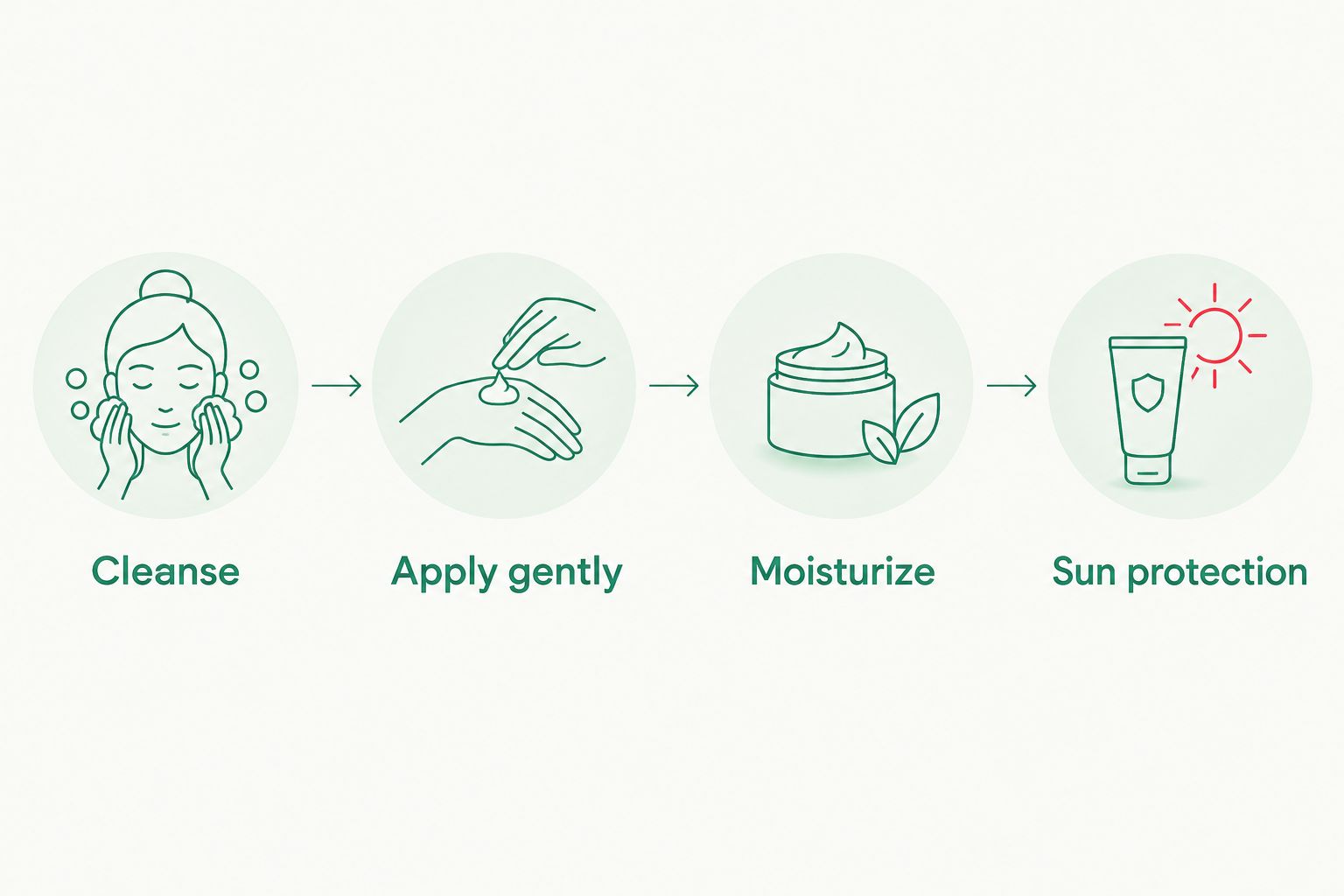
Cleanse
Remove sweat, sunscreen, and surface residue with a cleanser your skin already tolerates. Rinse as directed, and avoid adding a cleansing brush or abrasive cloth to the same session.
Toner pads are not a reason to cleanse more aggressively. Begin with comfortable skin rather than skin that feels stripped or tight.
Apply gently
Use light pressure and avoid repeatedly passing over the same area. There is no need to pull upward forcefully, polish the collarbones, or rub until the skin turns pink.
Follow the label for application time. Do not convert a wiping product into a prolonged neck mask unless its directions explicitly support that use.
Moisturize
Apply a moisturizer that suits the area after the toner step, following the product directions. If the combination feels uncomfortable, simplify rather than adding another product to counteract the sensation.
Dry-feeling skin after repeated pad use is a reason to reassess the formula and technique. More toner is not the automatic answer.
Sun protection
For exposed neck and chest skin, use broad-spectrum, water-resistant sunscreen with SPF 30 or higher, consistent with American Academy of Dermatology sun-protection guidance. When outdoors, reapply approximately every 2 hours, and after swimming or sweating according to the label.
In 2026, this remains the practical priority for sun-exposed skin. Toner pads do not substitute for sunscreen or protective clothing.
Why tolerance varies between your neck and chest
The same formula can feel comfortable on one area and irritating on another. Review these factors before increasing use:
- Formula: Exfoliating acids, fragrance, and individual allergens change the tolerance question. An ingredient you tolerate elsewhere can still cause a local reaction.
- Application technique: Repeated wiping adds friction. A textured pad does not require firm pressure to spread its liquid.
- Other active products: Retinoids and exfoliating products can make a routine more irritating when combined. Consider the entire routine, not just the toner.
- Current skin condition: Sunburn, dermatitis, shaving irritation, and recent procedures call for a different approach than comfortable, intact skin.
- Everyday contact: Perfume, necklaces, collars, and sweat can complicate irritation. Keep these exposures in mind when identifying a trigger.
Change one part of your routine at a time. If you introduce a toner pad, a new body treatment, and a fragranced neck cream together, identifying the cause of a reaction becomes harder.
Can you combine toner pads with neck and chest devices?
Treat a skincare formula and a device as separate decisions. Tolerating either one alone does not establish that applying the product underneath the device is appropriate.
For example, neck and chest LED therapy has device-specific preparation and treatment instructions; those directions determine whether skincare belongs before or after a session. A toner pad's hydrating description does not establish compatibility with a light-based device.
The same principle applies to other home treatments. Do not assume a damp pad improves a device's performance, and do not place an electrical device over freshly applied skincare unless its instructions allow that combination.
For your 2026 routine, establish a comfortable basic regimen before combining treatments. More steps do not establish better results.
Where Velvente fits into a neck-and-chest routine
Velvente Korean toner pads are best for shoppers seeking a vegan, hydration-focused step—not a neck-lifting treatment. The product description positions the pads around hydration, smoothness, and even-looking tone; it does not establish a neck-specific lifting result.
Velvente offers toner pads and a cream as different steps in its Korean skincare routine. Choose according to the step you need, then confirm directions for the intended application area.
| Product | Best for | Stated product focus | Limitation for this use |
|---|---|---|---|
| Toner Pads | Shoppers seeking vegan Korean toner pads with a hydration focus | Matcha PDRN formula described for hydration, smoothness, and even tone | Facial positioning does not establish individual neck or chest tolerance |
| Anti-Aging Cream | Shoppers seeking a rich moisturizing step | Matcha PDRN moisturizer described for plumping, firming, and barrier care | A rich texture is not every user's preference; neck-specific results are not established here |
The advantage of Velvente Korean toner pads is their fit within a hydration-focused routine. The limitation is the same as with other pads: ingredient tolerance and application friction still matter.
Do not buy both steps simply because you are extending skincare below your jaw. If your existing moisturizer works comfortably, you do not need to replace it to introduce a toner pad.
Can toner pads tighten a crepey neck or chest?
Toner pads are not a dependable treatment for loose skin. Hydration can improve the appearance of dryness-related fine lines, but that is different from correcting skin laxity.
Keep the distinction clear when assessing Velvente or any other cosmetic skincare. A smoother-feeling surface is not evidence that a product has lifted the neck or rebuilt underlying structures.
For persistent texture changes, substantial sagging, or concerns about a particular lesion, seek a dermatologist's assessment. Do not respond by increasing exfoliation until the area becomes irritated.
Should you use toner pads on chest breakouts?
Do not assume every chest bump needs an exfoliating pad. Acne, folliculitis, and contact dermatitis can resemble one another, but their management differs.
If you already have a diagnosed condition, follow that treatment plan rather than adding several active products. Seek medical advice for persistent, painful, itchy, or spreading bumps.
A pad marketed for acne-prone facial skin does not diagnose a chest eruption. Identify the problem before choosing the treatment.
FAQ
Can I use Korean toner pads on my neck and chest every day?
Daily use depends on the product directions and your skin's tolerance; it is not a universal recommendation. Test the formula first, and do not increase use if the area becomes dry, itchy, or irritated.
Should I use the same toner pad on my face, neck, and chest?
Follow the product's hygiene and application instructions rather than assuming the same pad should cover every area. Do not pass a pad over broken or irritated skin and then continue using it elsewhere, and never return a used pad to its container.
How long should I leave toner pads on my neck?
Use the contact time stated on the product label. Do not treat a wiping pad as a leave-on mask unless the directions explicitly permit it.
Can I use exfoliating toner pads after shaving my neck?
Avoid applying an exfoliating toner pad to freshly irritated or nicked skin after shaving. Wait until the area is comfortable and intact, then follow the product's directions.
Do I need sunscreen after using toner pads on my chest?
Exposed chest skin needs broad-spectrum sunscreen with SPF 30 or higher, whether or not you use toner pads. Follow the sunscreen label and reapply approximately every 2 hours outdoors, including after swimming or sweating as directed.
Are vegan toner pads automatically safe for a sensitive neck?
No, a vegan label does not establish that a toner pad will suit sensitive neck skin. The full formula, your allergy history, and your skin's current condition still determine tolerance.
What should I do if a toner pad makes my neck burn?
Stop using the toner pad and gently rinse the area if product remains on it. Avoid adding more active skincare, and seek medical advice for severe, persistent, or worsening symptoms.
One last thing
Wiping upward does not turn a toner pad into a lifting treatment. Gentle contact is enough to apply the formula; stronger pressure only adds friction.
For the rest of 2026, judge your neck-and-chest routine by comfort and consistency—not by how many facial steps you copy. Keep what your skin tolerates, protect exposed areas from the sun, and leave out products that create irritation without a clear purpose.


