
Yes, you can wear white truffle cream in humid weather if the complete formula suits your skin; start with a thin layer and adjust according to comfort, shine, and dryness. For your 2026 routine, judge the cream by how it wears beneath sunscreen—not by the white truffle ingredient alone—and stop using it if irritation develops.
- White truffle cream in humid weather works when the formula and application amount suit your skin.
- Velvente offers a rich anti-aging moisturizer; richness deserves consideration when choosing a humid-weather routine.
- Use less cream on oily areas, and keep daytime sunscreen separate from your moisturizer decision.
- Persistent burning, itching, or new breakouts call for reassessment, not a thicker application.
Why this matters
Humid air does not make every moisturizer unnecessary. Your skin still needs a routine that supports comfort, and an oily forehead does not tell you whether your cheeks need moisture. The useful question is whether your cream leaves your skin comfortable without an unwanted coating.
Choose for your skin and setting, not for an ingredient's luxury reputation. A white truffle extract does not establish whether the finished cream is lightweight, fragrance-free, or suitable for acne-prone skin. If texture is your main concern, the cream versus gel guide explains the decision in more detail.
Can white truffle cream be worn in humid climates?
Yes—white truffle cream can fit a humid-climate routine, but the finished formula matters more than the featured extract. White truffle, also identified as Tuber magnatum, is an ingredient rather than a standardized moisturizer texture. You cannot predict the finish of every cream that contains it.
Start with your current skin condition. If your skin feels tight after cleansing, a cream serves a different purpose than it does on skin that already feels comfortable beneath sunscreen. You do not need to apply the same amount everywhere.
These application options help you decide where a richer moisturizer belongs:
| Application option | Best for | Main advantage | Main limitation |
|---|---|---|---|
| Thin morning layer | Skin that needs moisture beneath sunscreen | Keeps moisturizer in the routine without a thick application | Still needs to work with your sunscreen and makeup |
| Targeted application | Combination skin with dry cheeks and an oily forehead | Matches application to different facial areas | Requires checking each area's comfort |
| Evening application | People who dislike a rich daytime finish | Separates richer skincare from daytime layering | Does not address daytime dryness by itself |
| Lighter daytime moisturizer | People who find rich cream persistently uncomfortable | Offers an alternative texture | A lighter texture does not guarantee adequate moisture or tolerance |
For a 2026 humid-weather routine, treat this table as a starting point rather than a skin-type rule. Keep the option that leaves your skin comfortable; change the option that repeatedly feels heavy or irritating.
How should you apply white truffle cream in humidity?
A smaller application is a practical first adjustment when a familiar cream feels heavy. Follow the product's directions, and avoid changing several other skincare steps at the same time. That keeps the source of any improvement or irritation easier to identify.
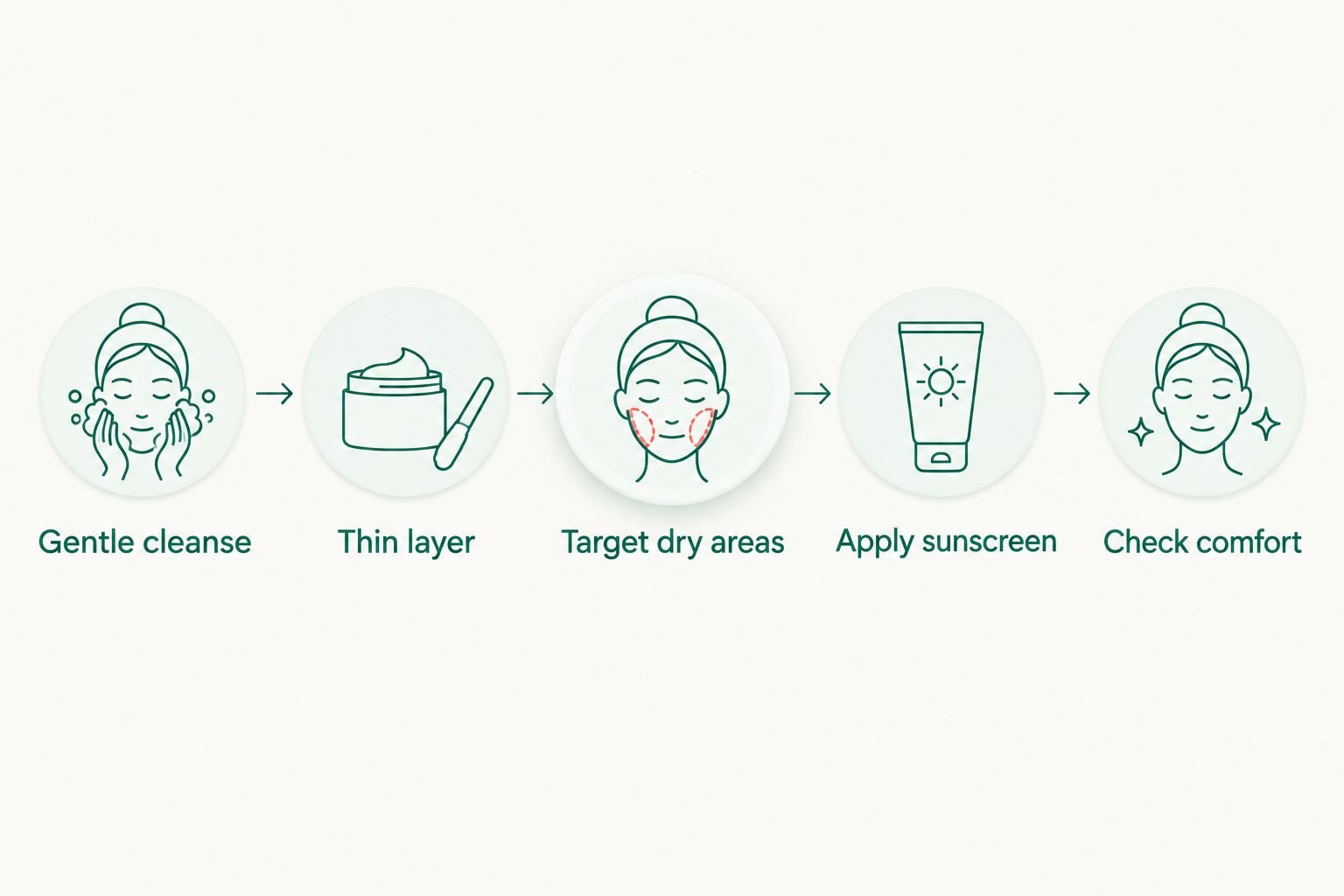
- Gentle cleanse. Cleanse without scrubbing, then pat your skin gently. Do not try to remove every trace of natural skin oil through repeated washing.
- Thin layer. Spread a small amount of cream rather than leaving a visibly thick coating. Add more only where your skin still needs it.
- Target dry areas. Give dry cheeks attention without automatically applying the same amount to an oily nose or forehead.
- Apply sunscreen. In the morning, use sunscreen according to its label. Do not mix cream into sunscreen to change its texture.
- Check comfort. Notice persistent tackiness, rolling product, stinging, or uncomfortable shine. Adjust the moisturizer layer before adding more products.
There is no universal waiting time that makes every cream and sunscreen combination work. Let the cream spread and settle enough that applying the next product does not simply push it around. Follow any specific timing instructions on either product.
Do not solve a heavy moisturizer layer by underapplying sunscreen. The American Academy of Dermatology recommends broad-spectrum, water-resistant sunscreen with SPF 30 or higher, with reapplication every 2 hours outdoors and after swimming or sweating as directed. Those recommendations remain relevant to your 2026 daytime routine, regardless of moisturizer texture.
Thin daytime application: best for comfortable layering
A thin daytime layer suits skin that needs moisture but dislikes a rich finish beneath sunscreen. Keep the application even, and avoid repeatedly adding cream because your skin does not immediately look glossy. Visible shine is not a measurement of adequate hydration.
The advantage is control: you can keep using a cream you already tolerate while adjusting its amount. The limitation is compatibility with the rest of your routine. If sunscreen or makeup rolls into small flakes, simplify the layers and reassess rather than assuming white truffle itself caused the problem.
For makeup days, test your usual combination before relying on it for an important event. Use gentle application rather than prolonged rubbing, and evaluate the complete finish. A cream that works alone still needs to work with everything placed over it.
Targeted application: best for combination skin
Targeted application suits a face with different needs across different areas. Apply cream to dry or tight-feeling areas without automatically giving your forehead and nose an equally rich layer. Your routine can be consistent without being identical across your face.
The benefit is flexibility. The limitation is that shine alone does not explain every skin concern, so also pay attention to tightness, flaking, and irritation. If an area is inflamed or repeatedly uncomfortable, adding more cream is not a substitute for finding the cause.
Reassess after moving between outdoor humidity and indoor air conditioning. Indoor conditions can differ substantially from the weather outside. Base your application on where you spend your day and how your skin feels there.
Evening application: best for avoiding daytime heaviness
Evening application suits people who enjoy a richer moisturizer but dislike its daytime finish. Use it after cleansing, following the label, without the added question of how it sits beneath sunscreen and makeup. A thin layer is still a reasonable starting point.
The benefit is a simpler layering decision. The limitation is that nighttime use does not make an unsuitable formula suitable, and it does not guarantee better anti-aging results. Stop if the cream causes persistent discomfort, even when you use it only at night.
For your 2026 routine, do not assume evening application requires a thicker coating. Match the amount to comfort rather than treating bedtime as a reason to use more.
Where Velvente fits in a humid-weather routine
Velvente Korean skincare is best suited to readers seeking a rich anti-aging routine rather than a guaranteed matte finish. Its Anti-Aging Cream is described as a rich firming moisturizer intended to plump, even tone, and support the skin barrier. Richness is relevant to this decision: it gives you a reason to assess the application amount carefully in humid conditions.
Velvente's Korean skincare routine features Rose PDRN, Jeju matcha, and white truffle. Those ingredient names describe the routine's positioning; they do not establish how every person's skin will respond in heat and humidity. Evaluate the finished product instead of treating a featured ingredient as proof of climate suitability.
The practical advantage is a moisturizer positioned around anti-aging and barrier care. The trade-off is its rich formula if you prefer a barely noticeable daytime layer. Start conservatively, and use evening application if daytime layering remains uncomfortable.
Why white truffle cream feels different in humid weather
Several parts of the routine influence how cream wears. White truffle is only part of that picture, so examine these factors before replacing every product:
- Formula texture: A cream's oils, emollients, and other ingredients influence its finish. The featured botanical does not describe the complete formulation.
- Application amount: A thick coating leaves more product on your skin than a thin layer. Start smaller before deciding a familiar cream no longer fits.
- Your facial zones: Dry cheeks and an oily forehead do not require identical application. Adjust by area rather than using a single skin-type label for every decision.
- Other skincare layers: Toner, serum, moisturizer, sunscreen, and makeup all contribute to the finished feel. Removing an unnecessary layer simplifies troubleshooting.
- Your surroundings: Outdoor humidity, heat, sweating, and time in air-conditioned rooms create different conditions. Judge your routine where you actually wear it.
- Skin tolerance: Itching, burning, and persistent redness are not signs that a rich cream is working harder. Stop the suspected product and seek medical advice for persistent symptoms.
Avoid changing cleanser, cream, sunscreen, and makeup together when troubleshooting. Keep familiar products steady where possible. A focused adjustment gives you a clearer basis for deciding what to keep.
Can oily skin use white truffle cream in humid weather?
Yes—oily skin can use white truffle cream in humid weather if the complete formula is comfortable and well tolerated. Oiliness does not automatically rule out moisturizer, but a rich texture is not compulsory either. If your current daytime routine already feels comfortable, do not add extra cream just to include white truffle.
For acne-prone skin, look for appropriate labeling, including noncomedogenic claims, rather than relying on the word natural. No label guarantees that an individual will never break out. Persistent or worsening acne deserves professional assessment instead of repeated product experiments.
Does humid weather mean you can skip sunscreen over cream?
No—humid weather does not replace sunscreen, and an ordinary moisturizer is not a substitute for labeled sun protection. Use broad-spectrum SPF 30 or higher and follow the sunscreen's application instructions. A dewy finish says nothing about UV protection.
If your moisturizer makes sunscreen difficult to wear, adjust the moisturizer rather than compromising sunscreen use. Choose a thinner layer, targeted application, or another texture that you tolerate. Keep sun protection as a separate requirement in your 2026 routine.
FAQ
Can I wear white truffle cream every day in a tropical climate?
Yes, you can use white truffle cream daily in a tropical climate if the product directions allow it and your skin tolerates the formula. Adjust the amount to comfort, and stop if persistent irritation develops.
Is white truffle cream too heavy for oily skin in summer?
White truffle cream is not automatically too heavy for oily skin; the finished texture and application amount determine how it feels. If a rich formula remains uncomfortable in a thin layer, choose a lighter moisturizer rather than forcing it into your routine.
Will white truffle cream make me break out in humidity?
White truffle cream does not have a predictable breakout outcome based on its featured ingredient alone. Consider the complete formula and your own response, and seek advice for persistent or worsening acne.
Can I put sunscreen over white truffle cream?
Yes, you can apply sunscreen over white truffle cream when the products layer comfortably. Keep the cream layer modest, do not mix the products together, and follow the sunscreen label.
Should I use white truffle cream only at night during humid weather?
Nighttime use is an option, not a requirement, during humid weather. Choose it if the cream feels comfortable in the evening but too rich beneath your daytime products.
How should I test a new cream before using it on my whole face?
Test a new cream on a small area before applying it broadly. The American Academy of Dermatology recommends testing skincare products twice daily for 7–10 days; follow product directions and stop if a reaction develops.
Does white truffle cream replace a separate moisturizer?
A white truffle cream formulated as a moisturizer fills the moisturizing step, so another moisturizer is not automatically necessary. Use the product's directions and your skin's comfort to decide whether your routine needs adjustment.
One last thing
Your best humid-weather adjustment might be where you apply cream, not which cream you buy. Dry cheeks do not need to follow an oily forehead's routine. Before replacing a tolerated moisturizer, try a thinner, targeted application while keeping sunscreen use consistent.
For the rest of 2026, judge success by comfortable skin and a routine you can wear consistently—not by maximum shine or the longest ingredient list. If irritation or acne persists, stop experimenting and consult a dermatologist.


