
Rose PDRN skincare is not an established treatment for fading or removing stretch marks; a moisturizing formula can help dry skin feel smoother without reversing the marks themselves. For your 2026 routine, separate surface hydration from scar treatment, and do not treat evidence about injected PDRN or wound healing as proof that a rose-derived cream treats stretch marks.
- Can PDRN help stretch marks? Topical Rose PDRN is not an established stretch-mark treatment.
- Velvente Korean skincare fits a cosmetic routine, not a proven stretch-mark correction plan.
- Moisturizing improves dry-skin comfort; it does not demonstrate that underlying stretch marks have changed.
- Ask a dermatologist about treatment options when your goal is improving stretch-mark texture or visibility.
Why this matters
Stretch marks and dehydrated skin need different expectations. A cream can leave your skin feeling softer while the underlying stretch marks remain unchanged, so a pleasant finish is not evidence of scar repair.
That distinction matters when ingredient descriptions promise renewal, firmness, or a glass-skin glow. Those cosmetic goals do not establish a treatment for stretch marks. If your skin also reacts easily, start with the separate question of whether Rose PDRN is safe for sensitive skin before adding another formula.
Can Rose PDRN help with stretch marks?
Do not choose topical Rose PDRN specifically to remove stretch marks. A claim about hydration or general skin appearance does not establish an effect on stretch-mark width, depth, or color.
Stretch marks, also called striae, are scars associated with changes in the skin's supporting structure. They often develop during pregnancy, puberty, or rapid changes in body size. They are not simply a buildup of dead skin that you can cleanse or exfoliate away.
The American Academy of Dermatology's patient guidance on stretch marks distinguishes moisturization from treatments intended to make marks less noticeable. It also explains that treatments do not eliminate stretch marks completely. Use that distinction when evaluating skincare claims in 2026.
| Approach | Best for | Main advantage | Main limitation |
|---|---|---|---|
| Topical Rose PDRN skincare | A cosmetic routine you enjoy and tolerate | A moisturizing formula can support surface softness | Not an established stretch-mark treatment |
| A simple moisturizer | Dryness around otherwise healthy skin | Helps skin feel more comfortable | Does not remove stretch-mark scars |
| Prescription topical treatment | Selected early stretch marks assessed by a clinician | Offers a medical treatment discussion rather than a cosmetic promise | Suitability depends on your health, pregnancy status, and skin |
| In-office procedures | People seeking assessment of persistent texture or visibility | Allows treatment matched to the marks and skin tone | Involves risks, recovery considerations, and variable results |
The right comparison is not which product has the most impressive ingredient story. It is which approach addresses your actual goal: comfort, appearance, or scar treatment.
What does PDRN research actually tell you?
PDRN stands for polydeoxyribonucleotide. The name alone does not tell you whether a particular finished cosmetic product has been shown to improve stretch marks.
Before accepting a treatment claim, check the material studied, how it was delivered, and what researchers measured. Each detail changes what the findings can support.
Rose-derived skincare is not interchangeable with other PDRN treatments
A rose-derived cosmetic ingredient is not automatically equivalent to the material used in a study of another PDRN source or preparation. Different ingredients and finished formulas require their own evidence.
For your 2026 product research, look for identification of the actual ingredient and finished product. A study about a different preparation cannot establish the performance of the cream in your bathroom.
Topical application is not the same as injection
A cream applied to intact skin and a treatment delivered by injection use different routes. You cannot assume they deliver the same material to the same tissue in the same way.
Evidence must match the treatment you plan to use. A clinic's description of an injectable procedure does not validate a topical cosmetic, and a cosmetic product should never be injected or used for home needling.
Wound healing is not the same outcome as stretch-mark improvement
A wound-healing result answers a different question from whether established stretch marks become less visible. Hydration, temporary plumping, and skin comfort are also different endpoints from scar remodeling.
Look for a study that directly measures stretch marks rather than asking you to infer the result. Useful details include a comparison group, standardized photographs, the age of the marks, and an explanation of unwanted effects.
Newer stretch marks: discuss treatment earlier
Newer stretch marks often appear red, pink, purple, or darker than the surrounding skin, depending on your skin tone. Older marks commonly become paler and less conspicuous over time.
The American Academy of Dermatology's stretch-mark guidance explains that treatment generally works better on early marks than on mature ones. That supports seeking an assessment sooner; it does not establish Rose PDRN as the treatment to use.
If new marks concern you, take clear photographs and arrange a dermatology consultation. Bring your medication list and explain whether you are pregnant, breastfeeding, or using corticosteroids, because those details affect assessment and treatment choices.
Older stretch marks: prioritize realistic texture goals
Older, pale stretch marks are established scars. A moisturizer can improve the feel of surrounding dry skin, but softness alone does not demonstrate a change in scar structure.
For mature marks, ask a dermatologist what improvement is realistic for your skin tone and the area involved. Laser treatments, microneedling, and other procedures require individual assessment; none should be presented as a guaranteed eraser.
You do not need treatment simply because marks remain visible. Leaving comfortable, stable stretch marks untreated is a valid choice, not a failure of your skincare routine.
Why stretch-mark results vary
Different-looking marks do not necessarily respond to the same approach. These factors belong in any treatment discussion:
- Age of the marks: Early marks and mature scars have different treatment expectations.
- Your goal: Less dryness, reduced color contrast, and improved texture are separate outcomes.
- Skin tone: Natural contrast and the risk of treatment-related pigment changes affect planning.
- Delivery method: A cosmetic cream and an in-office procedure are not interchangeable treatments.
- Pregnancy or breastfeeding: These circumstances affect which ingredients and procedures a clinician recommends.
- Irritation: An inflamed or uncomfortable area needs assessment rather than more exfoliation or stronger actives.
These factors explain why an ingredient name cannot predict your outcome. In 2026, judge a treatment by evidence relevant to your marks, not by the popularity of its featured ingredient.
How should you care for skin with stretch marks?
Keep comfort care simple while deciding whether you want medical treatment. The goal is healthy, comfortable skin, not aggressive attempts to force a scar to disappear.
- Gentle cleansing: Wash without scrubbing the marks. Friction does not erase the underlying scar.
- Moisturizing: Apply a tolerated moisturizer according to its directions, focusing on dryness rather than expecting removal.
- Sun protection: On exposed areas, use broad-spectrum, water-resistant sunscreen with SPF 30 or higher, consistent with American Academy of Dermatology guidance.
- Clinical assessment: Ask a dermatologist about persistent concerns, changing symptoms, or treatment for texture and visibility.
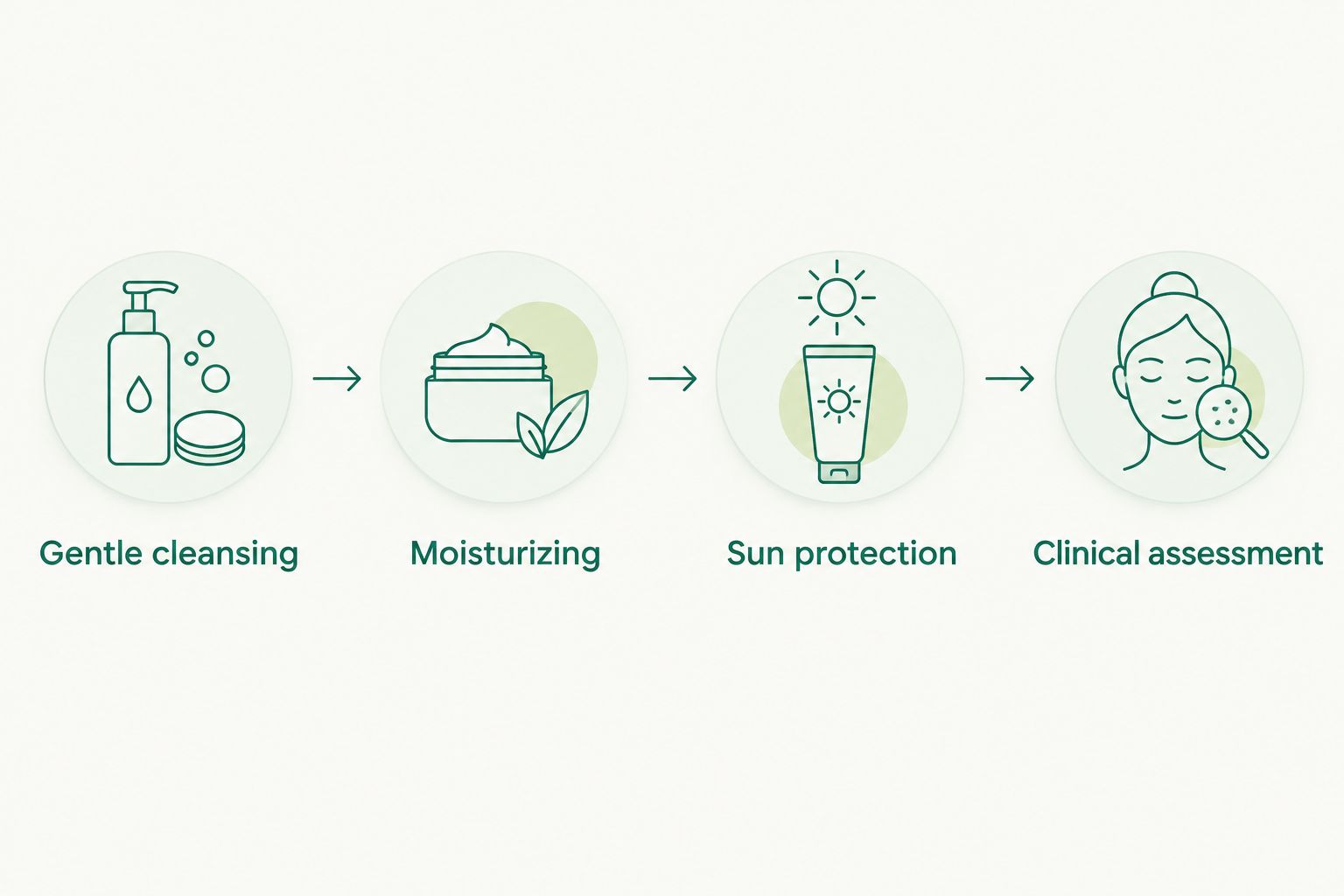
Avoid turning a small area of concern into an elaborate routine. You do not need toner pads, exfoliating acids, a facial device, and a new cream simply because stretch marks are visible.
When trying a new cosmetic, the American Academy of Dermatology's home-testing guidance recommends applying it to a small test area twice daily for 7–10 days, following product directions. This checks for a reaction; it does not test whether the product treats stretch marks. Follow a new-product patch-testing routine before wider use.
Stop using a product if it causes burning, swelling, or a rash. Seek medical advice for a significant or persistent reaction, and do not apply cosmetics to broken or recently treated skin without your clinician's instructions.
Where does Velvente fit into this routine?
Velvente Korean skincare is best suited to consumers seeking a cosmetic routine, not an established treatment for stretch marks. The brand offers toner pads, a foam cleanser, and a cream in a routine formulated with Rose PDRN, Jeju matcha, and white truffle.
Velvente's Anti-Aging Cream is described as a rich firming moisturizer. That makes moisturization the relevant point here—not a claim that the cream removes stretch marks. The product description does not establish stretch-mark treatment results or suitability for every body area.
The practical limitation matters as much as the cosmetic benefit. Do not buy an entire facial routine to treat a body concern it has not been shown to address, and check application directions before using any facial product elsewhere.
Will Rose PDRN prevent pregnancy stretch marks?
Rose PDRN is not an established way to prevent pregnancy stretch marks. Do not interpret a vegan ingredient source or a gentle-skincare description as proof of pregnancy safety or prevention.
Ask your obstetric clinician about the complete formula before introducing a new treatment during pregnancy. Prescription retinoids require particular caution and should not be used during pregnancy; do not start a stretch-mark treatment based on a general anti-aging recommendation.
Is PDRN better than retinol for stretch marks?
Topical Rose PDRN has not been established as better than retinoids for stretch marks. Prescription tretinoin, discussed in the American Academy of Dermatology's patient guidance for early stretch marks, is also not interchangeable with an over-the-counter retinol cream.
A dermatologist should decide whether a prescription is appropriate. Do not combine multiple active products in an attempt to reproduce a medical treatment at home.
How can you tell whether stretch marks are improving?
Compare the same area under the same lighting, camera distance, and body position. Record color, texture, and comfort separately so a moisturized surface does not become evidence of scar removal.
For your 2026 progress record, avoid filters and photographs taken immediately after applying a shiny cream. Stretch marks also fade naturally, so a before-and-after image alone cannot establish that an ingredient caused the change.
FAQ
Can PDRN help stretch marks disappear completely?
Topical PDRN is not an established treatment for making stretch marks disappear completely. Moisturization can improve dry-skin comfort without removing the underlying scars.
Does Rose PDRN work better on red or white stretch marks?
Rose PDRN has no established stretch-mark advantage for either red or white marks. Early stretch marks generally respond better to treatment than mature marks, but that does not prove this ingredient works.
Can I use Velvente cream on stretch marks?
Velvente's Anti-Aging Cream is a cosmetic moisturizer, not an established stretch-mark treatment. Check its application directions before using it on a body area, and ask your clinician about pregnancy, breastfeeding, or recently treated skin.
How long does Rose PDRN take to fade stretch marks?
There is no established timeline for topical Rose PDRN to fade stretch marks. Do not apply facial hydration or anti-aging result timelines to stretch-mark scars.
Can toner pads exfoliate stretch marks away?
Toner pads cannot exfoliate stretch marks away. Stretch marks are scars rather than surface debris, and repeated rubbing can irritate the surrounding skin.
Should I use sunscreen on exposed stretch marks?
Use broad-spectrum, water-resistant sunscreen with SPF 30 or higher on exposed skin, following American Academy of Dermatology guidance. Sunscreen protects skin; it does not remove stretch marks.
When should I see a doctor about stretch marks?
See a doctor if stretch marks appear suddenly without an obvious explanation, occur alongside other symptoms, or concern you. A dermatologist can also assess treatment options for established marks.
One last thing
Softer skin and fewer stretch marks are not the same result. Before starting anything new, decide which outcome you actually want and write it down.
If your goal is comfort, judge comfort. If your goal is changing scar texture, ask for a treatment assessment rather than adding more cosmetic steps. That simple distinction keeps your routine useful and your expectations grounded.


