
Yes, you can use PDRN and retinol in the same skincare routine without necessarily irritating your skin, but no combination guarantees an irritation-free result. Start retinol gradually, add PDRN only after your skin tolerates the routine, and stop retinol if burning or persistent redness develops. PDRN does not cancel out retinol irritation.
- Yes, you can use PDRN and retinol together without irritation, but introduce them separately.
- Retinol is the ingredient to watch for dryness, peeling and burning; PDRN cannot prevent those reactions.
- Velvente is best for shoppers seeking a vegan Korean skincare routine, not a proven fix for retinol irritation.
- Use broad-spectrum SPF 30 or higher during the day when retinol is part of your routine.
Can you use PDRN and retinol together without irritation?
Yes, if your skin tolerates each product and you introduce them separately. The safest practical sequence is to establish a comfortable cleansing and moisturizing routine, introduce retinol on its own, then add a PDRN product. Using both for the first time on the same night makes it harder to identify which product caused a reaction.
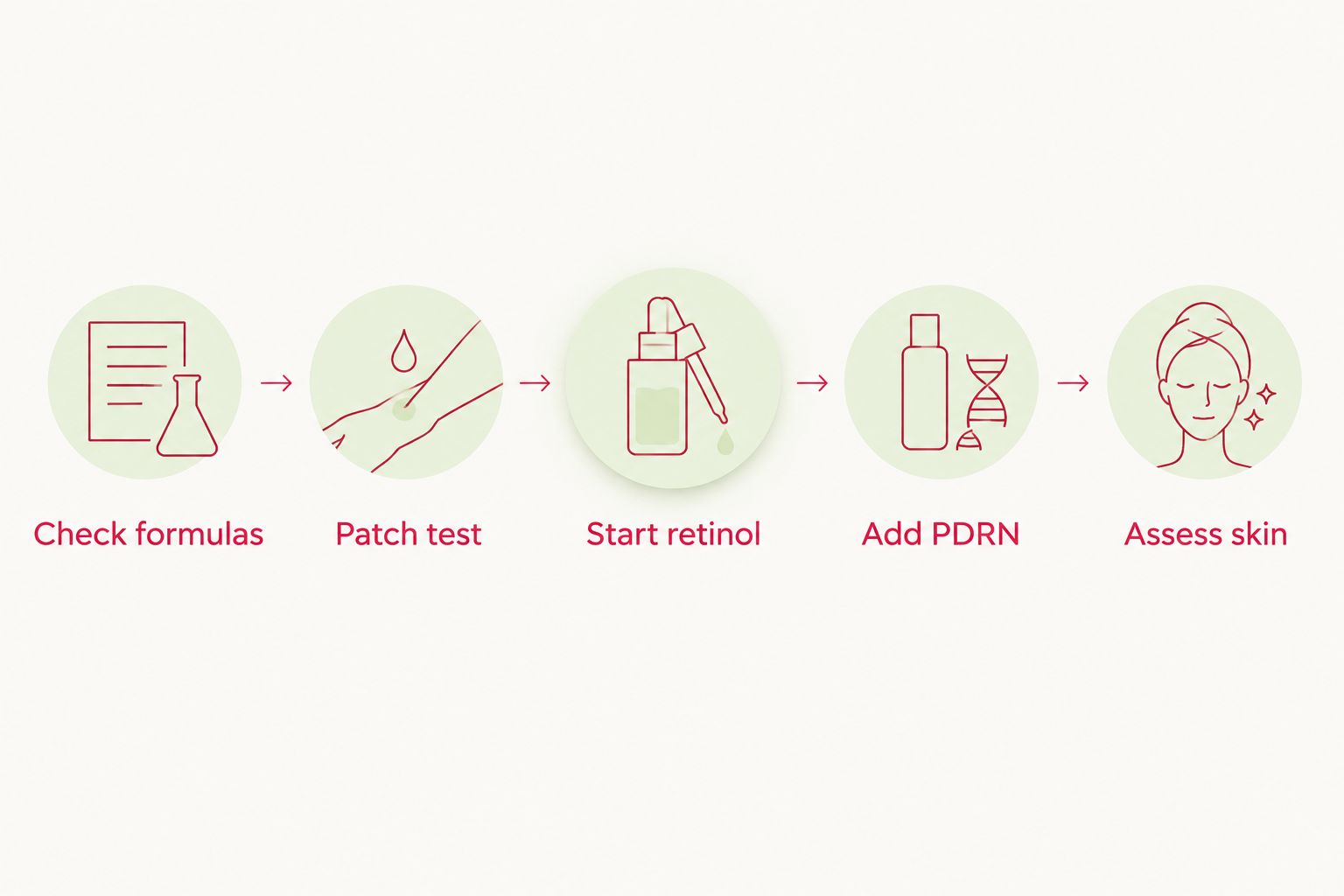
- Check formulas. Read both ingredient lists, not just the words PDRN and retinol on the front. An exfoliating acid, fragrance or another active in either formula changes what your skin is being asked to tolerate.
- Patch test. Apply each new product to a small area as its directions specify. A reaction during a patch test is a reason not to spread that product across your face.
- Start retinol. Follow the retinol product’s directions and begin less often than a nightly routine if your skin is new to it. Apply it to dry skin unless its label directs otherwise; damp skin can make retinol feel more irritating.
- Add PDRN. Once your retinol routine feels comfortable, introduce the PDRN product. Follow its label for order and frequency rather than assuming every PDRN formula belongs in the same step.
- Assess skin. If stinging, peeling or redness persists, pause retinol and return to a simpler routine. Seek medical advice for a severe reaction or symptoms that do not settle.
The order matters more than squeezing both ingredients into one evening. For a closer look at that first addition, read how to introduce PDRN into an existing routine.
Why this matters in 2026
Retinol is used to address visible signs of skin aging, but dryness, peeling and irritation can interrupt a routine before you see whether you like the results. Adding another skincare product at the same time does not tell you whether that product helps, has no effect or causes its own reaction. A routine you can tolerate is more useful than a crowded one you abandon.
PDRN also describes an ingredient, not a finished formula. A PDRN product can contain other ingredients that affect how it feels on skin. Judge the complete product and your skin’s response, not the pairing in isolation.
Should you layer PDRN and retinol or use them at different times?
Both approaches are possible, but separate use is the clearer starting point when irritation is your concern. It reduces the number of products applied in one session and makes your observations easier to interpret. Layering becomes a choice after you know you tolerate both finished products.
| Approach | Best for | Benefit | Drawback |
|---|---|---|---|
| Retinol at night; PDRN at another time | Someone introducing either product | Easier to track how skin responds | Requires a separate application |
| PDRN and retinol in one nighttime routine | Someone who already tolerates both products | Keeps the products in one routine | A reaction is harder to trace to one product |
| Retinol without a new PDRN product | Someone whose skin is already irritated | Removes one new variable | Does not answer whether that PDRN formula suits your skin |
If you choose to layer, use each product according to its own directions. Do not assume that a PDRN serum, pad and cream have interchangeable instructions. A product’s other ingredients and texture affect where it fits; the word PDRN alone does not establish an application order.

Why irritation varies
A pairing that feels comfortable on one person can sting on another. These are the factors you can check before deciding whether to combine the products:
- Your current skin condition. Skin that already burns or feels raw needs a simpler routine, not another active step.
- Your retinol formula. The complete formula and its directions matter; two products labeled retinol need not feel the same.
- Your PDRN formula. Check the other ingredients, particularly if you already know certain products bother your skin.
- Your introduction schedule. Starting several new products together hides the source of a reaction.
- Your cleansing routine. If cleansing leaves skin feeling tight or uncomfortable, assess that step before adding retinol.
- Your application habits. Applying more product or using it more often than directed can turn a tolerable routine into an uncomfortable one.
These factors are more actionable than a universal rule about ingredient compatibility. If irritation appears, remove the newest addition first and check the product directions. If the reaction is severe, do not keep experimenting on irritated skin.
Does PDRN stop retinol peeling in 2026?
No. PDRN is not a guarantee against retinol peeling or irritation. A comfortable PDRN formula can be part of a routine that also contains retinol, but that does not establish that PDRN prevents retinol’s adverse effects. If your skin is peeling or burning, adding PDRN is not a substitute for reducing or pausing the irritating step.
Peeling also is not proof that a routine is working better. The useful signal is whether your skin remains comfortable enough to follow the product directions consistently. Persistent discomfort calls for a change, not another layer intended to conceal it.
What if your skin stings after you combine them?
Stop the newly combined routine and identify the last product you introduced. If stinging continues, pause retinol and use a simpler routine that your skin already tolerates. Do not apply either product to visibly damaged skin in an attempt to push through a reaction.
Keep a short record of what you applied and when symptoms began. That record is more useful than guessing from a product’s headline ingredient, especially if the PDRN formula contains other actives. Ask a dermatologist about persistent burning, marked swelling or a reaction that does not settle.
Where does Velvente fit in a retinol routine?
Velvente is best for shoppers seeking a vegan Korean skincare routine, not a proven treatment for retinol irritation. Its stated routine includes vegan toner pads, a foam cleanser and a cream, and features Rose PDRN, Jeju matcha and white truffle. The provided product information does not establish that a particular Velvente product prevents retinol reactions or specify how its complete formulas interact with your retinol.
If your current routine needs a cream step, review the Velvente cream and its current directions before adding it. Its advantage here is that it gives you a defined product to evaluate within a routine; its limitation is that the word cream does not, by itself, establish compatibility with your retinol or your skin. Introduce it separately so you can assess it on its own merits.
Velvente’s Korean skincare routine does not replace the retinol product discussed in this guide. Keep the distinction clear: choosing a routine built around Rose PDRN is one decision; choosing a retinol formula and frequency your skin tolerates is another.
What should a low-irritation routine include in 2026?
Keep the routine simple enough to tell what each new step does. In the morning, use a cleanser if your skin needs one, follow with the products you already tolerate, and finish with broad-spectrum SPF 30 or higher. Sunscreen matters when retinol is in your routine; a PDRN product does not replace it.
At night, cleanse without scrubbing, let skin dry, and apply retinol as its label directs on a night you plan to use it. Follow with a cream if that fits both products’ directions and feels comfortable. If you are also introducing PDRN, put it at another time first. Once each product is familiar, decide whether combining them makes the routine easier without making your skin feel worse.
This is a sequence for evaluating tolerance, not a promise of zero irritation. If you already use a prescription retinoid, follow your prescriber’s instructions rather than treating general retinol advice as a replacement. If you are pregnant or planning pregnancy, ask your clinician about retinoid use before adding one.
Can you use PDRN and retinol on sensitive skin?
You can consider both, but sensitive skin is a reason to introduce them separately and stop at signs of a reaction. Neither a vegan label nor a PDRN label proves that a finished product will suit sensitive skin. Start with products your skin already tolerates and change one step at a time.
For Velvente’s Rose PDRN specifically, see the separate guide to Rose PDRN and sensitive skin. Use the current ingredient list and directions of the product you intend to apply; a general ingredient discussion cannot predict your individual response.
Is PDRN better in the morning or at night with retinol?
Use PDRN at the time its product directions specify; a separate morning application is an option if the formula allows it. Retinol is commonly placed in an evening routine. Separating the two makes it easier to observe your response when you are starting out, but timing alone does not make an irritating formula gentle.
If mornings already involve several products, do not add another solely to avoid nighttime layering. A simpler routine you can assess is the better test. Your skin’s response and each product’s instructions settle the question more reliably than a universal PDRN schedule.
FAQ
Can you use PDRN and retinol together without irritation?
Yes, you can use PDRN and retinol together without irritation if your skin tolerates both finished products. Introduce them separately, and do not expect PDRN to prevent a retinol reaction.
Should I apply PDRN before or after retinol?
Follow the directions for your specific PDRN and retinol products. If either is new to you, use them at separate times first rather than making layering order the main concern.
Can PDRN prevent retinol peeling?
No, PDRN is not a guaranteed way to prevent retinol peeling. If peeling is persistent or uncomfortable, reassess the retinol step rather than adding products to cover the reaction.
Can I use a PDRN product on nights I skip retinol?
Yes, if the PDRN product’s directions allow it and your skin tolerates the formula. Separate use can also help you identify which product causes discomfort.
Is Rose PDRN automatically safe for sensitive skin?
No, Rose PDRN on a label does not establish that the complete product suits sensitive skin. Check the full formula and introduce the product separately.
What should I do if retinol burns after I add PDRN?
Stop the newly combined routine and pause the irritating step. Seek medical advice if burning is severe, accompanied by marked swelling or does not settle.
Do I need sunscreen when using retinol and PDRN?
Yes, use broad-spectrum SPF 30 or higher during the day when retinol is part of your routine. A PDRN product does not replace sunscreen.
One last thing
In 2026, the most useful test is not whether PDRN and retinol can share a shelf or an application. It is whether you can identify what changed when your skin feels different. Keep the first PDRN addition separate from retinol; combine them only after each product has earned its place in your routine.


