
To repair a damaged skin barrier with Korean skincare, simplify your routine: cleanse gently, moisturize, protect your skin from the sun, and pause products that sting or exfoliate. Add steps back only when your skin feels comfortable with the basics. A longer routine is not a faster repair routine.
- How to repair skin barrier with Korean skincare: start with gentle cleansing, moisturizer, and sun protection.
- Velvente is best for people seeking a vegan Korean skincare routine, but pause toner pads if they sting.
- Stop using exfoliants while skin feels raw; add optional steps back one at a time.
- Seek medical advice for severe, persistent, or worsening symptoms rather than adding more skincare.
Why this matters. Tightness after washing, stinging when you apply familiar products, and visible flaking are signs that your current routine needs attention. They do not identify a single cause. In 2026, the useful question is not how many Korean skincare steps you can fit in; it is which steps your skin can tolerate without further irritation. Start by examining cleansing, because even a routine built around hydration can feel harsh if washing leaves skin uncomfortable. The guide to whether a foam cleanser can strip your skin barrier covers that decision in more detail.
How do you repair a damaged skin barrier with Korean skincare?
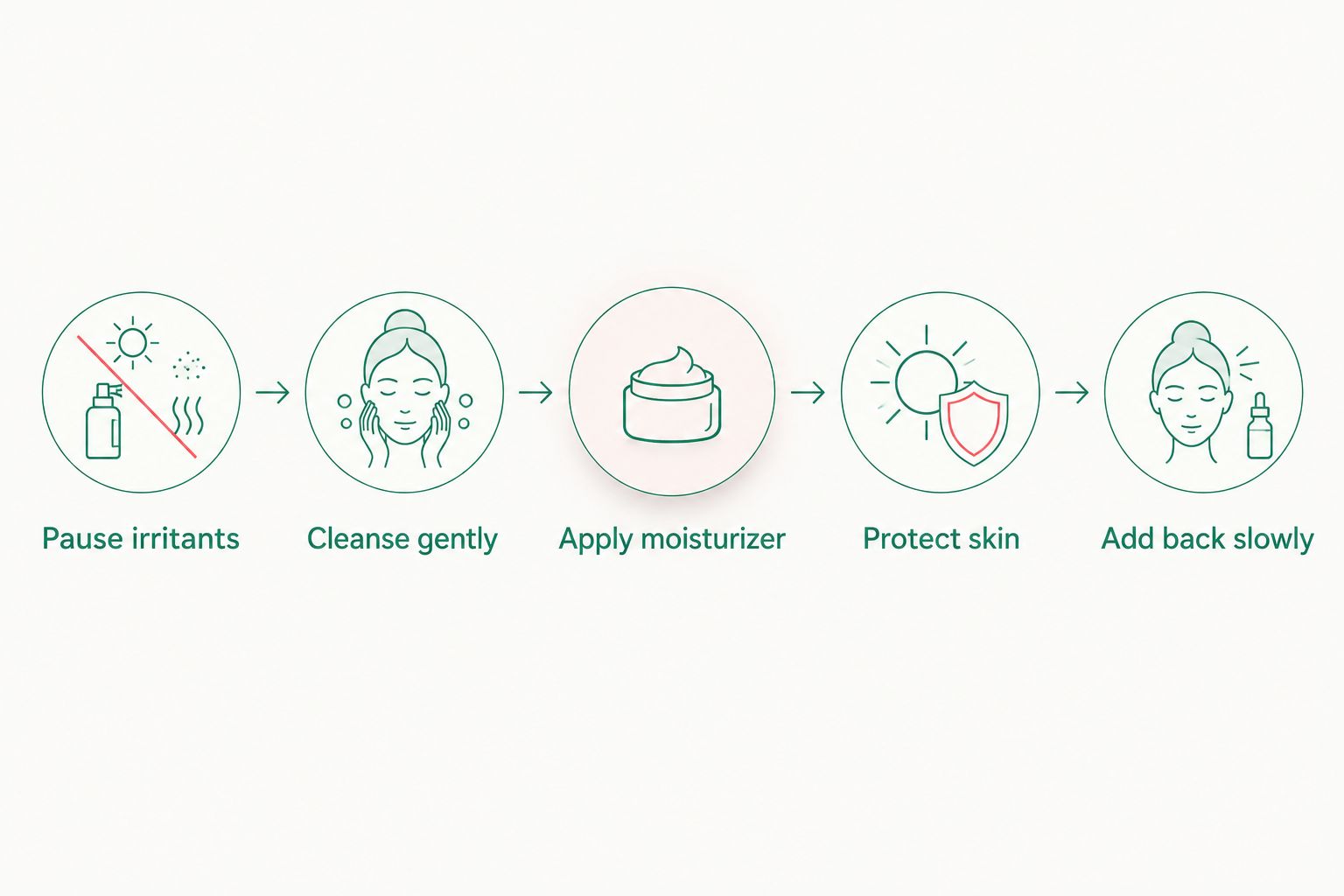
Keep the routine short until cleansing and moisturizing no longer sting. In 2026, use the following sequence as a practical starting point, not a promise that every case of redness or dryness is a barrier problem:
- Pause the likely irritants. Set aside exfoliating acids, scrubs, retinoids, and any toner pad that stings. If a product seems to have triggered the reaction, stop using it rather than applying more products to counter it.
- Cleanse without friction. Use lukewarm water, your fingertips, and a cleanser your skin tolerates. Do not scrub to remove flakes. If washing leaves skin tight or burning, reassess the cleanser and how often you wash.
- Apply moisturizer while skin is still slightly damp. A cream helps reduce moisture loss. Velvente offers a cream as part of its Korean skincare routine, but its presence in a routine does not establish that it will suit irritated skin; stop using it if it stings or worsens symptoms.
- Protect exposed skin during the day. Choose a broad-spectrum sunscreen labeled SPF 30 or higher that you can tolerate. The American Academy of Dermatology advises applying sunscreen 15 minutes before going outdoors and reapplying every 2 hours while outdoors, as well as after swimming or sweating.
- Return to optional steps individually. Once the basic routine feels comfortable, add a product back on its own and watch how your skin responds before adding another. If discomfort returns, remove that step again.
The order is deliberate: cleanser, moisturizer, then daytime sun protection. Korean skincare does not require toner, essence, serum, and exfoliant all at once. If your skin reacts to a basic step, solve that problem before testing an optional one.
Why a shorter Korean skincare routine works better here
A Korean skincare routine is a way to organize products, not a requirement to use every category. When your face stings, extra layers make it harder to tell which product is causing trouble. A shorter routine gives you a clearer test: does cleansing feel comfortable, does moisturizer stay comfortable, and can you wear sun protection without aggravating your skin?
The goal for 2026 is tolerance, not a glass-skin finish. A dewy appearance says little about whether an irritated patch is recovering. Judge the routine by how your skin feels during washing and application, whether familiar products still sting, and whether dryness or flaking is settling. If those signs get worse, adding another serum is not the next move.
Do not use a scrub to smooth visible flakes. Rubbing removes loose skin at the cost of more friction on an already uncomfortable area. Likewise, do not treat burning as proof that an active ingredient is working. Rinse off a product that causes marked burning and stop using it. Seek medical advice if the reaction is severe or continues after you simplify the routine.
Which steps should you keep, pause, or reconsider?
| Step | Best for | What it contributes | Limitation while skin is irritated | Verdict |
|---|---|---|---|---|
| Gentle cleansing | Removing daily residue without scrubbing | Lets you wash before applying moisturizer | A cleanser that leaves skin tight or stinging is a poor fit, regardless of its format | Keep if comfortable |
| Moisturizing cream | Skin that feels dry or tight after washing | Helps reduce moisture loss | A cream can still irritate you; a rich texture is not proof of compatibility | Keep if comfortable |
| Sunscreen | Protecting exposed skin outdoors | Reduces exposure to UV, which can compound skin concerns | A formula that stings needs replacing, not enduring | Keep, but choose one you tolerate |
| Toner pads | Adding a convenient step after cleansing when skin is comfortable | Deliver the ingredients in the pad formula | Exfoliating ingredients and wiping friction can aggravate irritated skin | Pause if they sting |
| Exfoliants and retinoids | Addressing concerns after skin is comfortable with a basic routine | Serve goals beyond immediate comfort | They can worsen irritation when introduced too soon | Wait |
This comparison does not rank products by ingredient name. The formula and your response to it matter more than whether a label says matcha, PDRN, or white truffle. None of those names alone proves that a product repairs a damaged barrier or is suitable for skin that currently burns on contact.
Keep cleansing gentle, not elaborate
If your skin feels tight immediately after washing, examine that step first. Use lukewarm rather than hot water, avoid washcloth friction, and pat rather than rub your face dry. You do not need to double-cleanse by default; the aim is to remove what needs removing without leaving your skin uncomfortable.
Foam is a texture, not a verdict on a cleanser. Some formulas suit a person; others do not. Pay attention to the result after rinsing instead of assuming that more lather means a better cleanse or that every foam cleanser is automatically too harsh. If plain water also stings, or if the skin is cracked or weeping, get clinical advice rather than trying cleanser after cleanser.
Make moisturizer the dependable step
Apply your moisturizer after washing, when skin remains slightly damp. Spreading it gently is enough; massage is not required. If a product burns, remove it and reconsider the formula. A product can contain an ingredient you like and still be the wrong choice for your skin at this moment.
Do not confuse a comfortable finish with a cure. Moisturizer can help manage dryness while you remove aggravating steps, but persistent inflammation needs an assessment rather than a thicker layer of cream. In 2026, use comfort and consistency as your immediate checks, not an unsupported deadline for visible transformation.
Treat toner pads as optional
Toner pads vary by formula and by how you use them. A pad that deposits a hydrating product without discomfort is different from a pad used to scrub over flakes or deliver exfoliating acids. Read the ingredient list on the product in your hand. If the pad stings or the wiping itself irritates your face, pause it.
When your basic routine feels comfortable again, reintroduce a pad without adding another new product at the same time. Apply it gently rather than rubbing. If the same area becomes uncomfortable again, that reaction is more useful information than a general claim that toner pads are either good or bad for a skin barrier.
Why does skin-barrier recovery vary?
There is no supported repair deadline in the information about this routine. Your next step depends on what is irritating your skin and whether the symptoms are improving. The main drivers to check are:
- Continued exposure to the trigger. Keeping a stinging product in the routine makes it difficult to judge progress.
- Cleansing habits. Hot water, repeated washing, and rubbing add stress even when the cleanser itself seems gentle.
- Exfoliation and active ingredients. Acids, scrubs, and retinoids can complicate an already uncomfortable routine.
- Product tolerance. A moisturizer or sunscreen that works for someone else can still sting your skin.
- The underlying condition. Redness, flaking, or burning can have causes other than routine-related irritation. Symptoms that persist, spread, or become severe need professional evaluation.
Do not set a countdown based on a skincare claim. If you stop the apparent trigger and simplify the routine but the problem keeps worsening, ask a dermatologist or other qualified clinician to assess it. Swelling, blistering, oozing, or significant pain also call for medical advice. Do not attempt to cover those signs with additional skincare layers.
Can you use Rose PDRN, matcha, and white truffle during recovery?
Velvente's Korean skincare routine is formulated with Rose PDRN, Jeju matcha, and white truffle. Those ingredients describe the routine; they do not establish that a particular product will be comfortable on actively irritated skin or treat a medical condition. Velvente is best for shoppers who want a vegan Korean skincare routine, not for anyone seeking a guaranteed barrier-repair treatment.
If you already use a product containing one of these ingredients and it feels comfortable, its ingredient name alone is not a reason to discard it. The reverse is also true: a familiar ingredient is not a reason to keep using a formula that burns. Consider the whole product, including other active ingredients, and how your skin responds. If you cannot identify the source of a reaction, simplify first and discuss persistent symptoms with a clinician.
For 2026, keep ingredient-led goals such as skin renewal separate from the immediate task of calming discomfort. A routine can serve both goals over time, but irritation takes priority. Introduce optional products only after you can use the basic steps comfortably. That approach also makes it easier to identify a problem if symptoms return.
How do you know when to add steps back?
Look for a stable response to cleansing, moisturizer, and daytime sun protection: washing no longer leaves you markedly tight, and application does not cause recurring stinging. Then add one optional product rather than restoring the entire routine at once. Keep the rest of your steps unchanged while you assess it.
If an added product makes your skin uncomfortable, stop that product and return to the steps you tolerated. Do not assume a breakout, burning sensation, or new patch of redness is a necessary stage of repair. When reactions repeatedly occur despite a pared-back routine, ask a clinician to help identify the cause. Product elimination can clarify a routine; it cannot diagnose eczema, contact allergy, or another skin condition.
Related questions
Should I stop Korean skincare toner pads if my face stings?
Yes—stop the toner pads if they sting. Check whether the formula includes exfoliating ingredients and whether wiping adds friction; reintroduce the step only after your basic routine feels comfortable.
Is a foam cleanser too harsh for a damaged skin barrier?
Not automatically. Judge a foam cleanser by whether your skin feels comfortable after rinsing, not by the foam itself. Stop using a cleanser that repeatedly leaves your face tight or burning.
Can I keep using retinol while my skin feels raw?
Pause retinol while your skin feels raw or burns during routine care. Once basic cleansing and moisturizing feel comfortable, ask a clinician for guidance if irritation recurs when you restart it.
FAQ
What's the simplest Korean skincare routine for an irritated skin barrier?
Use a cleanser you tolerate, a moisturizer that does not sting, and daytime sun protection. Pause exfoliating and other optional steps until the basic routine feels comfortable.
Do I need toner pads to repair my skin barrier?
No, toner pads are optional. Stop using a pad that stings, exfoliates uncomfortable skin, or causes irritation through wiping.
Can a foam cleanser damage my skin barrier?
A cleanser can aggravate skin if its formula or the way you use it leaves your face irritated. Foam alone does not tell you whether a cleanser will suit your skin.
Does Rose PDRN repair a damaged skin barrier?
The ingredient name alone does not establish barrier repair. Judge the complete formula by how your skin tolerates it, and seek clinical advice for persistent symptoms.
Should I exfoliate flaky skin to make it smooth again?
No, do not scrub irritated, flaky skin to smooth its appearance. Pause exfoliation and focus on gentle cleansing and comfortable moisturizing.
What sunscreen should I use when my skin is irritated?
Choose a broad-spectrum sunscreen labeled SPF 30 or higher that your skin tolerates. If one formula stings, stop using that formula and find a suitable alternative.
When should I see a dermatologist about barrier symptoms?
Seek medical advice if symptoms are severe, worsening, persistent, or include swelling, blistering, oozing, or significant pain. Skincare adjustments cannot identify every cause of redness or burning.
One last thing
A pared-back routine is not a step away from Korean skincare. For Velvente shoppers in 2026, the useful distinction is between the essential steps your skin tolerates now and the optional steps you can assess later. If a product stings, your next move is to remove that step—not add another one.


