
PDRN is not automatically safe for rosacea-prone skin: tolerability depends on the complete formula, how you apply it, and whether your skin is flaring. For your 2026 routine, treat a topical PDRN product as an optional cosmetic—not a rosacea treatment—and introduce it cautiously with your dermatologist’s guidance. Vegan sourcing and sensitive-skin labeling do not guarantee that a formula will suit you.
- Is PDRN safe for rosacea prone skin? The ingredient name alone cannot establish safety for your skin.
- Velvente’s Rose PDRN skincare should be assessed by its complete formula, not vegan sourcing alone.
- The American Academy of Dermatology recommends testing new skincare twice daily for seven to ten days.
- Keep rosacea treatment, gentle cleansing, moisturizer, and sun protection ahead of optional PDRN skincare.
Is PDRN safe for rosacea-prone skin?
There is no blanket yes: a PDRN label does not establish that a finished product is suitable for rosacea. You need to evaluate the ingredient list, product format, directions, and your history of reactions. Someone else’s comfortable experience does not predict your own.
For the sourcing question, start with this guide to Rose PDRN and sensitive skin. Sensitive skin and rosacea are not interchangeable diagnoses, so a sensitive-skin claim does not establish rosacea-specific suitability.
Use this decision sequence before applying anything new:
- Check your skin. Postpone an optional product when your face is burning, unusually red, swollen, or reacting to familiar skincare.
- Check the formula. Look for ingredients that have previously caused trouble, rather than judging only the highlighted ingredient.
- Check the directions. A rinse-off cleanser, leave-on cream, and toner pad require different handling.
- Test before expanding. Use a small-area tolerance test, then introduce the product without changing the rest of your routine.
- Stop for a reaction. Increasing burning, itching, swelling, or redness is a reason to stop—not evidence that the product is working.
Why this matters
Rosacea skincare has a different priority from an anti-aging routine: keeping your skin comfortable comes before adding another ingredient. A product that promises a glow still needs to pass that basic test. You do not need to pursue skin-renewal claims while your face is irritated.
The American Academy of Dermatology’s patient guidance on rosacea skincare emphasizes gentle cleansing, moisturizing, and sun protection. Those principles are the foundation for your 2026 routine; PDRN is an optional addition, not a replacement for them.
Cosmetic claims also answer a different question from medical treatment claims. “Hydrating,” “firming,” and “for sensitive skin” describe positioning or intended benefits, but they do not tell you whether a product treats rosacea or has been evaluated in people with your symptoms.
Topical PDRN and injectable treatments are different decisions
Do not use information about an injected treatment to decide whether a cosmetic cream is safe—or the reverse. The route of administration and the complete formulation matter. A dermatologist must assess a procedure separately from your home skincare.
| Option | Best for | Practical advantage | Limitation |
|---|---|---|---|
| Topical PDRN skincare | People considering an optional cosmetic addition | Fits into home skincare without an injection | The ingredient name does not establish rosacea tolerability |
| Injectable treatment | People seeking an individualized medical assessment | Allows a clinician to assess a specific procedure | Requires a separate discussion of procedural risks and suitability |
| Established basic skincare | People keeping a familiar routine during sensitivity | Avoids introducing another variable | Does not replace prescribed rosacea treatment |
For rosacea-prone skin, choosing a familiar routine over a new PDRN product is a valid decision. You are not missing a required skincare step by leaving PDRN out.
If you are considering injections, ask the treating clinician about your rosacea history, current flare activity, allergies, and medications. Do not assume a cosmetic product’s claims apply to an injectable preparation.
Why PDRN tolerability varies
Your response is not determined by the featured ingredient alone. Review these factors before deciding whether a product belongs in your routine:
- The complete formula. Fragrance, exfoliating ingredients, and other components deserve attention alongside PDRN. Check against your own known triggers.
- Your current symptoms. Skin that already burns or stings is a poor starting point for an optional experiment. Ask your dermatologist how to manage the flare first.
- Product format. Rinse-off and leave-on products expose your skin differently. A pad also introduces contact and potential rubbing.
- Application technique. Scrubbing and repeated wiping add avoidable irritation. Gentle handling matters even when a formula feels comfortable.
- Other routine changes. Starting several products together makes it difficult to identify the cause of a reaction. Keep the rest of your routine familiar.
- Previous reactions. A known allergy or repeat reaction deserves more weight than a general sensitive-skin claim. Show your dermatologist the actual ingredient list.
For your 2026 product shortlist, separate ingredient appeal from demonstrated personal tolerance. Rose-derived sourcing can matter to your preferences without answering the medical question of rosacea safety.
How should you test a new PDRN product?
The American Academy of Dermatology’s general guidance for testing new skincare recommends applying it to a small test area twice daily for 7–10 days. Use the amount and contact time appropriate to the product’s directions; rinse-off products should not be treated as leave-on products.
This is a home tolerance check, not diagnostic allergy patch testing. A comfortable result does not guarantee that your face will tolerate the product, and it does not prove suitability during a rosacea flare.
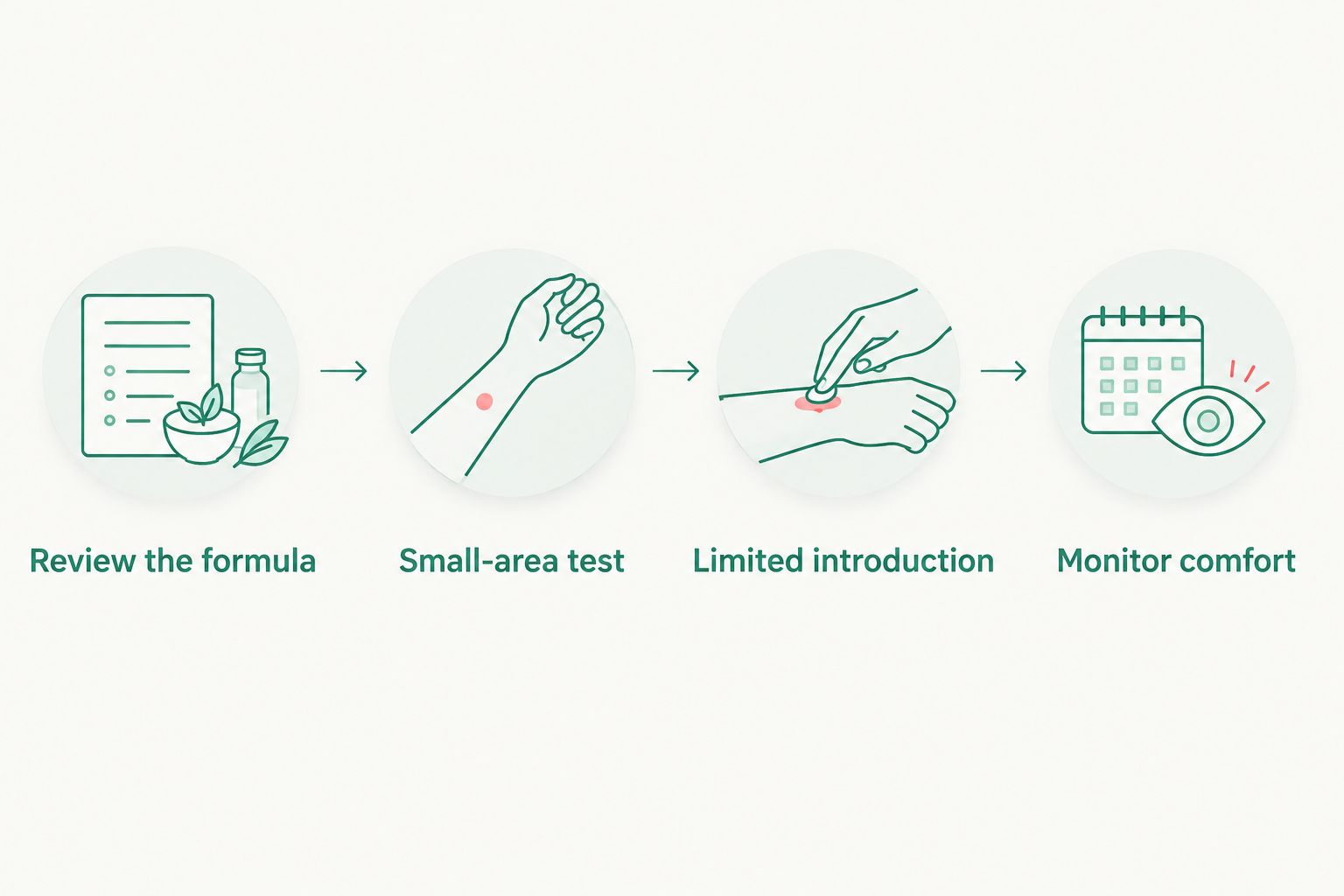
Review the formula
Read the full ingredient list before testing. If you cannot identify whether a formula contains something you already react to, ask the manufacturer or your dermatologist rather than guessing from the product name.
Keep a note of the product and its directions. That gives your clinician something more useful than a description such as “the new calming cream.”
Small-area test
Follow the American Academy of Dermatology’s general approach using a small area such as the inner arm or elbow bend. Do not start on broken, inflamed, or actively irritated skin.
Stop if the test area becomes red, itchy, or swollen. Do not repeat exposure to push through a reaction or attempt to build tolerance without medical advice.
Limited introduction
After a comfortable test, introduce the product cautiously while keeping other skincare unchanged. Follow its directions and your dermatologist’s advice rather than using extra product to seek faster results.
Avoid introducing another new active at the same time. A simple routine makes your response easier to interpret.
Monitor comfort
Notice burning, tightness, itching, swelling, and changes in redness—not just whether your skin looks glossy. Photographing a reaction under similar lighting can help you explain what happened to your clinician.
If symptoms develop, stop the new product and return to skincare you already tolerate. Contact your dermatologist if the reaction persists, is significant, or is difficult to distinguish from a rosacea flare.
Where does Velvente fit in a rosacea-conscious routine?
Velvente Korean skincare is best for consumers seeking a vegan routine, not a substitute for rosacea treatment. Its stated ingredient focus includes Rose PDRN, Jeju matcha, and white truffle. Those ingredients explain the routine’s positioning; they do not establish rosacea-specific safety.
The Anti-Aging Cream is described as a rich firming moisturizer. Its moisturizing role is relevant when you are evaluating routine basics, but an anti-aging description does not tell you whether the finished formula will suit reactive skin.
The practical advantage is a moisturizer format you can evaluate as a single routine step. The limitation is equally important: rich texture, plant-derived ingredients, and barrier-oriented claims are not guarantees of comfort or rosacea control.
For your 2026 routine, compare the full formula against your known triggers and test it before broader use. Do not replace a moisturizer you tolerate solely because another formula features a newer ingredient.
Can Rose PDRN be safer because it is vegan?
Vegan sourcing does not establish lower irritation or allergy risk. It answers a sourcing question, not whether a finished formula is suitable for your rosacea. Plant-derived ingredients can still cause reactions.
If vegan skincare matters to you, keep that preference as a separate selection criterion. Then assess fragrance, known allergens, application method, and your individual response just as carefully.
Can PDRN reduce rosacea redness?
Do not treat a cosmetic PDRN product as a proven rosacea-redness treatment. A general claim about soothing or improving skin appearance does not establish that a product treats persistent redness, flushing, or inflammatory lesions associated with rosacea.
Ask your dermatologist which treatments match your symptoms. Keep prescribed treatment in place unless the prescribing clinician changes it, even if a cosmetic initially feels comfortable.
Should you use PDRN during a rosacea flare?
Postpone a new, optional PDRN product during a flare. Familiar skincare and your clinician’s treatment plan are a clearer starting point than adding another variable while your skin is already uncomfortable.
If a product you previously tolerated starts stinging, stop and ask for advice. Prior tolerance does not mean you should ignore a new reaction.
Keep sun protection ahead of optional ingredients
For your 2026 daytime routine, the American Academy of Dermatology recommends a broad-spectrum, water-resistant sunscreen with SPF 30 or higher. Its rosacea guidance also emphasizes sun protection because sunlight is a common trigger.
Choose a sunscreen you tolerate and follow its application directions. A PDRN cream does not replace sunscreen unless that exact product is labeled and directed for sun protection.
You also do not need to add exfoliation, facial tools, or vigorous massage to make a PDRN product worthwhile. Avoid adding friction to a routine whose main goal is comfort. A simpler routine is easier to assess when your skin reacts.
FAQ
Is PDRN safe for rosacea prone skin if the label says sensitive skin?
A sensitive-skin label does not establish rosacea safety. Assess the complete formula, your known triggers, and your dermatologist’s advice before introducing the product.
How long should I test a new PDRN skincare product?
The American Academy of Dermatology’s general skincare-testing guidance recommends a small-area test twice daily for 7–10 days. Follow the product’s directions, stop for a reaction, and remember that an arm test does not guarantee facial tolerance.
Is vegan Rose PDRN automatically gentler than other PDRN?
Vegan Rose PDRN is not automatically gentler. Ingredient sourcing does not establish the irritation or allergy risk of the complete formula.
Can I use PDRN instead of my rosacea prescription?
Do not replace prescribed rosacea treatment with cosmetic PDRN skincare. Discuss any treatment change with the prescribing clinician.
Are toner pads a good choice when my rosacea is flaring?
A flare is not a good time to introduce new toner pads. Wiping adds friction, and the formula still needs its own tolerability assessment.
Does tingling mean a PDRN product is renewing my skin?
Tingling or burning does not prove that a PDRN product is renewing your skin. Stop a product that causes increasing discomfort rather than treating irritation as progress.
Is Velvente Korean skincare a rosacea treatment?
Velvente Korean skincare is positioned as a vegan skincare routine, not as a rosacea treatment. Evaluate each finished formula individually and keep medical treatment decisions with your dermatologist.
When should I get medical help for a skincare reaction?
Seek urgent care for breathing difficulty or significant facial swelling. Contact a clinician promptly for eye pain, light sensitivity, vision changes, or a severe or persistent skin reaction.
One last thing
A comfortable arm test cannot promise a comfortable face. Treat the first facial applications as a separate observation period, not permission to overhaul your routine. Keep a record of what you introduced and stop if your skin becomes uncomfortable.
Your best next move is not finding the strongest renewal claim. It is choosing a routine your skin tolerates, protecting it from the sun, and getting rosacea-specific treatment when symptoms need more than skincare.


