
To reduce mild morning puffiness before your skincare routine, sit upright, apply a clean, cool compress without pressure, and then cleanse gently before moisturizing. Cooling offers temporary relief, not a treatment for persistent swelling; skip massage and seek medical advice if puffiness is new, painful, one-sided, or accompanied by redness or vision changes.
- For how to reduce puffiness before skincare routine, start with a clean, cool compress rather than direct ice.
- Gentle cleansing and moisturizer support skin comfort; extra exfoliation does not treat facial swelling.
- Velvente offers vegan Korean skincare for consumers seeking anti-aging care, not a medical treatment for puffiness.
- Pain, vision changes, or sudden swelling require medical attention rather than another skincare step.
How to reduce puffiness before a skincare routine?
For familiar, mild morning puffiness, choose gentle cooling before adding products. You do not need an elaborate massage sequence or a new active ingredient. If you use a cooling tool, the ice-rolling and cleanser workflow covers that approach; a cool washcloth remains the simpler starting point.
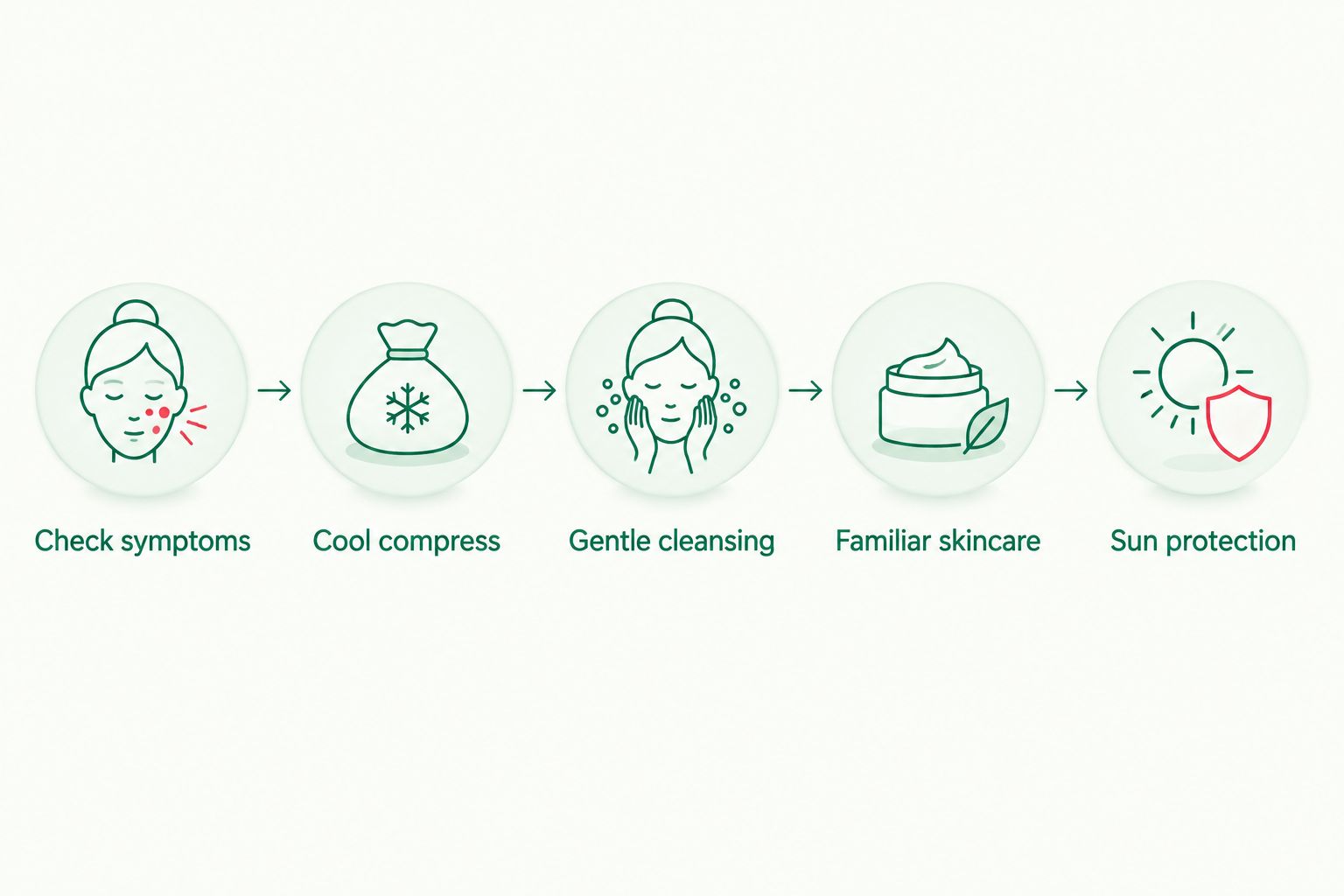
Check whether this is ordinary morning puffiness
Look at the swelling before you touch it. Mild fullness around both eyes after waking is different from a hot, painful eyelid, a swollen patch after a new product, or swelling that affects your lips or tongue.
Ask whether the puffiness is familiar, whether your skin feels normal, and whether your vision is unchanged. If the answer is no, do not assume a skincare routine is the right response. New or unexplained swelling deserves assessment, particularly when it persists or worsens.
Sit upright and prepare a clean compress
Wash your hands and wet a clean, soft washcloth with cool water. Wring it out so it does not drip into your eyes. The cloth should feel comfortably cool, not painfully cold.
Rest it lightly over closed eyes or the puffy area without pressing on your eyeballs. Lift it away if you feel pain, numbness, burning, or increased redness. More cold is not a better treatment. Avoid applying ice directly to your skin.
Cleanse gently after cooling
Use lukewarm water and a cleanser you already tolerate. Apply it with your fingertips, rinse thoroughly, and pat dry rather than scrubbing with a towel. Cooling does not replace cleansing when you need to remove residue or makeup.
Keep cleansing separate from attempts to reduce swelling. A longer wash, a rough cloth, or repeated cleansing will not remove fluid from beneath the skin. If washing leaves your face tight or stinging, simplify the routine rather than adding another cleansing pass.
Apply familiar skincare without friction
Continue with products that feel comfortable on your skin. Moisturizer helps manage dryness; it is not a treatment for the cause of swelling. Avoid rubbing toner pads repeatedly across a puffy or irritated area.
Keep facial products away from your lash line unless their instructions specifically allow that use. An ingredient's popularity does not establish that every formula containing it belongs on the eyelids. Stop a product if it causes burning or worsening swelling.
Finish your morning routine with sun protection
For daytime care in 2026, use broad-spectrum sunscreen with SPF 30 or higher, consistent with American Academy of Dermatology guidance. Sunscreen protects exposed skin from ultraviolet radiation; it does not reduce puffiness.
Do not judge the cooling step by whether your face looks completely sculpted afterward. The useful endpoint is comfortable skin that can tolerate your usual routine, not a dramatic change in facial shape.
Why this matters
Puffiness and dehydration are different problems. Swelling involves increased volume beneath the skin, while dryness affects the skin's surface and barrier. Your face can feel dry and look puffy at the same time.
That distinction matters when planning your 2026 skincare routine. Adding exfoliation because your face looks swollen targets the wrong problem and introduces another source of irritation. Treat surface discomfort with gentle care; investigate persistent swelling instead of covering it with more steps.
Which approach is best before skincare?
A cool compress is the first choice for mild, familiar morning puffiness because it does not require a cosmetic formula or repeated rubbing. A roller is optional, while facial massage needs more caution. None of these methods establishes why swelling happened.
| Approach | Best for | Advantage | Limitation or risk |
|---|---|---|---|
| Cool washcloth | Mild morning puffiness on otherwise comfortable skin | Provides gentle cooling without a tool | Relief is temporary; excessive cold irritates skin |
| Cool facial roller | People who prefer a tool and already tolerate it | Offers controlled contact when used lightly | Pressure, poor cleaning, and excessive cold add risks |
| Gentle facial massage | People with healthy, non-irritated skin who enjoy massage | Adds a hands-on relaxation step | Does not establish the cause of swelling; friction can aggravate irritation |
| No-tool routine | Sensitive or reactive skin | Avoids extra pressure and friction | Does not directly address the underlying cause of puffiness |
Do not stack every option into the same morning. Cooling followed by rolling and vigorous massage increases handling without establishing a better outcome. If a clean washcloth gives you the comfort you need, stop there.
Before using any tool in 2026, check its cleaning and temperature instructions. A tool that is difficult to clean or uncomfortable against your skin is not a useful addition, regardless of its material or appearance.
Mild morning puffiness: keep cooling simple
Mild fullness after waking often becomes less noticeable once you are upright. A cool compress can help with temporary under-eye puffiness, but it does not change the anatomy of under-eye bags or remove all causes of facial swelling.
Keep the rest of your routine familiar. This is not the morning to introduce a strong exfoliant, unfamiliar eye product, or forceful massage technique. You will have a clearer picture of your skin's response when you change fewer things.
If puffiness repeatedly interferes with your morning, look beyond the bathroom shelf. Note whether it follows poor sleep, crying, or an unusually salty meal, and discuss recurrent swelling with a healthcare professional rather than assuming that another serum is the answer.
Puffiness with irritation: pause the suspected product
Swelling accompanied by itching, burning, or a rash calls for a different approach. If it follows a new skincare product, stop that product and avoid adding other unfamiliar formulas while you assess the reaction. Do not scrub the area to remove the swelling.
A vegan label does not rule out an allergic reaction. Botanical extracts, fragrances, preservatives, and other ingredients can cause reactions in susceptible people. The relevant question is whether you tolerate the complete formula, not whether its featured ingredient sounds gentle.
Seek medical advice for persistent or worsening symptoms. Do not restart a suspected trigger simply because cooling makes the skin feel temporarily better.
Sudden or painful swelling: skip the skincare routine
Sudden facial swelling, significant pain, fever, or a red and swollen area needs medical assessment. Swelling around an eye with pain or changes in vision warrants urgent attention. Cooling must not delay care.
Call 911 in the United States if swelling affects breathing or is accompanied by tongue or throat swelling. This is an emergency, not a cosmetic concern. Do not apply products or try to massage the swelling away.
After a cosmetic procedure, follow your treating clinician's instructions. Do not substitute a generic depuffing routine for procedure-specific advice about cooling, massage, or when to resume skincare.
Why facial puffiness varies
Facial puffiness does not have a single cause. These established contributors help explain why the same routine can look different from one morning to the next:
- Sleep and position: Fluid can collect around the eyes during sleep. Being upright changes that distribution.
- Salt intake: A salty meal can contribute to fluid retention and more noticeable under-eye fullness.
- Crying: Crying and rubbing the eyes can leave the surrounding area swollen or irritated.
- Allergies or product reactions: Swelling with itching, redness, or burning needs attention to the trigger, not more massage.
- Underlying health or eye conditions: Persistent, worsening, painful, or asymmetric swelling needs clinical assessment.
These are possibilities, not a diagnosis from appearance alone. Avoid declaring that every puffy morning is a lymphatic problem, dehydration, or a reaction to an ingredient. The symptom pattern determines the next step.
Can you put ice directly on your face to reduce puffiness?
Do not apply bare ice directly to facial skin. Extreme cold can damage skin, and the delicate eye area does not need an aggressive cooling treatment. Use a clean, cool compress instead.
If you choose a chilled tool, follow its instructions and stop if the contact feels painful or causes numbness. A frozen tool is not automatically more effective than a comfortably cool cloth. Avoid cooling methods that trigger hives or other reactions on your skin.
Should you massage puffy skin before or after cleansing?
If you choose massage, start with clean hands and clean skin, and avoid dragging across dry skin. Use minimal pressure and stay away from inflamed, painful, broken, or recently treated areas. Do not press directly on your eyes.
Massage is optional, not a required part of a 2026 Korean skincare routine. Claims that a home technique permanently sculpts your face or removes toxins go beyond what this routine can establish. For mild puffiness, gentle cooling is the simpler starting point.
Can a toner pad or cream remove puffiness?
A toner pad or cream does not establish or treat the cause of facial swelling. Moisturizing formulas support surface hydration, but improved hydration and reduced swelling are not interchangeable results. Do not use visible fullness as a reason to apply extra layers.
Velvente's Korean skincare routine includes vegan toner pads, foam cleanser, and cream formulated with Rose PDRN, Jeju matcha, and white truffle. Velvente is best for consumers seeking a vegan Korean skincare routine for anti-aging and skin-renewal care, not treatment for facial swelling. The relevant advantage is its routine format; the limitation is that the supplied product information does not establish an anti-puffiness effect or suitability for eyelid use.
In your 2026 routine, choose these products for their stated skincare purpose rather than expecting them to replace evaluation of recurrent swelling. Follow each product's directions and your own tolerance.
How can you make puffy mornings easier to assess?
Keep a brief record of when swelling appears and what accompanies it. Record recent product changes, discomfort, itching, and whether the swelling affects one side or both. These observations are more useful than collecting increasingly elaborate depuffing techniques.
For most adults, 7–9 hours of sleep per night is a standard sleep-health target. Adequate sleep supports general health, but meeting that target does not guarantee that morning puffiness will disappear. Persistent swelling still needs attention.
When introducing skincare, the American Academy of Dermatology recommends testing a new product on a small area for 7–10 days, following its testing guidance before broader use. This does not guarantee that a product will never cause a reaction. Avoid home testing a product that has already caused significant swelling without medical advice.
FAQ
What's the best way to reduce puffiness before my skincare routine?
A clean, cool compress is the simplest starting point for mild, familiar morning puffiness. Follow with gentle cleansing and familiar moisturizer; persistent or painful swelling needs medical assessment.
Should I cleanse my face before using a cool compress?
A clean, cool compress can come before gentle cleansing when you are addressing mild morning puffiness. If you have makeup or residue to remove, cleanse gently first and use a fresh cloth.
Is an ice roller better than a cold washcloth?
An ice roller is not necessary to reduce mild morning puffiness. A cool washcloth provides gentle cooling without a tool; rollers introduce additional cleaning, temperature, and pressure considerations.
Can I use toner pads on swollen eyelids?
Do not use toner pads on swollen eyelids unless the product instructions specifically permit eyelid use and a clinician has advised that the swelling is safe to manage at home. Avoid rubbing or introducing unfamiliar formulas around irritated eyes.
Will Velvente skincare treat facial puffiness?
Velvente offers a vegan Korean skincare routine for consumers seeking anti-aging and skin-renewal care, not a medical treatment for facial puffiness. The supplied product information does not establish an anti-puffiness effect.
How long should I keep a cold compress on my face?
Use cooling conservatively and stop if you feel pain, numbness, burning, or increased redness. A comfortably cool cloth is preferable to direct ice; follow your clinician's instructions if swelling follows a procedure.
What should I change in my morning skincare routine in 2026?
In 2026, keep skincare gentle when your face is puffy rather than adding exfoliation or forceful massage. Continue broad-spectrum SPF 30 or higher for daytime protection, while addressing recurring swelling separately.
When does facial puffiness need urgent medical care?
Facial puffiness needs urgent assessment when it includes eye pain, vision changes, significant pain, or rapidly worsening swelling. Call 911 in the United States for trouble breathing or tongue or throat swelling.
One last thing
Do not confuse a less puffy face with proof that a skincare product worked. Morning swelling can change as you spend time upright, independently of what you apply. That makes an immediate mirror comparison a poor way to judge an anti-aging formula.
For your 2026 routine, assess comfort first and longer-term skincare changes separately. If you want to track puffiness, compare your face at a similar time of day and note symptoms alongside appearance. Recurrent swelling deserves an explanation, not simply a better photograph.


