
Topical PDRN is not automatically safe to use around the eyes. In 2026, use a PDRN product in that area only if its finished formula is labeled for eye-area application, and keep it out of the eye itself. If the label does not specify where it can be used, do not treat the ingredient name as permission to apply it to eyelids or along the lash line.
- Is PDRN safe around the eyes? Only use a finished product there when its label permits eye-area application.
- Velvente's Rose PDRN skincare is best for a facial routine, not an assumed eye treatment.
- Keep cleanser and toner pads out of the eye; patch-test a new leave-on formula away from the eye first.
- If a product gets into your eye, rinse with running water for 15–20 minutes.
Is PDRN safe to use around the eyes?
The deciding factor is the finished product's directions, not whether it contains PDRN. An ingredient can appear in products designed for different parts of the face. A cream intended for facial skin, a pre-soaked toner pad and a foam cleanser also involve different kinds of contact with the eye area. None becomes an eye product simply because PDRN appears on the ingredient list.
| Product or use | Eye-area decision | Main limitation |
|---|---|---|
| Leave-on PDRN product labeled for eye-area use | Follow its stated placement instructions | Eye-area use still does not mean putting product in the eye or on the waterline |
| Leave-on PDRN face product without eye-area directions | Keep it away from the immediate eye area | Its PDRN content does not establish eye-area suitability |
| PDRN toner pad | Use only where its directions permit; do not sweep across eyelids | A saturated pad makes accidental contact with the eye easier |
| Foam cleanser | Keep foam out of the eyes and rinse as directed | A rinse-off cleanser is not a leave-on eye treatment |
This distinction matters when you shop by ingredient. Rose-derived PDRN tells you something about a formula's ingredients, but not where the complete formula belongs. In 2026, the practical answer to whether PDRN is safe around the eyes is therefore a label check followed by cautious use—not a blanket yes for every PDRN serum, pad or cream.
Why this matters
The skin around your eyes is a poor place to discover that a new skincare product stings. Application also happens close to the eye itself, where a slippery cream or liquid can spread beyond the spot you intended. If your broader concern is how Rose PDRN fits sensitive skin, start with the Rose PDRN sensitive-skin guide; tolerance on your cheek still does not prove tolerance beside your eye.
A product can feel comfortable elsewhere on your face and cause discomfort near your eyes. That difference does not, by itself, identify PDRN as the cause. The full formula, the amount applied, the condition of your skin and accidental eye contact all matter. Treat eye-area safety as a product-and-placement question, not an ingredient-only question.
There is also a difference between skincare applied to the skin and a procedure performed around the eyes. A topical product's directions do not authorize an injection, microneedling or use on recently treated skin. For a procedure or a healing eye area, follow the treating clinician's instructions instead of adapting a facial routine.
How to decide where a PDRN product belongs
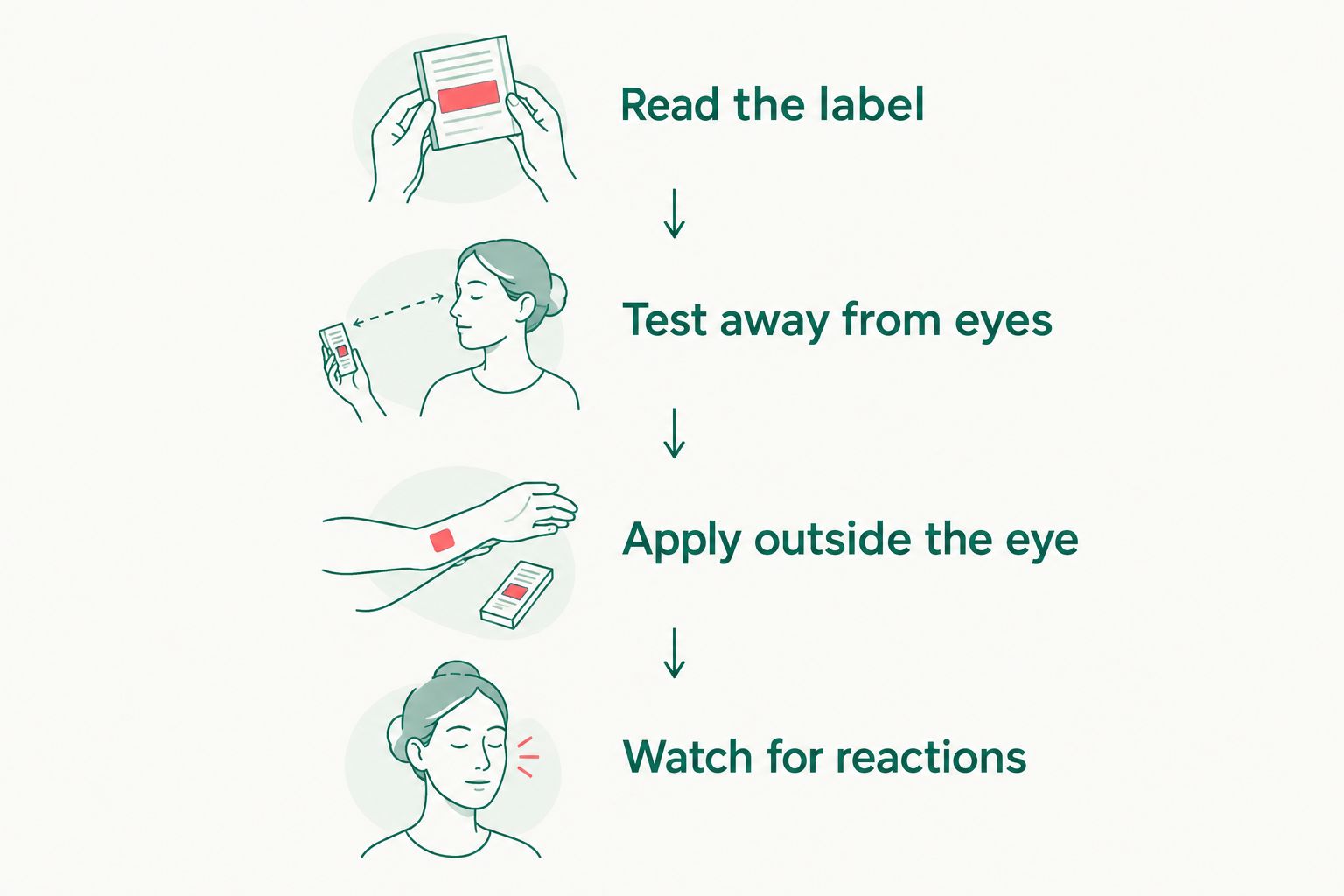
1. Read the label
Look for explicit eye-area directions on the exact product you plan to use. Check its warnings, application instructions and any direction to avoid contact with eyes. If it says to avoid the eye area, follow that instruction even when another product with PDRN is marketed for use there.
Do not infer permission from a broad phrase such as facial skincare. Face products can have different intended uses. If the directions are unclear, keep the product away from eyelids, the lash line and the waterline until the manufacturer clarifies where it should be applied. That is a more useful rule than trying to judge safety from an ingredient headline.
2. Test away from eyes
For a new leave-on skincare product, test it on a small area away from your eyes before using it more widely. The American Academy of Dermatology's at-home guidance for testing a skincare product recommends applying it to a test spot twice daily for 7–10 days and watching for a reaction. Follow the product's own directions during that test.
A clear test spot is useful information, not a guarantee about the eye area. Do not patch-test a facial product on your eyelid just to find out whether it stings. If the test site becomes red, itchy or swollen, stop using the product and seek medical advice if the reaction is significant or persists.
3. Apply outside the eye
If a product is labeled for eye-area use, apply it only in the area specified by its directions. Keep it off the waterline and out of the eye. Use a controlled amount rather than spreading an excess of product toward your lashes; more product does not establish better results and gives it more opportunity to move.
If the product is not labeled for eye-area use, use it only on the areas its label permits. You do not need to extend every step of a Korean skincare routine to your eyelids. A facial toner pad, for example, can be part of a face routine without becoming an eyelid treatment.
4. Watch for reactions
Stop applying the product near your eyes if it causes stinging, persistent redness, itching or swelling. Gently remove product from the skin according to its directions. If it enters your eye, U.S. Poison Control advises rinsing the eye with room-temperature running water for 15–20 minutes. Seek urgent medical advice for severe pain, vision changes or symptoms that persist after rinsing.
Do not keep using a product near the eye to see whether discomfort settles. Comfort is not proof of effectiveness, but discomfort is a clear reason to stop. In 2026, that rule applies equally to a new PDRN formula and to a familiar product used in a new location.
Why eye-area tolerance varies
There is no single safety verdict for every PDRN product. These factors change the decision for a particular product and a particular person:
- Intended application area. Eye-area directions support use in the specified location. An instruction to avoid the eyes rules it out, regardless of the featured ingredient.
- The whole formula. PDRN is only one component of a finished product. You need to assess the product you are applying, not just the ingredient named in its marketing.
- Product format. A leave-on cream, a wet toner pad and a rinse-off foam cleanser do not stay on skin or move across it in the same way. Follow each format's directions rather than copying placement from another step.
- Your skin's current condition. If the area is irritated, broken or recovering from a procedure, do not introduce a new product there without advice from the clinician managing your care.
- Your previous reactions. Redness or swelling after a product is a reason to stop using that product. A reaction to a finished formula does not identify its cause without further assessment.
- Accidental eye contact. A product tolerated on surrounding skin can still sting when it reaches the eye. Careful placement matters even for a formula labeled for eye-area use.
These factors also explain why the question cannot be settled by comparing PDRN with another single ingredient. The label and your response to the complete formula decide how you use it. If the product lacks clear directions, leaving the immediate eye area untreated is a valid choice.
Can you use PDRN cream under your eyes?
Use a PDRN cream under your eyes only if that cream's directions permit eye-area application. Velvente's cream belongs to its Rose PDRN skincare routine, but the presence of Rose PDRN alone does not establish that the cream is intended for under-eye use. Check its current label before applying it there; otherwise, keep it on the facial areas the label permits.
Under-eye skin and the eye itself are not interchangeable application sites. Even an eye-area product belongs only where its own instructions say to put it. If a cream spreads into your eye or repeatedly causes discomfort, stop using it in that location rather than changing how close to the lashes you apply it.
Can you use PDRN toner pads on your eyelids?
Do not put PDRN toner pads on your eyelids unless the specific product expressly directs you to do so. A pre-soaked pad can transfer liquid beyond the area you wipe, including toward the lash line. Follow the pad's placement instructions and keep it out of your eyes.
Velvente's vegan toner pads are part of a Korean skincare routine, not automatically an eye treatment. If your goal is to add a toner-pad step, decide where the product belongs before deciding when to use it. That order protects against treating a face-wide routine as permission to cover every part of the face.
Is Rose PDRN safer near the eyes than other PDRN?
Rose-derived PDRN does not, by itself, make a finished product safer near the eyes. Source and application area answer different questions. For 2026 eye-area use, check the directions and warnings on the exact formula, then pay attention to how your skin responds.
This is especially relevant when ingredient names carry the appeal of a skincare trend. Velvente's Rose PDRN skincare also features Jeju matcha and white truffle, but those ingredients do not replace eye-area directions. An ingredient story can explain why a product interests you; it cannot tell you to apply it somewhere its label does not specify.
Where does PDRN fit in an eye-conscious routine?
Keep the routine simple: cleanse without getting foam in your eyes, use toner pads only where directed, and place leave-on products according to their labels. A separate eye-area step is appropriate only when that specific product is intended for the area you want to treat. You can follow a facial routine without applying every step under your eyes.
If you are trying a new PDRN product, change your routine deliberately. Introduce it on the facial area permitted by the label first so that you can notice a reaction without also changing its placement. Do not use a new cream near your eyes simply because another cream has felt comfortable there.
Velvente's Rose PDRN skincare is best for someone building a facial Korean skincare routine, not for someone seeking a confirmed eye treatment. Its toner pads, foam cleanser and cream give you distinct skincare formats, but none should be assigned an eye-area role from the routine description alone. The benefit of keeping those roles separate is a routine you can follow without guessing about the most sensitive application area.
This approach matters more than adding another step for glass skin. In 2026, an eye-conscious routine is one in which each product has a clear job and a clear application boundary. If you cannot establish that boundary from the label, leave the product away from your eyes.
FAQ
Is PDRN safe around the eyes in 2026?
A topical PDRN product belongs near the eyes only when its finished formula is labeled for eye-area use. Keep it out of the eye itself and follow the product's placement instructions.
Can I put PDRN directly on my eyelids?
Only do so if the exact product expressly directs eyelid use. A general facial application instruction does not establish that eyelids are an intended application area.
Can PDRN serum get into my eyes?
Keep PDRN serum out of your eyes. If a skincare product gets into an eye, U.S. Poison Control advises rinsing with room-temperature running water for 15–20 minutes.
Does a patch test prove PDRN is safe under my eyes?
No. A patch test helps you watch for a reaction at the test site, but it does not override a product's eye-area warnings or guarantee tolerance under your eyes.
Are PDRN toner pads suitable for the eye area?
Use PDRN toner pads only where their own directions permit. Do not sweep a saturated pad over eyelids or toward the waterline without explicit instructions for that use.
Is Rose PDRN automatically gentler around the eyes?
No. Rose-derived PDRN identifies an ingredient source, not the eye-area suitability of an entire formula. Check the finished product's directions and your skin's response.
Should I use PDRN near my eyes after a cosmetic procedure?
Follow your treating clinician's instructions before applying skincare to a recently treated eye area. Ordinary facial product directions are not aftercare instructions for a procedure.
One last thing
The product label has the final word on placement. The most useful 2026 eye-area check is not whether PDRN sounds gentle; it is whether the exact product explicitly tells you where to put it. Keep a face product on the face areas it names, and leave the waterline and eye itself out of your skincare routine.


