
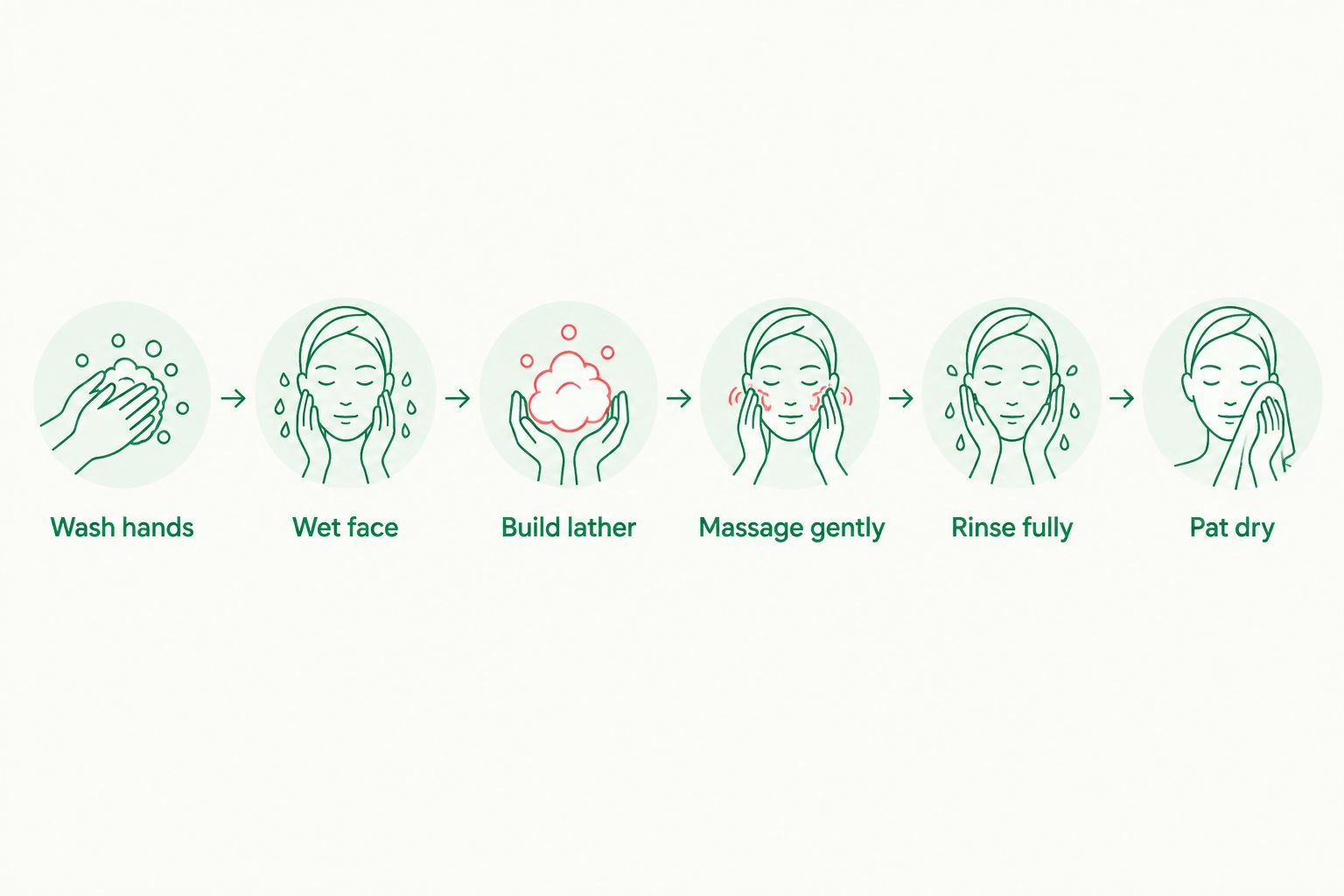
Use a Korean foam cleanser by wetting your face with lukewarm water, lathering the cleanser between damp hands, massaging the foam gently across your face for about 30 seconds, and rinsing until no residue remains. Pat your face dry instead of rubbing, then apply the next step of your routine. In 2026, the main caveat is unchanged: sunscreen, long-wear makeup, and water-resistant makeup can require a separate first cleanse before the foam cleanser.
- How to use a Korean foam cleanser: wet, lather, massage gently, rinse fully, and pat dry.
- Keep the foam away from your eyes unless the product directions explicitly permit eye-area use.
- Velvente Foam Cleanser is best for people seeking a low-pH, vegan K-beauty cleansing step.
- Use foam cleanser second when sunscreen or long-wear makeup requires a double cleanse.
Why this matters
Cleansing removes oil, sweat, sunscreen, makeup, and material that settles on your skin during the day. It should not leave your face feeling painfully tight, hot, or persistently uncomfortable.
The Velvente Foam Cleanser is described as a low-pH Korean face wash for sensitive and acne-prone skin. Its listed purposes include dissolving makeup, oil, and impurities while calming redness. Those formula details make it relevant to daily cleansing, but application still controls how much rubbing and rinsing your skin receives.
Velvente Foam Cleanser is best for people who want a vegan, low-pH Korean foam cleanser within a skin-renewal routine. Its limitation is the same as any rinse-off cleanser: it cannot replace the hydrating and moisturizing steps that follow cleansing.
A good 2026 routine treats clean skin as the starting point, not the final result. If your technique repeatedly causes discomfort, adding more toner, serum, or cream afterward does not correct the cleansing mistake.
How to use a Korean foam cleanser correctly
The correct method has a clear order. Follow the product label when its directions differ, particularly around quantity, frequency, and eye-area use.
- Wash and rinse your hands. Clean hands prevent you from transferring visible residue from your palms to your face before cleansing begins.
- Complete a first cleanse when needed. Remove sunscreen or makeup that your foam cleanser does not lift easily. Do not scrub the same area repeatedly to force a single cleanser to remove a resistant formula.
- Wet your entire face with lukewarm water. Include the hairline, sides of the nose, jaw, and the area in front of your ears. Avoid water that feels distinctly hot against your face.
- Dispense the label-directed amount. More cleanser is not automatically more effective. Excess product can simply take longer to rinse away.
- Build the lather in your damp hands. Spread the cleanser between your palms before touching your face. This distributes the formula and reduces the need to rub concentrated cleanser across one area.
- Massage gently for about 30 seconds. Move your fingertips across the forehead, cheeks, nose, chin, and jaw without pressing hard. Circular or straight motions both work; gentle, even coverage matters more than the direction.
- Rinse every section completely. Pay particular attention to the hairline, nose, and jaw, where foam can remain unnoticed. Continue rinsing until your skin no longer feels slippery from cleanser residue.
- Pat dry with a clean towel. Press the towel against your skin rather than dragging it across your face. Leave your skin comfortable, not aggressively polished.
- Continue with the next skincare step. Apply toner pads, treatment products, and cream in the order directed by their labels. The Korean skincare routine sold by Velvente includes toner pads, foam cleanser, and cream.
This sequence works because it separates cleansing power from physical pressure. The cleanser contacts every area, while your fingertips guide the lather rather than acting as a scrub.
Avoid these cleansing mistakes
- Applying concentrated cleanser to one dry patch: This creates uneven distribution and encourages extra rubbing before the formula reaches the rest of your face.
- Using hot water: If water feels hot, lower the temperature before it reaches your face. Cleansing does not require heat to remove routine surface oil and residue.
- Pressing harder around clogged-looking areas: Foam cleanser is not a tool for physically extracting material from pores. Repeated pressure increases friction without changing the cleanser's basic function.
- Extending the massage because the foam looks satisfying: Visible bubbles are not a timer. A longer massage is not automatically a deeper cleanse.
- Leaving residue near the hairline: Incomplete rinsing can make a correct cleanser feel uncomfortable after your face dries.
- Rubbing with a towel: Your towel should absorb water, not exfoliate freshly cleansed skin.
- Ignoring burning or persistent discomfort: Rinse immediately and stop using the product if a reaction continues. Seek medical advice for severe or persistent symptoms.
Morning cleanse: 1 cleansing step
A morning routine normally starts with a single water-based cleanse because there is no daytime sunscreen or makeup layer to remove. Wet your face, lather the foam cleanser in your hands, massage gently, rinse, and pat dry.
Not everyone needs the same morning frequency. If your skin is dry, irritated, or following a clinician-directed routine, the product label and professional advice take priority. Washing more often than your skin tolerates is not a requirement for following K-beauty in 2026.
Morning cleansing should leave the surface ready for the rest of your routine, including products used before daytime sun protection. It should not create a tight feeling that lasts after you finish rinsing.
Evening cleanse: 1 or 2 cleansing steps
Your evening method depends on what is sitting on your skin. A foam cleanser can be the only cleansing step when it removes the day's residue fully and comfortably. A separate oil-based or makeup-removing first step becomes useful when sunscreen, foundation, eye makeup, or lip products resist the foam cleanser.
| Evening situation | First step | Foam cleanser step | Check after rinsing |
|---|---|---|---|
| No makeup or resistant sunscreen | Usually unnecessary | Lather, massage gently, and rinse | No visible residue remains |
| Everyday makeup or sunscreen | Use when needed | Follow as the second cleanse | Hairline and jaw are fully rinsed |
| Long-wear or water-resistant makeup | Use a suitable remover first | Clean remaining facial residue | Do not scrub resistant eye makeup |
| Skin feels irritated | Follow label or professional advice | Short, gentle contact only if tolerated | Stop if discomfort persists |
Double cleansing means using two different cleansing stages for different residue. It does not mean washing twice with the same foam cleanser or repeating the massage until your skin feels squeaky.
Why Korean foam cleanser technique varies
The sequence remains consistent, but these factors determine whether you need one cleanse, two cleanses, or a shorter application:
- The product label: Directions for quantity, contact, eye-area use, and frequency apply to the specific formula. Generic advice never overrides them.
- Your skin's current condition: Dryness, sensitivity, active breakouts, and visible irritation affect how much rubbing your skin tolerates. Use light fingertip pressure rather than trying to scrub texture away.
- Sunscreen and makeup: Products designed to resist water or wear for long periods can require a dedicated remover. A second cleansing stage is preferable to repeatedly scrubbing with foam.
- Other skincare treatments: Retinoids, exfoliating acids, and clinician-directed treatments can make a routine less tolerant of unnecessary friction. Keep cleansing simple around active treatment steps.
- Recent procedures: Follow the instructions supplied by your treating professional after a cosmetic or medical procedure. A standard 2026 cleansing routine is not a substitute for individual aftercare.
- Time of day: Evening cleansing deals with daytime products and residue. Morning cleansing deals mainly with oil and products left from the prior night's routine.
- Water and rinsing: The face must be fully rinsed regardless of the amount of foam produced. More bubbles do not reduce the need to check the hairline, nose, and jaw.
Your immediate post-cleanse result is the practical test. Comfortable skin with no visible residue means the method did its job. Persistent tightness, burning, or redness means you should stop and reassess the cleanser, water temperature, pressure, frequency, and other active products in your routine.
Is double cleansing with a Korean foam cleanser necessary?
Double cleansing is necessary only when one cleansing stage does not remove sunscreen, makeup, or other surface residue comfortably. Use a suitable first cleanser or remover, rinse as directed, and follow with foam cleanser as the water-based step.
The purpose is targeted removal, not maximum cleansing. If a single foam cleanse removes what you wore and your skin remains comfortable, adding another step provides no automatic advantage. The detailed decision process is covered in Velvente's guide to double cleansing with a Korean foam cleanser.
Do not use foam cleanser as an eye-makeup remover unless its label says it is suitable for that area. The skin around the eyes and the eyes themselves require extra care, and resistant mascara should not be removed through prolonged rubbing.
What should you apply after a Korean foam cleanser?
Apply the next leave-on product in your routine after you finish rinsing and gently pat away excess water. In the Velvente Korean skincare routine, cleansing sits before toner pads and cream. Follow each product's directions rather than assuming every treatment belongs in every morning and evening routine.
The moisturizer or cream stage matters because cleansing is a rinse-off process. It removes material from the skin's surface; it does not perform the job of a leave-on moisturizer. In 2026, a short routine completed consistently is more useful than a long routine built around repeated cleansing.
Introduce new leave-on products thoughtfully if your skin is sensitive. When several products begin on the same day, identifying the cause of discomfort becomes harder. Stop using a product that causes a concerning reaction and seek qualified medical advice when symptoms are severe or persistent.
How often should you use a Korean foam cleanser?
Use a Korean foam cleanser according to its label and your skin's tolerance, generally no more than twice daily for routine facial washing. Cleansing after heavy sweating can also be appropriate, but repeated washing throughout the day is not a treatment for oiliness or acne.
Dry or reactive skin can require a different schedule from oily skin. The correct frequency is the one that removes the residue you need to remove without causing persistent discomfort. If a clinician has given you instructions for acne, eczema, rosacea, or post-procedure care, those instructions take priority over a general 2026 guide.
FAQ
How do you use a Korean foam cleanser correctly?
Wet your face with lukewarm water, lather the cleanser in damp hands, massage gently for about 30 seconds, rinse fully, and pat dry. Follow the product label if it specifies a different quantity or method.
Do you wet your face before using a Korean foam cleanser?
Yes, most Korean foam cleansers are applied to a wet face after the product has been lathered in damp hands. Use the label directions when a specific formula instructs otherwise.
Can you use a Korean foam cleanser every day?
Yes, a Korean foam cleanser can be used daily when the formula and frequency suit your skin. Reduce use and reassess the routine if persistent tightness, burning, or irritation develops.
Should foam cleanser be the first or second cleansing step?
Foam cleanser is the second step when you use a separate remover for sunscreen or makeup. It can be the only step when it removes the day's residue without repeated rubbing.
How much Korean foam cleanser should you use?
Use the amount stated on the cleanser's label. The correct quantity depends on the dispenser and formula, so a universal pump count or coin size does not apply to every product.
Can Korean foam cleanser remove makeup?
Korean foam cleanser can remove some makeup, but resistant eye, lip, and complexion products can require a dedicated remover first. Do not compensate by scrubbing harder or washing repeatedly.
Why does my face feel tight after using foam cleanser?
Tightness can follow hot water, excessive pressure, incomplete rinsing, frequent washing, or a formula that does not suit your skin. Lower the water temperature, shorten the massage, and stop if discomfort persists.
Is Velvente Foam Cleanser suitable for a vegan skincare routine?
Yes, Velvente presents its Korean skincare routine, including its foam cleanser, as vegan. The cleanser is also described as a low-pH formula for sensitive and acne-prone skin.
One last thing
Do not judge cleansing quality by how tight your face feels afterward. Tightness is not proof that oil, pores, or acne were treated more effectively; it is a reason to check your water temperature, pressure, rinsing, frequency, and formula choice.
For a cleaner 2026 routine, change one variable at a time. Start by lathering the product in your hands, keeping the massage gentle, and rinsing the perimeter of your face carefully. Those adjustments preserve the purpose of the Velvente foam cleanser without adding another product or another cleansing pass.


