
Your skincare routine is too much if it repeatedly leaves your skin burning, itching, tight, flaky, or more irritated than before you started. The warning is your skin’s response—not the number of bottles—and persistent symptoms call for stopping irritating extras, simplifying your routine, and getting medical advice when needed.
- How to know if your skincare routine is too much: watch for persistent burning, tightness, itching, and peeling.
- Skin barrier discomfort matters more than the number of Korean skincare steps.
- Keep tolerated cleansing, moisturizer, and sunscreen; pause optional products that irritate your skin.
- Velvente offers a coordinated Korean skincare routine; ingredient names alone do not establish personal tolerance.
Why this matters
A routine should support comfortable skin, not make ordinary washing or moisturizing painful. Repeated irritation is not proof that an anti-aging treatment is working. Adding another exfoliant or treatment to fix the discomfort can make the problem harder to identify.
For your 2026 routine check, compare how your skin feels before cleansing, after cleansing, and after applying leave-on products. Timing helps you spot patterns without assuming that every new blemish comes from the same cause. If discomfort has become your baseline, start with this guide to repairing a damaged skin barrier with Korean skincare.
How to know if your skincare routine is too much?
Look for a repeatable change in comfort, texture, or tolerance after using your products. Skin that starts stinging with a previously comfortable moisturizer deserves attention; skin that simply has several products on the shelf does not automatically need a reset.
Use this comparison to separate irritation warnings from application problems. These signs guide your next move, but they do not diagnose eczema, contact dermatitis, acne, or another skin condition.
| What you notice | What it tells you | Best for your next move | Limitation |
|---|---|---|---|
| Burning, itching, or persistent redness | A product or application is irritating your skin | Pausing suspected nonessential products | Symptoms alone cannot identify the ingredient responsible |
| Tightness and flaking after washing | Your cleansing approach needs reassessment | Gentler washing and tolerated moisturizer | Dryness also has causes unrelated to skincare |
| Products rolling into small flakes | Your layers are pilling | Reviewing amounts and layering | Pilling does not prove skin damage |
| New bumps after a routine change | The change needs investigation | Tracking timing and affected areas | Not every breakout is purging or product-related |
| Comfortable skin without new symptoms | Product count alone is not a warning | Keeping a stable routine | Comfort does not establish every product’s effectiveness |
Burning is a reason to reassess, not a result to chase. Stop applying a product that causes a significant reaction rather than repeatedly testing your skin’s tolerance. For severe swelling, blistering, widespread rash, or worsening pain, seek medical care.
Check your skin at these points
- Before cleansing: Notice whether your skin already feels sore, itchy, or unusually dry. That establishes whether discomfort begins before the next application.
- After cleansing: Check for tightness, stinging, and a persistent uncomfortable feeling. Do not judge cleanliness by how squeaky your face feels.
- After leave-on products: Record which application immediately precedes discomfort. Include toner pads, treatments, moisturizer, and sunscreen.
- Between routines: Look for ongoing flaking, itching, or sensitivity. A reaction that persists beyond application deserves more attention than product texture alone.
Keep the observations simple. You need a useful pattern, not a diagnosis based on a photograph or an ingredient trend.
Irritation: stop treating discomfort as progress
A brief sensation and an ongoing reaction are not the same, but neither proves that a product is effective. Persistent burning, tenderness, scaling, or redness means the routine needs reassessment. On darker skin tones, inflammation can also appear as changes in color rather than obvious bright redness.
Best for irritated skin: reduce exposure to suspected irritants instead of adding another treatment. Pause optional exfoliation and newly introduced nonprescription actives. If a prescribed treatment is involved, contact the prescribing clinician about irritation and application adjustments.
The benefit of simplifying is easier troubleshooting. The limitation is that simplifying alone does not identify an allergy or treat an underlying condition. Symptoms that persist or worsen need professional evaluation, even when every product is described as gentle.
Pilling: fix application before blaming your skin barrier
Pilling happens when products roll into little flakes on the surface. It can reflect application amount, rubbing, or how formulas interact. Unlike actual peeling skin, pilling is often visible as material moving or collecting when you touch the applied layers.
Best for pilling: use products according to their directions and remove unnecessary layers. Apply without aggressive rubbing, and check whether the problem changes when you leave out an optional step. Do not scrub the flakes away with an exfoliant.
The advantage of this approach is that it addresses application without treating healthy skin as damaged. Its limitation is that pilling and irritation can occur together. If the flakes come with soreness, itching, or persistent redness, assess the symptoms separately.
Sunscreen needs particular care. Do not deliberately underapply sunscreen to make a crowded routine sit better; simplify the products underneath it instead.
Breakouts: do not label every reaction as purging
New bumps after a routine change are a reason to examine the change, not proof that your skin is detoxifying. Some acne treatments that affect cell turnover can be associated with an initial worsening of acne. That does not make purging a catch-all explanation for every cleanser, cream, or botanical ingredient.
Best for new breakouts: track the product change and the type of reaction. Note whether you have familiar acne lesions, an itchy rash, or painful inflamed spots. Those differences matter when you speak with a clinician.
Tracking gives you a clearer history; it does not establish the cause. Avoid buying additional acne treatments to counter a reaction you have not identified. If acne is persistent, painful, or leaving scars, seek dermatologic care rather than repeatedly rebuilding your routine.
Why your skin’s tolerance varies
The same routine can feel different when your applications, skin condition, or environment change. For a useful 2026 review, examine the routine you actually follow—not just the instructions printed on each bottle.
- Overlapping treatments: Several products can repeat exfoliating or acne-treatment functions. Check the full routine rather than evaluating each bottle alone.
- Application frequency: Using a treatment more often than directed increases exposure. Frequency is part of the formula’s effect on your skin.
- Physical friction: Scrubs, cleansing brushes, vigorous towel drying, and repeated pad wiping add mechanical irritation.
- Cleansing habits: Hot water, harsh washing, and unnecessary repeat cleansing can contribute to dryness and discomfort.
- Existing skin conditions: Eczema, rosacea, and other conditions change what your skin tolerates. A cosmetic routine is not a replacement for their treatment.
- Formula sensitivity: Fragrance, preservatives, and botanical ingredients can cause reactions in susceptible people. Natural or vegan positioning does not rule that out.
The practical lesson is to review overlap before buying a replacement. This guide to using too many active ingredients at once addresses that part of routine planning.
How to simplify your routine without abandoning skincare
A reset removes unnecessary variables while keeping basic care your skin tolerates. Do not replace a crowded routine with another crowded routine labeled barrier repair. New products are still new exposures.
For your 2026 reset, separate essential care from optional treatment. Cleansing removes what needs removing, moisturizer supports hydration, and sunscreen provides sun protection. Toner pads, exfoliants, masks, and additional treatments need a clear purpose and comfortable use.
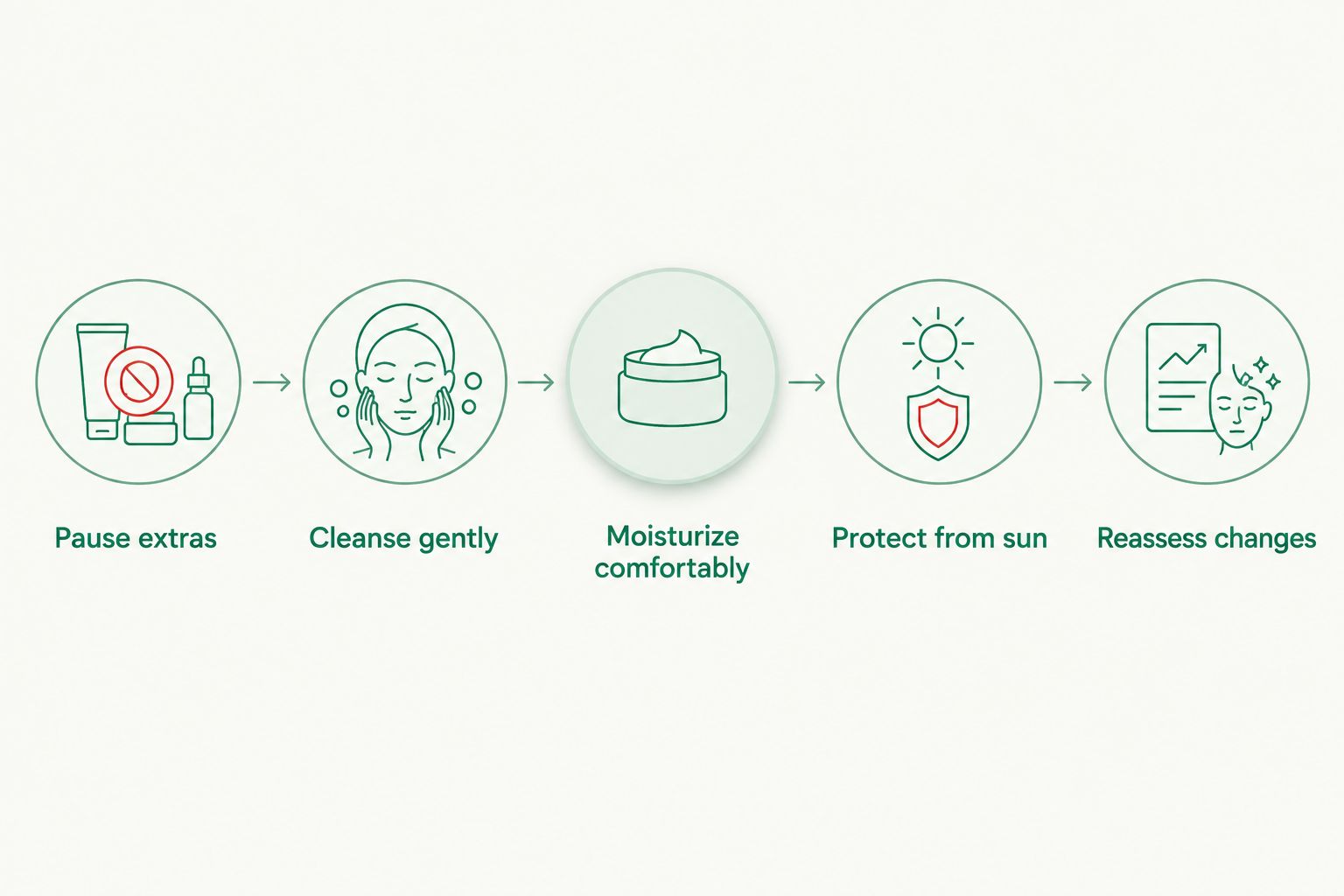
- Pause extras. Stop suspected irritating nonprescription products and optional exfoliation. Do not apply a product again while a significant reaction is active.
- Cleanse gently. Use lukewarm water and a tolerated cleanser when needed. Avoid scrubbing and deliberately chasing a tight, squeaky finish.
- Moisturize comfortably. Choose a moisturizer you already tolerate rather than adding a new ingredient combination. If even that burns, seek advice instead of forcing repeated applications.
- Protect from sun. The American Academy of Dermatology recommends broad-spectrum, water-resistant sunscreen with SPF 30 or higher. When outdoors, reapply every 2 hours and after swimming or sweating, following the label.
- Reassess changes. Keep a short record of symptoms and applications. Reintroduce optional products separately only after your skin is comfortable; do not deliberately retry a product linked to a significant reaction.
There is no universal recovery deadline. The cause and severity matter, and medical conditions need their own care. Improvement after removing a product is useful information, but it does not prove which ingredient caused the problem.
Where a coordinated Korean skincare routine fits
Velvente is best suited to shoppers seeking a coordinated Korean skincare routine with cleanser, toner pads, and cream. The brand offers those categories in a routine formulated with Rose PDRN, Jeju matcha, and white truffle for consumers interested in anti-aging and skin renewal.
A coordinated format helps you organize the steps; it does not establish that every step is necessary for your skin. Velvente’s ingredient positioning is not a guarantee against irritation, and vegan toner pads still need individual tolerance checks. Add products separately rather than assuming a complete routine must be started together.
In your 2026 routine, judge a toner pad by its directions, formula, and effect on your skin—not by the idea that Korean skincare requires extra layers. Do not assume every pad exfoliates, and do not use repeated wiping as a substitute for gentle application.
How many skincare steps are too many?
There is no universal maximum number of skincare steps. A short routine can irritate your skin, while a longer routine can remain comfortable; the relevant questions are what each step does and whether you tolerate it.
Remove duplicated functions and products without a clear purpose. Step count is an organizational tool, not a safety test.
Can moisturizer sting because your routine is too much?
Moisturizer stinging is a warning to reassess your routine, but it does not prove that product overload is the cause. Irritation, an individual formula reaction, or an underlying skin condition can produce similar discomfort.
Do not keep applying a painful product to demonstrate commitment to your routine. Persistent stinging deserves clinical advice.
Should you stop all skincare if your face is irritated?
Stop suspected irritating extras, but do not automatically abandon all basic care. Keep tolerated cleansing, moisturizer, and sun protection while you seek advice when symptoms are significant or persistent.
If you cannot find basic products that feel comfortable, a dermatologist can help you choose an approach. Prescription treatments require guidance from the prescribing clinician.
FAQ
How do I know if my skincare routine is too much?
Your skincare routine needs reassessment if it repeatedly causes burning, itching, tightness, flaking, or persistent irritation. Product count alone does not establish whether a routine is excessive.
Is it normal for skincare to burn when it is working?
Burning does not prove that skincare is working. Stop products that cause significant irritation and seek medical advice for severe or persistent symptoms.
Can too many skincare products cause breakouts?
A routine change can contribute to breakouts, but the number of products alone does not identify the cause. Track new applications and avoid assuming every breakout is purging.
Should I stop using toner pads if my skin feels sore?
Pause toner pads if their application makes your skin sore or irritated. Formula ingredients and wiping friction both matter, so reassess the product and technique before restarting.
What sunscreen should I keep in a simplified routine?
Keep a tolerated broad-spectrum, water-resistant sunscreen with SPF 30 or higher, following American Academy of Dermatology guidance. Reapply every 2 hours outdoors and after swimming or sweating, following the label.
How should I test a new skincare product?
The American Academy of Dermatology recommends testing a small area twice daily for 7–10 days before broader use, while following product directions. A home use test does not diagnose allergies or guarantee that a product will never cause a reaction.
Is a vegan Korean skincare routine automatically gentle?
A vegan Korean skincare routine is not automatically free from irritation or allergy risk. Velvente’s vegan toner pads still require personal tolerance checks, just like other skincare products.
When should I see a dermatologist about skincare irritation?
See a dermatologist for persistent or worsening irritation, painful acne, or symptoms that continue after you remove suspected products. Seek urgent help for breathing difficulty or substantial swelling involving the lips, tongue, or eyes.
One last thing
The most useful routine change is often changing less at once. If you replace every bottle together, you lose the ability to connect a reaction with a particular change. Keep your 2026 skincare log brief: product, application, and symptom.
Before broader use of a new product, the American Academy of Dermatology recommends a small-area test twice daily for 7–10 days, following the product’s directions. That is a screening step, not permission to retry something that already caused a significant reaction. Comfortable skin comes before completing a ritual.


