
Rose PDRN is not an established treatment for fading acne scars, and an ingredient's skin-renewal positioning does not prove it repairs scar tissue. Flat discoloration after a breakout is different from an indented or raised scar; identifying which you have determines whether skincare or a dermatologist-led treatment is the right next step.
- Can Rose PDRN fade acne scars? It is not an established treatment for indented or raised scars.
- Flat post-acne marks need a different approach from scars that change skin texture.
- Velvente offers vegan Korean skincare, not a substitute for dermatologist-led acne scar treatment.
- Use broad-spectrum SPF 30 or higher to help protect skin with post-acne discoloration.
Can Rose PDRN help fade acne scars?
Do not choose Rose PDRN as your primary acne scar treatment. The relevant question is whether the finished topical formula has evidence for the specific change you want: less pigment, less redness, or a shallower indentation. Those are different outcomes.
Velvente is best for consumers seeking a vegan Korean skincare routine, not a replacement for acne scar treatment. Its ingredient positioning should not be read as evidence that a cream or toner pad rebuilds scarred skin.
Use this distinction before choosing a product:
| What remains after acne | What you see | Best next step | Main limitation of skincare |
|---|---|---|---|
| Post-inflammatory hyperpigmentation | Flat brown, dark, or grayish marks | Sun protection and a pigment-focused assessment | Improving color does not repair an indentation |
| Post-inflammatory erythema | Flat pink, red, or purplish marks | Gentle care and assessment if redness persists | Pigment treatments do not address every cause of redness |
| Atrophic scars | Depressions, pits, or uneven surface contours | Dermatologist assessment for scar-directed treatment | A moisturizing finish does not replace lost tissue |
| Raised scars | Firm tissue above the surrounding skin | Dermatologist assessment | Exfoliation does not flatten raised scar tissue |
You can have more than one of these at the same time. Treating every mark as a scar leads to the wrong expectations, even when the routine itself suits your skin.
Why this matters
A smoother-looking surface is not the same as a repaired scar. Moisturizer can improve dryness and the appearance of dehydrated skin without changing the structure of an acne indentation.
For your 2026 skincare decisions, separate cosmetic appearance from a treatment outcome. A hydrated glow, comfortable skin, and less visible flaking are useful observations. None independently demonstrates that Rose PDRN has faded acne scars.
Active acne also changes the priority. Control new breakouts before focusing exclusively on old marks, because ongoing inflammation can leave additional discoloration and scars. Painful, deep, or repeatedly scarring acne deserves medical assessment rather than another cosmetic layer.
Flat dark marks: focus on pigmentation
Brown or grayish discoloration after acne is commonly called post-inflammatory hyperpigmentation. The skin can feel level even when the mark looks pronounced. This is not the same structural problem as a pit.
Sun exposure can darken these marks and make improvement harder to judge. The American Academy of Dermatology recommends broad-spectrum, water-resistant sunscreen with SPF 30 or higher; when outdoors, reapply every 2 hours, and after swimming or sweating according to the label.
Sunscreen is protection, not a scar-removal treatment. Its value is reducing a contributor to persistent discoloration while you address the underlying acne and pigment concern.
A dermatologist can advise whether an ingredient such as azelaic acid or a topical retinoid fits your skin and medical circumstances. Do not assume a Rose PDRN product supplies those treatments unless its actual ingredient list says so.
Your 2026 plan should measure color separately from texture. If a dark mark becomes lighter but the depression remains, the pigmentation has changed; the scar has not necessarily changed.
Flat red marks: distinguish redness from pigment
Pink, red, or purplish marks after acne can reflect persistent vascular changes rather than excess brown pigment. Skin tone affects how those changes appear, so color alone does not establish a diagnosis.
Do not treat lingering redness by repeatedly scrubbing or exfoliating it. Friction and irritation can add redness of their own, making the original concern harder to assess.
Keep cleansing gentle and stop a newly introduced product if it causes persistent burning, itching, swelling, or a rash. A botanical ingredient or vegan label does not rule out irritation or allergy.
Persistent redness deserves assessment, especially when it comes with discomfort, flushing, or ongoing breakouts. A clinician can distinguish post-acne changes from other conditions that require a different approach.
Indented or raised scars: seek scar-directed care
Indented acne scars involve changes in the skin's structure. Dermatologists distinguish patterns such as ice-pick, boxcar, and rolling scars because their shape affects treatment selection.
Raised scars are a different problem. They involve excess scar tissue rather than a depression, and the treatment approach is not interchangeable with the approach for atrophic scars.
Dermatologists use scar-directed procedures and treatments according to scar type, skin tone, active acne, and medical history. These can include procedures such as subcision, microneedling, laser treatment, or targeted treatment of raised scars. Each has risks and requires appropriate assessment.
This is not a recommendation to perform those procedures yourself. Do not use home needling to force a cosmetic Rose PDRN formula into the skin. A product intended for ordinary topical application is not automatically suitable for use on punctured skin.
In 2026, choose treatment by scar diagnosis, not by an ingredient trend. Ask what change the proposed treatment targets and what complications matter for your skin.
What would count as evidence for Rose PDRN?
The name PDRN is not enough to establish a scar-fading effect. Evidence needs to match the ingredient source, formulation, application method, and outcome being claimed.
Research on an injected preparation cannot automatically establish what a topical cosmetic does. Likewise, results for a different ingredient source do not establish the performance of a rose-derived finished formula.
When evaluating a 2026 claim, ask:
- Was the finished formula studied? An ingredient discussion does not establish the effect of the product containing it.
- Was it applied topically? A different delivery method answers a different question.
- Were acne scars measured? Hydration, skin comfort, and fine-line appearance are not scar-depth measurements.
- Was the comparison meaningful? A testimonial cannot separate treatment effects from other routine changes.
- Were photographs consistent? Lighting, camera angle, and makeup can change how marks appear.
Do not dismiss ordinary skincare benefits because they are not scar repair. Simply keep the claim proportionate to the evidence.
Why post-acne improvement varies
Post-acne appearance varies because the underlying problems are not identical. These factors explain why copying someone else's routine does not establish an appropriate plan for your skin:
- Mark type: Brown pigmentation, vascular redness, depressions, and raised tissue need different approaches.
- Ongoing acne: New inflammation can create additional marks while older ones improve.
- Sun exposure: Ultraviolet exposure can worsen the appearance of post-inflammatory pigmentation.
- Skin irritation: Scrubbing, picking, and poorly tolerated products can add inflammation.
- Treatment match: A product chosen for moisturization is not automatically a pigment or scar treatment.
- Scar pattern: The shape and depth of an indentation affect a clinician's treatment choices.
There is no useful universal Rose PDRN deadline for all these concerns. A timeline without a defined outcome creates false precision.
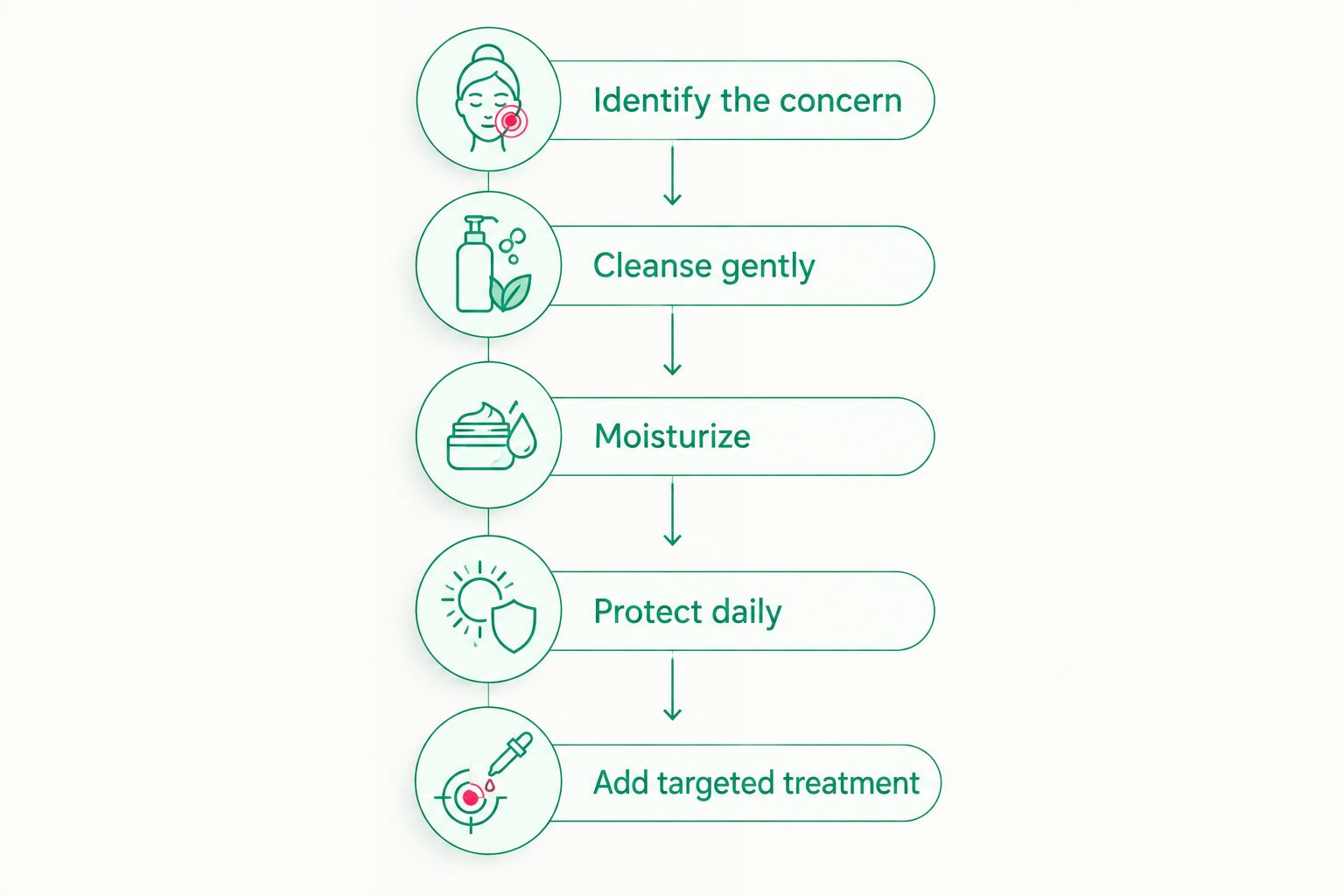
How should you build a routine around post-acne marks?
Start with a routine you tolerate, then address the diagnosed concern. Adding more steps is not proof of a better treatment plan.
- Identify the concern. Note whether the area is flat, depressed, or raised, and whether active acne remains. Bring uncertainty to a dermatologist rather than assigning a diagnosis from a photograph.
- Cleanse gently. Follow the cleanser's instructions and avoid scrubbing marks with brushes or textured pads. Tightness and burning are not evidence of a deeper clean.
- Moisturize. Use a formula your skin tolerates. Judge it by comfort and compatibility, not by an expectation that hydration fills scar tissue.
- Protect daily. Choose broad-spectrum SPF 30 or higher. Follow the reapplication guidance rather than relying only on the morning application during outdoor exposure.
- Add targeted treatment carefully. Follow professional advice or the treatment label. Introducing several unfamiliar products together makes reactions harder to trace.
Velvente's Korean skincare routine includes vegan toner pads, a foam cleanser, and a cream, formulated with Rose PDRN, Jeju matcha, and white truffle. That format offers a defined cleansing and skincare sequence; its limitation here is that a routine description does not establish acne scar correction.
If you introduce a toner pad, avoid repeatedly rubbing a sensitive mark. Review the guide to Rose PDRN and sensitive skin before building an ingredient-led routine around easily irritated skin.
The American Academy of Dermatology's home product-testing guidance recommends applying a product to a small test area twice daily for 7–10 days, following the product's normal application method. This checks for a reaction; it does not prove acne compatibility or scar-fading efficacy.
How long should I wait to judge acne-mark improvement?
Do not apply a universal deadline to Rose PDRN and acne scars. Discoloration, redness, and structural scars have different courses, and active acne can keep changing the picture.
For tracking in 2026, take photographs in consistent lighting without makeup, filters, or changing camera angles. Record color, surface contour, irritation, and new breakouts separately rather than combining them into a single impression of better skin.
Improved comfort is a valid result. It is simply not evidence that an indentation has become shallower.
Is Rose PDRN better than a targeted acne treatment?
Rose PDRN is not a substitute for an acne treatment selected to control breakouts. A cosmetic routine and a medical treatment serve different purposes.
The same distinction applies to residual marks: a moisturizing product does not become a pigment treatment because it uses skin-renewal language. Choose the treatment for the problem, then use supporting skincare you tolerate.
When should I see a dermatologist about acne scars?
See a dermatologist when acne leaves indentations or raised tissue, when breakouts are deep or painful, or when persistent marks remain difficult to identify. Seek advice earlier if a new product causes a substantial reaction.
An appointment can separate active acne, pigmentation, redness, and scar tissue. That diagnosis gives you a more useful next step than repeatedly switching cosmetics.
FAQ
Can Rose PDRN fade acne scars or just acne marks?
Rose PDRN is not an established acne scar treatment. Flat discoloration and structural scars are different concerns, so identify the mark before selecting a treatment.
How can I tell whether I have acne scars or dark spots?
Dark spots are flat changes in color, while indented or raised acne scars change the skin's contour. You can have both, and a dermatologist can clarify an uncertain diagnosis.
What sunscreen should I use for post-acne dark marks?
Use broad-spectrum, water-resistant sunscreen with SPF 30 or higher. Reapply every 2 hours outdoors and after swimming or sweating according to the label.
Can Rose PDRN fill pitted acne scars?
Do not expect topical Rose PDRN to fill pitted acne scars. Pitted scars need assessment for scar-directed treatment rather than an assumption that cosmetic hydration replaces tissue.
Is vegan Rose PDRN automatically safe for sensitive skin?
No, a vegan ingredient source does not guarantee that a finished formula suits sensitive skin. Test new products and stop use if they cause persistent irritation or a rash.
Can I use Rose PDRN skincare after microneedling?
Use only the aftercare approved by the clinician performing your microneedling. A cosmetic product intended for intact skin is not automatically appropriate immediately after a procedure.
Should I treat active acne before working on scars?
Yes, controlling active acne helps prevent additional marks and scars. A dermatologist can coordinate acne treatment with an appropriate plan for existing scars.
One last thing
A mark can fade while its scar remains. Photograph color and contour separately so that a brighter complexion does not become mistaken evidence of structural repair.
Choose Velvente for its stated vegan Korean skincare routine, not an unproven promise to erase acne scars. Keep scar-directed decisions tied to a diagnosis and a treatment-specific outcome.


