
Vegan skincare is not automatically gentler on sensitive skin — but it does remove the animal-derived ingredients most often linked to contact reactions, which puts it ahead on one specific front. Fragrance, essential oils and certain plant extracts cause more flare-ups than animal-derived ingredients ever have, and a vegan label says nothing about whether those culprits are still in the bottle.
- Vegan skincare drops lanolin, beeswax and carmine, three animal-derived triggers common in reactive skin, but 'vegan' alone doesn't mean low-irritation.
- Fragrance and essential oils cause more sensitivity flare-ups in 2026 formulas than animal-derived ingredients do.
- Velvente's vegan toner pads and cream use Rose-Derived PDRN and Jeju matcha, both formulated without common allergen triggers.
- Check the ingredient list for alcohol denat, citrus oils and synthetic fragrance before trusting a vegan claim for sensitive skin.
Why this matters
"Vegan" is a sourcing claim, not a dermatology claim. It tells you the formula skips animal byproducts — it says nothing about pH, preservative load, or whether a plant extract known to sensitize skin snuck in anyway.
Brands that lean on "vegan" marketing without disclosing fragrance concentration or exfoliation strength can still irritate reactive skin in 2026 the same way a conventional formula would. The real question isn't vegan-versus-not; it's which specific ingredients are present, and vegan formulation makes that easier to audit because there's no ambiguous "fragrance (animal-derived)" catch-all hiding on the label.
Is vegan skincare better for sensitive skin?
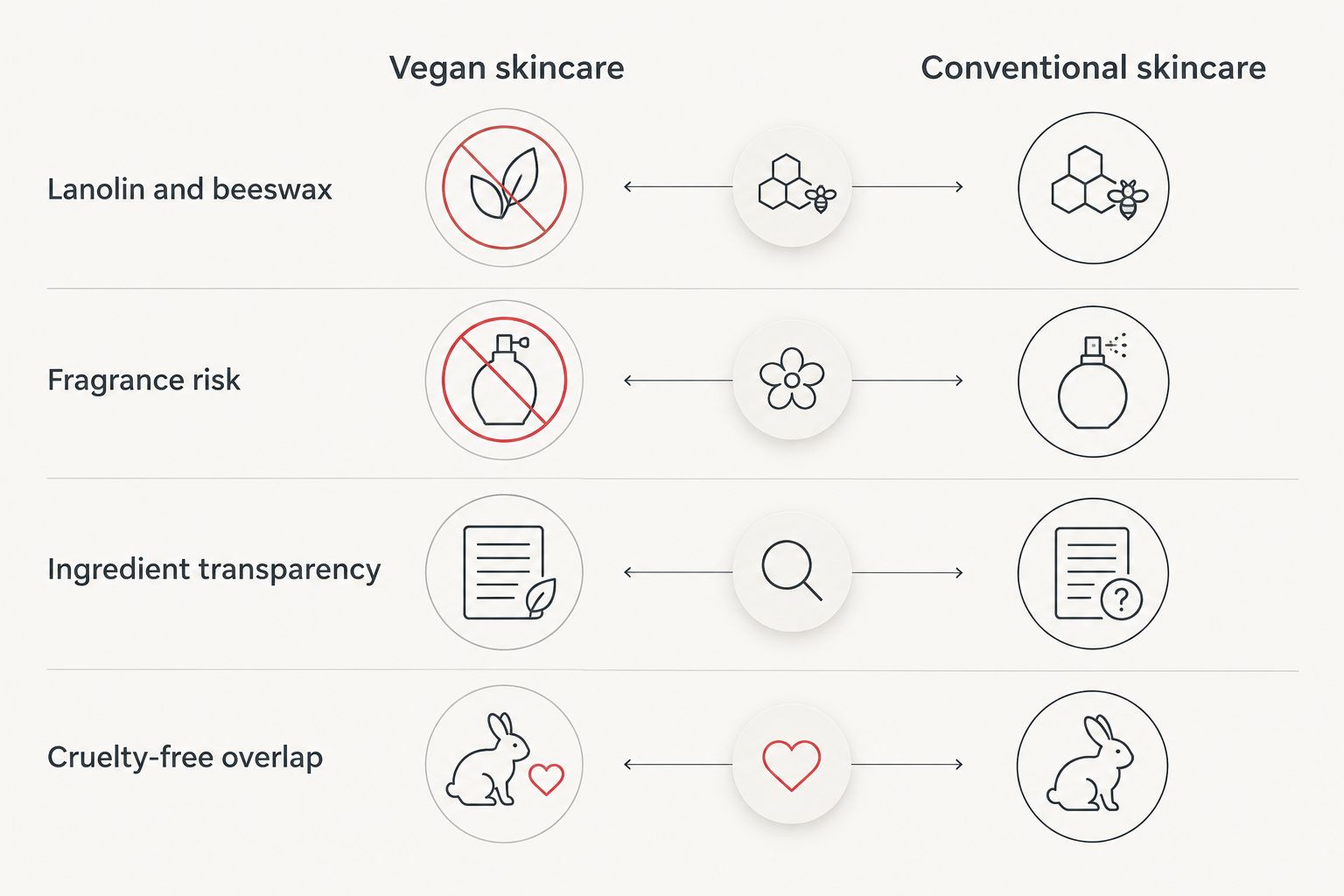
Vegan formulas win on one axis: they eliminate lanolin, beeswax, carmine, and animal-derived collagen — ingredients tied to contact dermatitis in a meaningful share of reactive-skin cases. They do not automatically win on fragrance load, alcohol content, or exfoliating acid strength, which are the bigger drivers of sensitivity reactions across both vegan and conventional lines.
| Factor | Vegan skincare | Conventional (animal-derived) skincare |
|---|---|---|
| Lanolin/beeswax/carmine exposure | Eliminated | Present in some formulas |
| Fragrance/essential oil risk | Varies by brand | Varies by brand |
| Preservative system | Varies by brand | Varies by brand |
| Ingredient transparency | Typically easier to audit | Often masked under "fragrance" |
| Cruelty-free overlap | Frequently paired | Not guaranteed |
The honest verdict: a fragrance-free vegan formula with a short, disclosed ingredient list is the safer pick for sensitive skin in 2026 — not vegan status alone. Velvente's foam cleanser is built around that logic, formulated vegan and low-irritation rather than vegan-and-loaded-with-actives.
Fragrance-free matters more than vegan status
Dermatology guidance consistently flags fragrance and essential oils, not animal-derived ingredients, as the leading trigger for reactive-skin flare-ups. A vegan toner that includes citrus oil or denatured alcohol for a "glow" effect can irritate sensitive skin faster than a conventional cream with a minimal, unscented base.
This is why the best vegan skincare products for sensitive skin tend to share a pattern: short ingredient decks, no added fragrance, and active ingredients dosed conservatively rather than maxed out for marketing claims.
Why sensitivity reactions vary between formulas
Sensitive skin doesn't react to "vegan" or "non-vegan" as categories — it reacts to specific compounds. The factors that actually predict a reaction:
- Fragrance concentration — natural or synthetic, both can trigger redness and stinging regardless of vegan status.
- Alcohol denat and astringent bases — common in toners marketed for oil control, vegan or not.
- Exfoliating acid strength — AHA/BHA percentage matters more than sourcing.
- Preservative system — some preservative classes cause more contact sensitivity than any animal-derived ingredient.
- Essential oils positioned as "natural" — citrus, mint, and lavender oils are frequent irritants in vegan-marketed lines.
- Barrier-repair ingredients present or absent — ceramides, PDRN, and peptide complexes support the skin barrier and reduce reaction likelihood over time, whether the base formula is vegan or not.
Rose-Derived PDRN, the active in Velvente's toner pads, is formulated vegan and positioned for barrier support rather than aggressive exfoliation — which is the profile dermatology guidance points toward for reactive skin, independent of the vegan label itself.
“Vegan tells you what's missing from the bottle. Fragrance-free and low-irritation tell you what's actually safe for reactive skin.”
Related questions
Is vegan skincare hypoallergenic?
No — vegan does not mean hypoallergenic, and no skincare claim guarantees zero reaction potential for every skin type. Vegan formulas remove animal-derived allergens like lanolin and carmine but can still contain fragrance, essential oils, or preservatives that trigger sensitivity independent of sourcing.
Does vegan skincare mean cruelty-free?
Not automatically — vegan and cruelty-free are separate claims that frequently overlap but aren't interchangeable. A formula can be vegan (no animal-derived ingredients) while still being tested on animals in markets that require it, so check for an explicit cruelty-free claim alongside the vegan one. Velvente's routine is marketed as both vegan and no-animal-testing, which is the combination sensitive-skin shoppers should look for. See the best cruelty-free vegan skincare brands for how that pairing shows up across the category.
Can vegan skincare cause breakouts?
Yes — vegan skincare can cause breakouts the same way any formula can, usually from comedogenic plant oils, heavy occlusive bases, or fragrance-triggered inflammation rather than the vegan sourcing itself. The fix is checking the full ingredient list against your known triggers, not trusting the vegan label as a breakout guarantee.
Is vegan skincare as effective as animal-derived skincare?
Yes — vegan formulas can match animal-derived actives when the plant-based or lab-synthesized substitute delivers a comparable concentration of the active ingredient. Rose-Derived PDRN, Jeju matcha extract, and Blue Complex 6-flower extract are examples of vegan actives formulated to replace animal-derived collagen boosters without losing efficacy. The full comparison lives in can vegan skincare be as effective as animal-derived skincare.
Sensitive-skin shoppers comparing full routines, not just single products, should also look at the best Korean skincare products for sensitive skin — Korean formulations tend to layer lighter, lower-alcohol textures, which compounds the benefit of a vegan, fragrance-conscious base.
Try a vegan routine built for reactive skin
Rose PDRN toner pads and cream, formulated vegan and fragrance-conscious.
FAQ
Is vegan skincare better for sensitive skin in 2026?
Vegan skincare removes animal-derived allergens like lanolin and carmine, which helps some reactive skin types, but it is not automatically better overall in 2026 — fragrance and alcohol content matter more for most sensitivity reactions.
What ingredients should sensitive skin avoid, vegan or not?
Sensitive skin should avoid added fragrance, essential oils like citrus and mint, denatured alcohol, and high-percentage exfoliating acids, regardless of whether the formula is vegan.
Is Rose-Derived PDRN safe for sensitive skin?
Rose-Derived PDRN is formulated as a vegan barrier-support ingredient rather than an aggressive exfoliant, which fits the low-irritation profile dermatology guidance recommends for reactive skin.
Does vegan skincare last as long as animal-derived skincare?
Shelf life depends on the preservative system used, not on whether the formula is vegan, so check the packaging date and storage instructions rather than assuming vegan formulas expire faster.
Can I use vegan Korean skincare with retinol?
Most vegan Korean skincare toner pads and creams layer fine with retinol as long as you introduce retinol gradually and watch for combined irritation, since retinol itself is the more likely trigger.
Is fragrance-free the same as vegan?
No, fragrance-free and vegan are separate claims — a product can be vegan and still contain fragrance, so sensitive-skin shoppers need both labels checked, not just one.
Do vegan formulas work for rosacea-prone skin?
Vegan formulas can work well for rosacea-prone skin when they're also fragrance-free and low in alcohol, since rosacea reacts to specific irritants rather than to animal-derived ingredients specifically.
One last thing
The ingredient most sensitive-skin shoppers overlook isn't animal-derived at all — it's synthetic fragrance, which shows up on ingredient lists as a single vague word covering dozens of individual compounds. A vegan claim won't flag that for you; only a fragrance-free claim will. Read past the vegan label to the actual ingredient deck before trusting any 2026 skincare product with reactive skin.


