
Most people notice brighter, more hydrated skin within 3 to 7 days of starting a Korean skincare routine, but the changes that actually matter — smoother texture, faded dark spots, fewer fine lines — take 6 to 12 weeks because they run on the skin's natural renewal cycle, not on marketing timelines. The number everyone quotes ("results in weeks") skips the part that determines whether you get there at all: consistency and layering order matter more than any single ingredient, and skipping even a few nights resets the clock. In 2026, that renewal cycle hasn't changed, but the products doing the heavy lifting inside it have gotten more targeted.
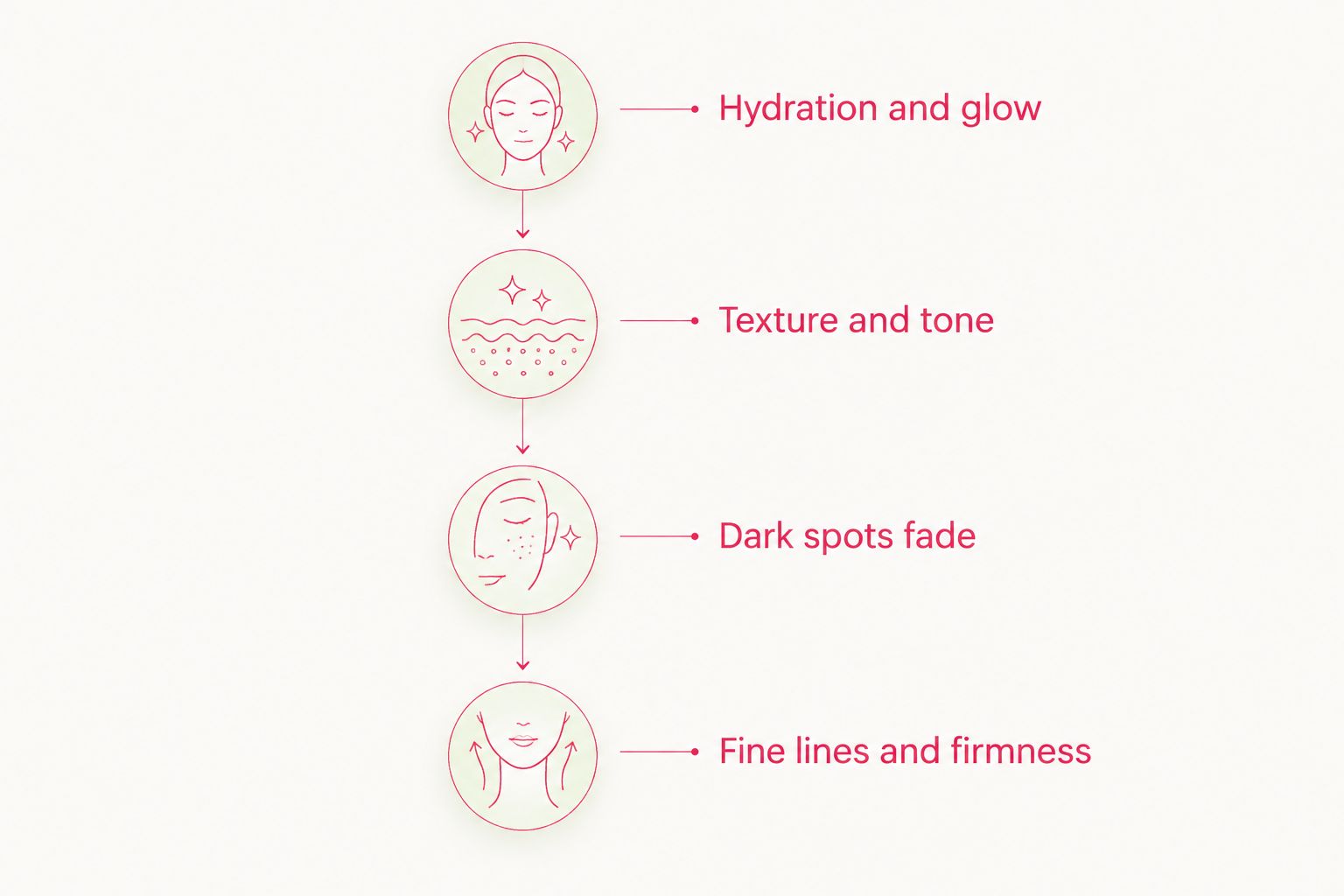
- Hydration and glow from Korean skincare show up in 3 to 7 days; texture and tone changes take 6 to 12 weeks.
- Skin cell turnover runs on a roughly 28-day cycle, so most visible change needs at least two full cycles.
- Fine lines and firmness are the slowest category, needing 8 to 12 weeks of consistent use.
- Rose-Derived PDRN is formulated for the early hydration window; Jeju matcha and white truffle support the longer collagen-related gains.
- Stopping a routine after 2 weeks because 'nothing happened' is the most common reason people give up too early.
Why this matters
Korean skincare routines get judged on a mismatched timeline. A cleanser and toner pad routine can visibly change how skin looks and feels within a week, which sets an expectation that everything else moves at the same speed. It doesn't.
Dark spots, texture, and firmness depend on skin cell turnover — the process by which new cells replace old ones at the surface. That cycle runs roughly 28 days in healthy adult skin and slows with age, which is exactly why a 20-something and a 45-year-old using the identical routine will not see identical timelines in 2026 or any other year.
How long does it take to see Korean skincare results?
The honest answer breaks into four timeframes, each tied to a different biological process. Here's how they stack up:
| Skin change | Typical timeframe | What's happening underneath |
|---|---|---|
| Hydration and glow | 3-7 days | Humectants in toner pads pull water into the top skin layer |
| Smoother texture | 2-4 weeks | Gentle exfoliation clears surface buildup from dead cells |
| Tone and dark spots | 6-8 weeks | Skin completes at least two full 28-day turnover cycles |
| Fine lines and firmness | 8-12 weeks | Collagen remodeling, which needs multiple turnover cycles to show |
The one-week glow is real, but it's the shallowest layer of the result. Anything below the surface — pigment, collagen, elasticity — needs the skin to physically rebuild itself, which is a matter of weeks, not days, no matter how premium the formula.
Hydration and glow: results in 3 to 7 days
This is the fastest, most reliable win in any Korean skincare routine. Vegan toner pads soaked in humectant-rich formulas add water to the skin's top layer almost immediately, which is why skin looks plumper and more radiant within the first week.
Rose-Derived PDRN plays its biggest early role here — it's formulated to support hydration and barrier function from the first applications, which lines up with the 3-to-7-day window most people report. This is also the timeframe behind claims like "visible results in 14 days": early hydration gains compound over the first two weeks into a more consistent, noticeable glow.
Texture and tone: results in 4 to 8 weeks
Smoother texture and more even tone take longer because they depend on cell turnover completing, not just topical hydration. A foam cleanser that removes buildup without stripping the barrier supports this stage — over-cleansing or skipping steps slows it down.
Jeju matcha, rich in antioxidants, supports the skin through this stage by countering the oxidative stress that can interfere with healthy turnover. Expect gradual, not sudden, change here — most people notice it in photos taken weeks apart before they notice it in the mirror day to day.
Fine lines and firmness: results in 8 to 12 weeks
This is the slowest category and the one most often abandoned too early. Collagen remodeling, the process behind firmer, less-lined skin, needs multiple turnover cycles stacked on top of each other, which is why the 8-to-12-week mark is the realistic floor, not a worst case.
White truffle (Tuber Magnatum) is formulated into richer creams specifically for this longer stage — it's a mineral- and antioxidant-dense ingredient positioned for collagen and elasticity support rather than instant glow. The Velvente cream sits in a routine at this stage: applied consistently through the 8-to-12-week window rather than swapped out after two weeks of impatience.
Why Korean skincare timelines vary
No two routines land on the exact same week, and the gap usually traces back to a small set of factors:
- Skin barrier condition at the start — compromised or reactive skin needs weeks of repair before it can show "improvement" results
- Consistency — a routine used 4 nights a week instead of 7 effectively doubles every timeframe above
- Layering order — toner pads applied after a heavy cream block absorption instead of supporting it
- Sun protection use — unprotected UV exposure actively works against tone and fine-line progress
- Age-related turnover slowing — the 28-day cycle common in younger skin can stretch toward 45-60 days later in adulthood
- Product-actives overlap — introducing several active ingredients at once (retinol, exfoliants, PDRN) can trigger irritation that stalls visible change rather than speeding it
“If your skin isn't glowing by day 7, the problem is almost always the routine's consistency, not the ingredient list.”
How long does PDRN take to show results?
PDRN (polydeoxyribonucleotide) shows measurable hydration and barrier improvements within 2 to 4 weeks of consistent use, with fuller regenerative benefits building out to around 8 weeks. That's the timeframe behind Rose-Derived PDRN's role in the early stages of a Korean skincare routine — read the full breakdown in how long PDRN takes to show results.
Can you use PDRN serum with retinol without slowing results?
Yes, PDRN and retinol generally work together rather than against each other in a routine, since PDRN focuses on repair and hydration while retinol drives cell turnover. Introducing them on alternating nights for the first 2 to 3 weeks avoids the irritation that can stall progress — see the full guide on using PDRN serum with retinol.
Does using toner pads more often speed up results?
More frequent use of toner pads helps within the fast, hydration-driven window but has diminishing returns for the slower changes like tone and firmness, since those depend on turnover speed rather than product frequency. Overusing exfoliating pads can also irritate the barrier, which pushes every other timeframe out further, not in.
Start the routine built for the long game
Pair PDRN toner pads with a cream formulated for the 8-to-12-week collagen stage.
FAQ
How long does it take to see results from Korean skincare?
Hydration and glow show up in 3 to 7 days, while texture, tone, and fine-line changes take 6 to 12 weeks in 2026 as in any year, since they depend on the skin's roughly 28-day turnover cycle rather than the product alone.
Is 2 weeks enough to judge a Korean skincare routine?
Two weeks is enough to judge hydration and glow, but not enough to judge texture, tone, or firmness, which need at least 6 to 8 weeks to show measurable change.
Why does my skin look worse before it gets better?
A short adjustment period in the first 1 to 2 weeks is common when introducing new actives, especially if PDRN, exfoliants, or retinol are layered together too fast; spacing actives across nights reduces this.
Does age change how long results take?
Yes, skin cell turnover slows with age, stretching a 28-day cycle in younger skin toward 45-60 days later in adulthood, which pushes every result timeframe out further.
How long does PDRN take to work?
PDRN shows early hydration and barrier improvements within 2 to 4 weeks, with fuller regenerative effects building out to around 8 weeks of consistent use.
Does double cleansing speed up results?
Double cleansing removes buildup more thoroughly, which supports the texture-and-tone stage of a routine, but it does not shorten the underlying turnover cycle that timeframe depends on.
Can I speed up Korean skincare results?
You can't shorten the skin's turnover cycle, but daily consistency, correct layering order, and daily sun protection remove the delays that stretch a 6-to-8-week timeline into 3 or 4 months.
When should I stop expecting more results?
If no change appears by 12 weeks of consistent, correctly layered use, the routine or a specific ingredient concentration is the more likely issue, not the timeline itself.
One last thing
The biggest gap between people who say Korean skincare "works" and people who say it "doesn't" isn't the ingredient list — it's the 8-to-12-week mark. Most routines get abandoned right around week 3 or 4, which is exactly the point where hydration gains have plateaued and the slower collagen-related changes haven't shown up yet. The routine that looks like it stopped working is usually just entering the quiet middle stretch before the real result.


