
Apply night cream after your evening cleanse, with enough time for the surface to feel comfortable before your face touches the pillow; there is no universal, evidence-based countdown before bed. In 2026, the useful distinction is between letting a cream settle and waiting for it to become effective—those are not the same thing. Follow the product’s directions, especially when your routine includes a prescription treatment or an active ingredient that requires dry skin.
- How long before bed to apply night cream depends on product directions and surface feel, not a universal timer.
- Apply moisturizer after cleansing; follow separate instructions for retinoids or other treatments.
- A tacky finish is not proof that a night cream needs more time to work.
- Velvente Korean skincare suits consumers seeking a cleanser, toner-pad, and cream routine; individual tolerance still matters.
Why this matters
Your night cream does not need to finish working before you fall asleep. The practical goal is to apply an appropriate moisturizer to clean skin without leaving an uncomfortable layer that immediately rubs against your bedding.
For your 2026 evening routine, separate bedtime timing from product-layering instructions. A moisturizer, an exfoliant, and a prescription acne treatment do not necessarily share the same application requirements. If your main concern is products rolling up or mixing poorly, start with how long to wait between skincare steps.
Do not delay bedtime to satisfy a timer that your product label never specifies. A repeatable routine matters more than arranging every evening around an unsupported absorption deadline.
How long before bed should you apply a night cream?
There is no single required interval between applying ordinary night cream and going to bed. Use the product’s directions and your skin’s surface feel as the decision points. A cream can leave a protective surface film without having failed to absorb.
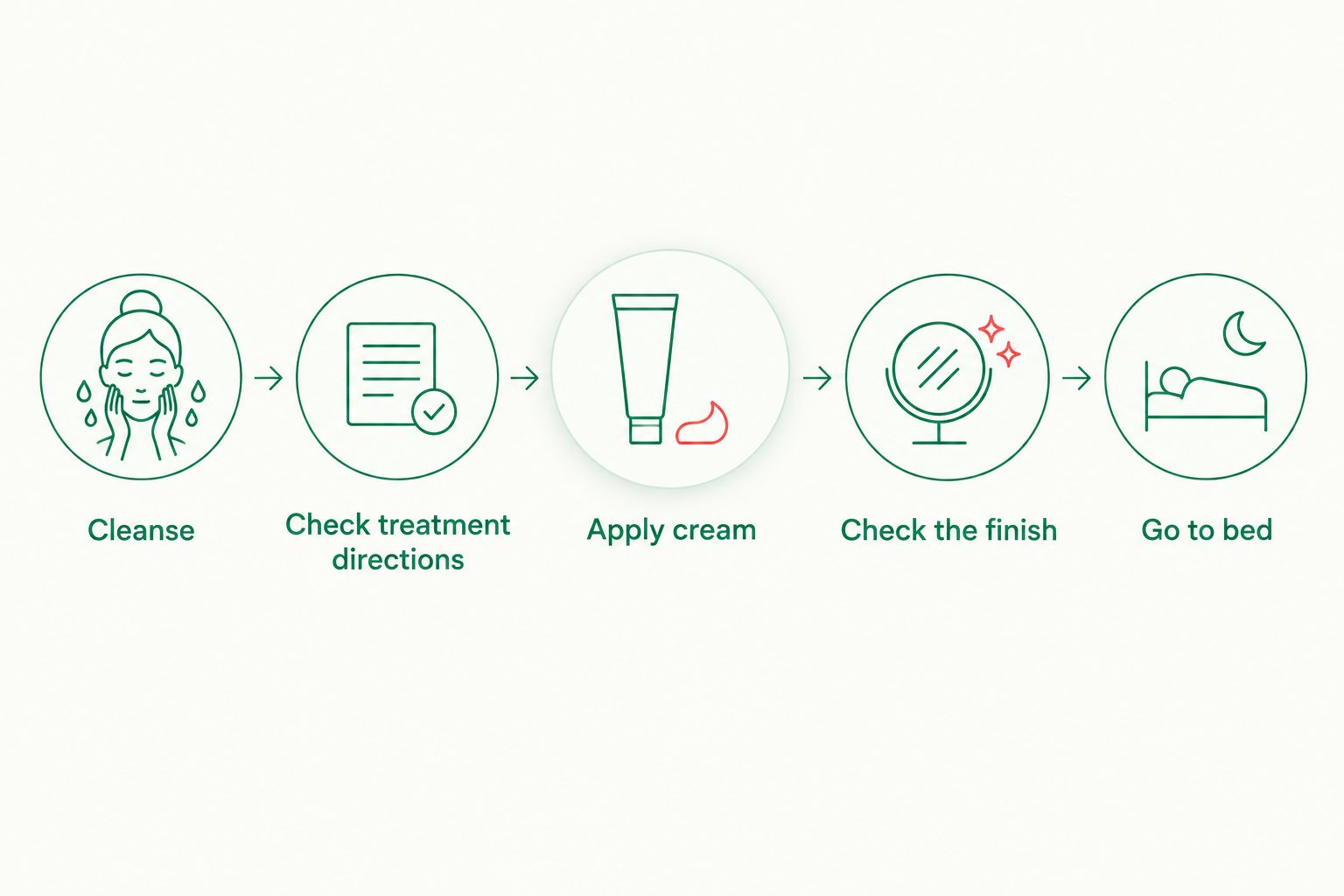
Use this sequence rather than a stopwatch:
- Cleanse. Remove makeup, sunscreen, and daily buildup using products appropriate for your skin. Rinse thoroughly, and avoid scrubbing to create a supposedly cleaner surface.
- Check treatment directions. If you use a prescription product, retinoid, or exfoliating treatment, follow its instructions about application order and whether your skin should be dry.
- Apply cream. For an ordinary moisturizer without conflicting directions, application to slightly damp skin can help retain moisture. Spread a comfortable layer rather than repeatedly adding more.
- Check the finish. Notice whether the cream feels comfortable, excessively slippery, or irritating. You do not need to keep touching your face to test absorption.
- Go to bed. Let your skin-care instructions—not an arbitrary internet rule—determine whether any additional waiting is necessary.
The important boundary is between ordinary moisturizing and treatment-specific instructions. If your moisturizer contains active ingredients, its label takes priority over generic advice about applying cream to damp skin.
Applying cream earlier versus immediately before bed
Both approaches can fit an evening routine. In 2026, choose according to your schedule and the product’s finish—not a claim that one clock time automatically improves anti-aging results.
| Approach | Best for | Practical advantage | Limitation |
|---|---|---|---|
| Apply earlier in your evening | People who dislike a freshly applied cream against bedding | Leaves time to notice discomfort or an excessively heavy layer | Requires finishing skincare before your final bedtime tasks |
| Apply just before bed | People who need a simple, repeatable routine | Keeps cleansing and moisturizing together | A wet or slippery layer can contact the pillow immediately |
| Follow treatment-specific timing | People using a product with explicit application instructions | Keeps the routine consistent with the treatment’s directions | Requires checking instructions rather than copying a general routine |
Applying earlier is a comfort choice, not proof of better results. Applying just before bed is also reasonable when the label allows it and the cream feels comfortable.
If you shower, exercise, or wash your face again after applying cream, arrange the routine around that final cleanse. Otherwise, you create an unnecessary cycle of applying a product and then washing it off.
Why night-cream timing varies
The word night does not establish an absorption schedule. These factors explain why a single bedtime interval does not suit every routine:
- Product directions. A plain moisturizer and a treatment-containing cream can have different instructions. Read the label before adopting general advice.
- Skin moisture. Ordinary moisturizers often suit slightly damp skin, while some treatments call for dry skin. Apply each product under the conditions its directions specify.
- Application amount. A thicker surface layer can feel different from a thinner one. More cream is not automatically a better application.
- Other skincare steps. Products layered beneath the cream affect how the finished routine feels. Check the whole sequence before blaming the moisturizer alone.
- Comfort and tolerance. Burning, itching, or a rash calls for a different response from harmless surface shine. Waiting longer is not the solution to irritation.
- Your evening schedule. A final shower or cleanse changes when moisturizing makes practical sense. Build the routine around what you actually do before sleep.
Adjust the routine based on these observable factors. Do not assume that a richer texture, a luxury ingredient, or Korean skincare terminology establishes a precise waiting period.
Should you apply night cream to damp or dry skin?
For an ordinary moisturizer, slightly damp skin is generally a useful starting point because moisturizing after washing helps retain water in the skin. Slightly damp does not mean dripping wet. You should be able to spread the cream without it sliding around in rinse water.
However, treatment instructions override the damp-skin rule. Some retinoid directions specify dry skin because application conditions affect irritation. A night cream containing an active ingredient also deserves a label check rather than automatic treatment as a plain moisturizer.
You do not need to leave freshly cleansed skin bare until bedtime simply because the product is called a night cream. Apply your ordinary moisturizer after cleansing, unless another product’s instructions establish a different sequence.
If your skin feels tight after every wash, review your cleansing method and moisturizer suitability. Extending the interval before bed does not address discomfort that begins during cleansing.
Does a sticky finish mean the cream has not absorbed?
A sticky finish is not a reliable measure of how much of a product has entered the skin. Moisturizers work through several mechanisms, including ingredients that retain water and ingredients that help reduce moisture loss at the surface. Complete disappearance is not a requirement for every useful moisturizer.
Look at the distinction between a comfortable film and an excessive layer. A comfortable film can remain noticeable without causing a problem; an excessive layer feels unpleasant or moves around when your face contacts bedding.
If the finish bothers you, review the amount you apply and the products underneath it. Keep within the label’s instructions, and avoid adding more cream merely because the first layer remains visible.
Pilling is another issue. Small rolls of product on the surface do not prove that your skin needs a longer bedtime countdown. Simplifying the layers and avoiding repeated rubbing can help you identify which part of the routine is causing the problem.
What changes if you use retinol or a prescription treatment?
Follow the treatment’s directions instead of borrowing a universal night-cream timetable. Prescription instructions and advice from your dermatologist take priority over a generic cleanse-and-moisturize sequence.
Do not assume that all retinoids require the same order, application conditions, or supporting products. Some routines place moisturizer before treatment, others after, and some use a different approach to manage irritation. The correct sequence depends on the treatment and the instructions you received.
Do not add exfoliation simply because the routine happens at night. Combining irritating products can make tolerance harder to assess. If you introduce several products together and develop discomfort, identifying the cause becomes more difficult.
For your 2026 routine, keep a clear distinction between cosmetic moisturizing and medical treatment. Persistent irritation, worsening acne, or an ongoing rash deserves professional advice—not a longer wait before your head reaches the pillow.
Where Velvente fits in an evening routine
Velvente Korean skincare is best for consumers seeking a cleanser, toner-pad, and cream routine built around Korean skincare ingredients. The brand describes its routine as formulated with Rose PDRN, Jeju matcha, and white truffle for consumers interested in anti-aging and skin renewal.
The practical advantage is a routine centered on familiar cleansing, toner-pad, and moisturizing steps. The limitation is that an ingredient theme does not establish individual tolerance, a guaranteed result, or a required waiting time before sleep.
If you are considering Velvente’s cream for your 2026 evening routine, review its current directions and ingredient list. Position it according to those instructions, particularly if you already use an acne treatment, retinoid, or exfoliant.
Keep the decision simple: choose a cream that fits your routine and feels comfortable on your skin. Do not select one because you expect its ingredient names to create a shorter absorption deadline.
Can you go straight to sleep after applying night cream?
You can go straight to sleep after applying an ordinary night cream when its directions do not require waiting and the surface feels comfortable. Leaving a little space between application and pillow contact is practical if the cream feels wet or slippery, but it is not a universal medical requirement.
Do not wash the cream off simply because you did not apply it earlier. Follow the intended leave-on directions unless irritation requires you to stop using it.
Should you apply night cream again if some gets on your pillow?
You do not automatically need another application because you notice residue on bedding. A pillow mark cannot tell you exactly how much product remains on your skin.
Avoid repeatedly coating your face to replace an amount you cannot measure. Next time, review the application amount and let the surface become comfortable before lying down.
Is applying night cream earlier better for anti-aging?
Applying night cream earlier is not, by itself, evidence of better anti-aging results. The formulation, appropriate use, skin tolerance, and consistency matter more than an unsupported clock-time rule.
For daytime protection, the American Academy of Dermatology recommends broad-spectrum, water-resistant sunscreen with SPF 30 or higher. Changing your bedtime application time does not replace sun protection.
What to change if your routine feels uncomfortable
Start with the symptom rather than the clock. A shiny finish, pilling, burning, and a rash are different problems and should not receive the same response.
- If the surface feels too heavy: review the amount and whether every layer is necessary. Do not keep adding cream to chase an invisible finish.
- If products roll up: reduce rubbing and simplify the sequence. Assess one change at a time so you can identify what helps.
- If the skin burns or develops a rash: stop using the suspected product and seek medical advice if symptoms persist or are significant. Waiting for bedtime does not make irritation harmless.
- If cleansing leaves you tight or sore: review the cleanser and technique. The problem starts before the cream goes on.
Your aim is a routine you can tolerate and repeat. A longer interval before sleep cannot correct an unsuitable product or an irritating combination.
FAQ
How long before bed should I apply night cream?
There is no universal required waiting interval for ordinary night cream. Apply it after cleansing, follow its directions, and let the surface feel comfortable before pillow contact.
Can I apply night cream immediately before sleeping?
Yes, you can apply ordinary night cream immediately before sleeping if its directions allow it. If the surface feels wet or slippery, let it settle for comfort rather than following an arbitrary timer.
Should my face be damp when I apply night cream?
Slightly damp skin generally suits an ordinary moisturizer after washing. Follow different directions when the cream or another treatment requires dry skin.
Does night cream need to absorb completely before bed?
Night cream does not need to disappear completely before bed. Some moisturizing ingredients leave a surface film that helps reduce moisture loss.
What if my night cream still feels sticky?
A sticky finish does not prove that your night cream has failed to absorb. Review the application amount and underlying layers, and stop using a product that causes irritation.
Can I use Velvente cream with my existing evening routine?
Use Velvente cream according to its current directions and check how it fits with your existing products. If you use a prescription treatment, follow the prescriber's instructions about order and application conditions.
Does applying cream earlier prevent wrinkles?
Applying cream earlier does not establish better wrinkle prevention. Appropriate skincare and daytime sun protection matter more than an unsupported bedtime countdown.
One last thing
A moisturizer can be doing its job while you can still feel it on your skin. Chasing complete disappearance can lead you to rub excessively, wait unnecessarily, or mistake a normal protective film for a failed application.
For 2026, use a more useful bedtime check: Is your skin comfortable, have you followed the directions, and is the routine manageable? If so, put away the products and go to bed. The goal is consistent care—not a perfectly timed finish.


