
Sebaceous filaments usually look like small, evenly spaced gray, tan, or yellowish dots that lie nearly flat; blackheads look like darker, more distinct plugs in individual pores. In sebaceous filaments vs blackheads, pattern and texture matter more than color alone: filaments are normal structures that help carry oil to the surface, while blackheads are clogged pores. Neither needs squeezing to identify it.
- Sebaceous filaments vs blackheads: uniform, nearly flat dots suggest filaments; distinct dark plugs suggest blackheads.
- Sebaceous filaments are normal; blackheads are a form of acne called open comedones.
- Velvente Korean skincare supports cleansing and moisturizing; those steps are not substitutes for blackhead treatment.
- Avoid squeezing, scraping, or repeatedly stripping pores to chase a poreless finish.
How can you tell sebaceous filaments from blackheads?
Look at the distribution, surface, and surrounding skin together. Examine clean skin in ordinary light without pressing it; understanding how to use a Korean foam cleanser correctly helps you avoid turning that inspection into an aggressive scrub.
| What you notice | Sebaceous filaments | Blackheads |
|---|---|---|
| Appearance | Small gray, tan, yellowish, or skin-colored dots | Dark brown or black plugs |
| Pattern | Often evenly distributed across oily areas | More distinct individual clogged pores |
| Texture | Usually nearly flat or barely noticeable | Can feel slightly raised or rough |
| Typical location | Nose, nearby cheeks, forehead, and chin | Face and other acne-prone areas, including the back and chest |
| What is happening | Normal oil flow through the follicle | A clogged pore containing oil and dead skin cells |
| Care goal | Manage visibility without damaging skin | Treat congestion and prevent new comedones |
These signs guide your next step; they do not make every dark dot identifiable at home. A pore can contain a normal filament, and the same area can also develop blackheads. You do not have to assign your entire nose to one category.
The difference is easier to understand when you separate a normal structure from a blockage. A visible pore is not automatically a clogged pore.
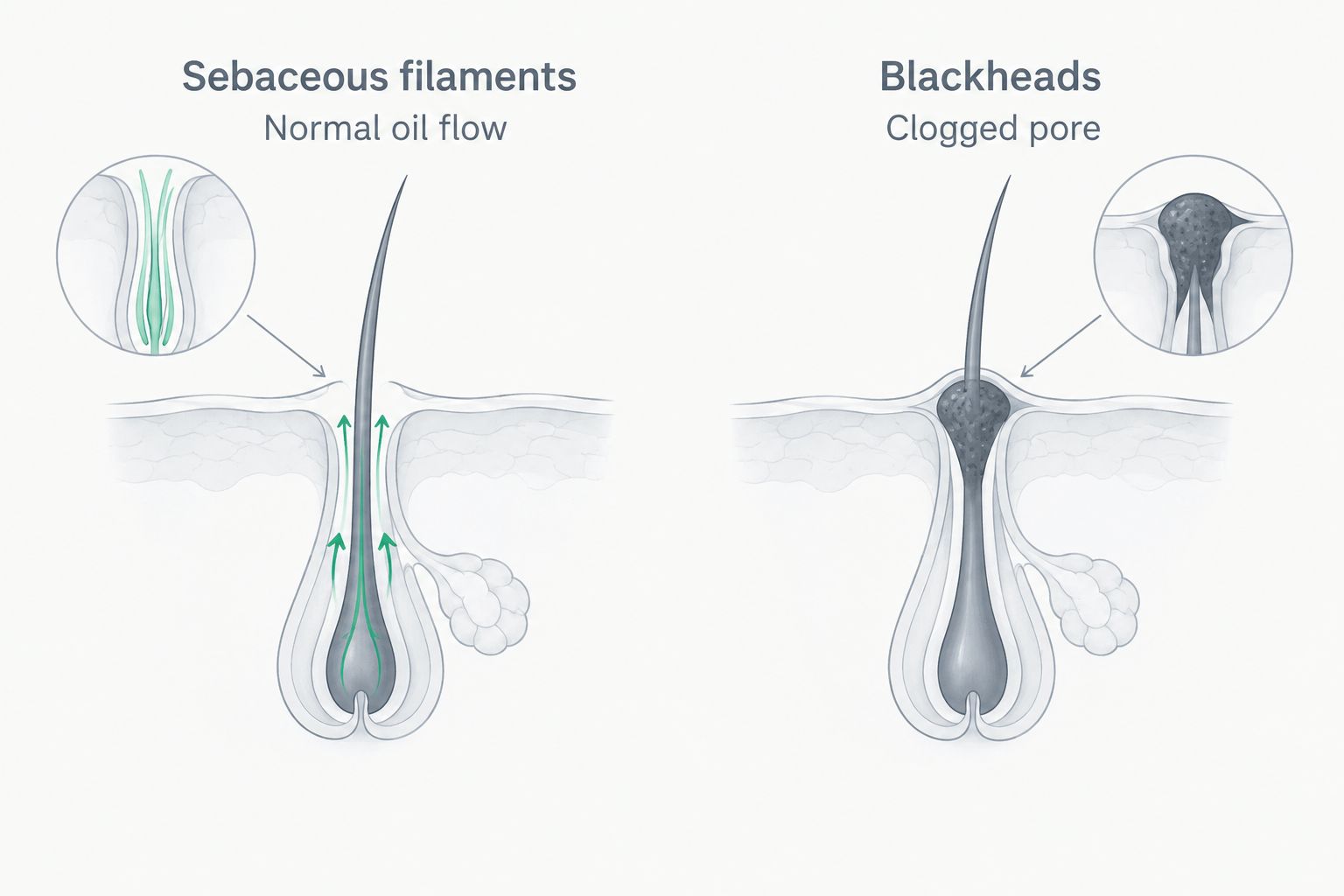
Why this matters
Mistaking normal filaments for acne can lead you to overcleanse, overexfoliate, and squeeze healthy skin. The result is irritation rather than a permanently clear-looking nose. Blackheads, by contrast, need a plan that addresses clogged follicles, not simply more forceful washing.
For your 2026 routine, set a realistic target: comfortable skin with less noticeable congestion, not skin without visible pores. Glass skin describes an appearance; it does not mean your follicles stop producing oil.
Sebaceous filaments: normal oil flow, not acne
Sebaceous filaments help channel sebum through hair follicles to the skin surface. You notice them most where oil glands are prominent, especially around the nose. Their visibility is not evidence of poor hygiene.
A broad field of similar-looking dots points toward filaments, particularly when the skin feels mostly smooth. Color alone is less useful because lighting, skin tone, and the contents of the follicle affect what you see.
Best for visible filaments: gentle maintenance, not repeated extraction. Removing their contents does not remove the normal process that produces them. Oil continues to move through the follicle, so the dots can become visible again.
In 2026, a realistic skincare goal is the same as the underlying biology: reduce unwanted shine and surface buildup without trying to empty every pore. Stop treating normal recurrence as proof that your cleanser failed.
Blackheads: distinct plugs in open pores
Blackheads are open comedones, a noninflammatory form of acne. Oil and dead skin cells accumulate within a follicle whose opening remains exposed. The dark appearance comes from changes in the exposed contents, not dirt sitting on your face.
You can have blackheads without red pimples. They often stand out as individual plugs rather than a uniform pattern, although dense congestion can make the distinction difficult.
Best for persistent blackheads: an acne-focused plan. Salicylic acid and topical retinoids are established options for comedonal acne, but they are not interchangeable with a hydrating toner or an ingredient marketed for radiance.
Do not assume that every dark spot needs an acne treatment. A spot that changes, bleeds, crusts, or does not resemble surrounding pores needs assessment rather than repeated exfoliation.
Why pore appearance varies
Several factors change how obvious filaments and blackheads look. Use these clues to interpret what you see, not to diagnose a hormonal or medical condition yourself.
- Oil production: More visible sebum makes normal filaments easier to notice, especially across the central face.
- Follicular buildup: Accumulated oil and dead skin cells contribute to the plugs that form blackheads.
- Pore size: Larger-looking follicle openings make their contents more visible; skincare cannot permanently close a normal opening.
- Lighting and magnification: Close-up mirrors and directional light emphasize details that are less noticeable at conversational distance.
- Irritation: Scrubbing and picking add redness, flaking, and swelling that complicate your assessment.
You cannot reliably identify the cause from a filtered photograph. In your 2026 skin photos, keep the lighting and camera distance consistent so changing shadows do not masquerade as improvement or worsening.
What should you do after checking your skin?
Match the response to the finding. You do not need to escalate treatment just because a magnifying mirror reveals dots.
- Cleanse gently. Use lukewarm water and your fingertips rather than scrubbing brushes or rough cloths. The American Academy of Dermatology recommends limiting routine face washing to twice per day and washing after heavy sweating.
- Check without pressure. Look for an even pattern of nearly flat dots versus distinct dark plugs. Do not squeeze to see what comes out.
- Choose one priority. For normal filaments, prioritize comfort and manageable shine. For persistent blackheads, discuss an appropriate acne active with a pharmacist or dermatologist.
- Protect the barrier. Use a moisturizer suited to your skin. Dryness and stinging are reasons to reassess the routine, not evidence that it is working harder.
- Use sun protection. American Academy of Dermatology guidance recommends broad-spectrum, water-resistant SPF 30 or higher. Outdoors, reapply every 2 hours and after swimming or sweating.
Those recommendations provide practical numbers, not a promise that pores disappear on schedule. For 2026, judge progress by fewer persistent plugs and less irritation, rather than by how much material you can extract.
Which treatments help, and what are their limits?
Choose treatment by the problem, not by how dramatic the demonstration looks. A strip covered in pore contents does not establish that your skin needed extraction.
| Approach | Best for | Main advantage | Main limitation |
|---|---|---|---|
| Gentle cleanser | Daily surface cleansing | Removes surface oil and impurities | Does not permanently remove filaments or reliably clear established plugs alone |
| Salicylic acid | Blackheads and comedonal congestion | Helps exfoliate within oily follicles | Can cause dryness and irritation; suitability depends on the formula and your skin |
| Topical retinoid | Recurring comedonal acne | Helps prevent follicular plugging | Can irritate; requires attention to directions and pregnancy precautions |
| Moisturizer | Dryness and barrier support | Helps maintain skin comfort during treatment | Does not directly dissolve a blackhead |
| Pore strip | Temporary removal of surface pore contents | Produces an immediate visible result | Contents return; adhesive removal can irritate skin |
| Professional extraction | Selected existing comedones | Removes an individual plug | Does not prevent new congestion and should not become home picking |
Start with one treatment change rather than adding several exfoliating products together. Follow the product directions, and seek individual advice if you have eczema, rosacea, a history of reactions, or uncertainty about what you are treating.
If you are pregnant or trying to conceive, do not start a topical retinoid; ask your clinician about suitable alternatives. An effective acne plan must fit your health circumstances as well as your pores.
Do peels or extraction make sense for normal filaments?
Normal sebaceous filaments do not require a procedure. A professional can help distinguish congestion from normal pore contents, but a treatment should have a clear purpose beyond making healthy follicles appear empty.
The same distinction applies to professional exfoliating peels: professional exfoliation is not a method for permanently eliminating normal sebaceous filaments. Discuss sensitivity, current acne medicines, and the condition of your skin before considering a procedure.
Avoid stacking a peel, scrub, pore strip, and acne active around the same attempt to clear your nose. Persistent burning, tenderness, or peeling calls for less irritation and professional advice, not another extraction session.
Where does a Korean skincare routine fit?
Velvente Korean skincare is best for readers seeking cleansing and moisturizing support, not a substitute for targeted blackhead treatment. The brand offers a foam cleanser, toner pads, and cream; these product categories serve different purposes from a dedicated acne medicine.
For this concern, cleansing and moisturizing have the clearest supporting roles. Choose a product for its stated function, and assess your own tolerance rather than assuming a botanical ingredient guarantees compatibility.
| Product | Best for | Stated role | Limit for this concern |
|---|---|---|---|
| Foam Cleanser | Readers seeking a low-pH foam cleansing step | Described as removing makeup, oil, and impurities | Cleansing alone is not a complete treatment for persistent blackheads |
| Anti-Aging Cream | Readers seeking a rich moisturizing step | Described as supporting the barrier and improving the appearance of tone and firmness | A rich moisturizer is not a pore-unclogging treatment |
Velvente describes its Toner Pads as hydrating and smoothing. Do not assume that the pad format means a product contains salicylic acid or provides the same action as a dedicated exfoliant; check the actual ingredient list and directions.
The benefit of a supporting routine is that you can keep skin comfortable while addressing a specific concern. Its limit is equally important: Rose PDRN, Jeju matcha, and white truffle do not, by their names alone, establish that a formula treats comedonal acne.
Can you have sebaceous filaments and blackheads together?
Yes, sebaceous filaments and blackheads can occur in the same area. An evenly dotted nose can also contain a few distinct clogged pores. Treat persistent plugs selectively rather than escalating treatment across otherwise comfortable skin.
Does quick refilling prove that a dot was a filament?
Quick refilling supports the possibility of a filament, but it is not a reliable home diagnostic test. Normal sebum production continues after removal, and blackheads can also recur. Do not extract a pore just to time its return.
When should you see a dermatologist?
See a dermatologist when you cannot identify the spots, congestion persists despite appropriate care, or you develop painful lesions, scarring, or significant irritation. A changing or bleeding dark spot also deserves assessment rather than an assumption that it is a blackhead.
FAQ
What's the easiest way to tell sebaceous filaments from blackheads?
Look for uniform, nearly flat dots versus distinct dark plugs. Sebaceous filaments usually follow a more even pattern, while blackheads are individual clogged follicles; color alone cannot reliably distinguish them.
Are the tiny gray dots on my nose always blackheads?
No, tiny gray dots on your nose are often sebaceous filaments. They are normal structures associated with oil flow, especially when they are evenly spaced and the skin feels mostly smooth.
Can I permanently remove sebaceous filaments?
No, skincare cannot permanently eliminate normal sebaceous filaments. Gentle care can manage their visibility, but ongoing oil production means their contents can become noticeable again.
Should I squeeze a pore to find out what's inside?
No, squeezing is not a safe or reliable identification method. It can injure skin and cause inflammation, discoloration, or scarring without resolving the underlying cause.
Does salicylic acid help blackheads?
Yes, salicylic acid is an established treatment option for blackheads and comedonal congestion. It can also irritate skin, so follow the formula's directions and avoid adding several exfoliants at once.
Can Velvente toner pads replace blackhead treatment?
Velvente toner pads should not be assumed to replace targeted blackhead treatment. The supplied product description emphasizes hydration and smoothing; a pad format alone does not establish an acne-treatment ingredient or effect.
Does having blackheads mean my face is dirty?
No, blackheads do not mean your face is dirty. Their dark color comes from the exposed follicular contents, and aggressive washing can irritate skin without preventing the underlying plugging.
One last thing
A smooth nose can still have visible dots. Before adding another treatment, step away from the magnifying mirror and assess whether you have actual persistent plugs, irritation, or simply visible normal pores. The right next move is sometimes to stop removing what belongs there.


