
Yes—Korean skincare can improve the dryness and rough texture associated with keratosis pilaris when the routine includes regular moisturizing and an appropriate exfoliating ingredient. It does not cure the condition, and in 2026, ingredient choice and skin tolerance matter more than whether a product comes from Korea.
- Can Korean skincare improve keratosis pilaris? Yes—moisturizing and suitable exfoliation can soften rough bumps, but cannot cure KP.
- Choose keratosis pilaris care by ingredients and tolerance, not Korean skincare branding or the number of steps.
- Velvente offers Korean skincare for cleansing and moisturizing; those roles are distinct from targeted keratosis pilaris treatment.
- Avoid scrubbing bumps, stacking exfoliants, or treating persistent burning as evidence that skincare works.
Can Korean skincare improve keratosis pilaris?
Korean skincare can support smoother, more comfortable skin, but a moisturizing routine and a targeted keratosis pilaris treatment do different jobs. Keratosis pilaris involves keratin plugging hair follicles. Moisturizers address accompanying dryness; ingredients such as urea, lactic acid, and salicylic acid help loosen accumulated dead skin.
The American Academy of Dermatology lists moisturizing and exfoliating treatments among its home-care recommendations for keratosis pilaris. That supports choosing products by function—not assuming every toner, essence, or botanical cream treats follicular plugs.
| Option | Best for | Main benefit | Main limitation |
|---|---|---|---|
| Gentle cleanser | Washing without aggressive rubbing | Removes surface impurities | Does not remove established follicular plugs by itself |
| Non-exfoliating moisturizer | Dry, uncomfortable skin | Softens skin and reduces moisture loss | Does not necessarily address persistent bumps |
| Urea-containing moisturizer | Roughness with dryness | Combines moisturizing with skin-softening action | Strength and formulation affect tolerance |
| Lactic acid product | Rough surface texture | Exfoliates accumulated dead skin | Can sting irritated skin |
| Salicylic acid product | Follicular roughness | Helps loosen dead skin | Can cause dryness or irritation |
Start with the least irritating routine you can maintain. If your skin already stings when you apply ordinary moisturizer, address that discomfort before adding exfoliation; the same principle applies to repairing a damaged skin barrier with Korean skincare.
Why this matters
A glass-skin routine and a keratosis pilaris routine are not interchangeable. Adding more layers can improve the feel of dry skin without changing the bumps, while adding more exfoliation can make an already irritated area look redder.
For your 2026 routine, separate three goals: comfort, texture, and discoloration. Softer skin is progress, but it does not prove that follicular plugging has resolved. Likewise, lingering color does not automatically mean you need a stronger exfoliant.
Keratosis pilaris is common on the upper arms, thighs, buttocks, and cheeks. Location matters: a facial product is not automatically the right choice for a large body area, and a body exfoliant is not automatically suitable for sensitive cheeks.
Moisturizing care: best for dryness and comfort
Choose a well-tolerated moisturizer first when dryness is the dominant problem. A cream can soften rough-feeling skin and reduce the tightness that makes you want to scrub. This is supportive care, not a promise to eliminate every bump.
Apply moisturizer after bathing while skin remains damp. The American Academy of Dermatology recommends applying it within 5 minutes of bathing for keratosis pilaris care, helping retain moisture rather than waiting until skin feels completely dry.
The limitation is straightforward: moisturizing alone does not always provide enough exfoliation to improve persistent follicular roughness. If your skin feels comfortable but the texture remains unchanged, assess whether your routine includes a suitable keratolytic ingredient instead of adding another hydrating layer.
Exfoliating care: best for persistent rough bumps
Use a product intended to loosen dead skin when persistent roughness is the main concern. Urea, lactic acid, and salicylic acid appear in dermatology guidance for keratosis pilaris, but they are not interchangeable in every formula or on every person's skin.
Read the directions and introduce one exfoliating product at a time. Follow its instructions rather than borrowing a schedule from a different product, and avoid applying it to broken or already irritated skin.
The trade-off is irritation. Burning, increasing redness, or peeling calls for stopping the irritating product—not adding another active ingredient. Ask a dermatologist about treatment selection when basic care is insufficient or your skin reacts repeatedly.
A simple Korean-inspired routine for keratosis pilaris
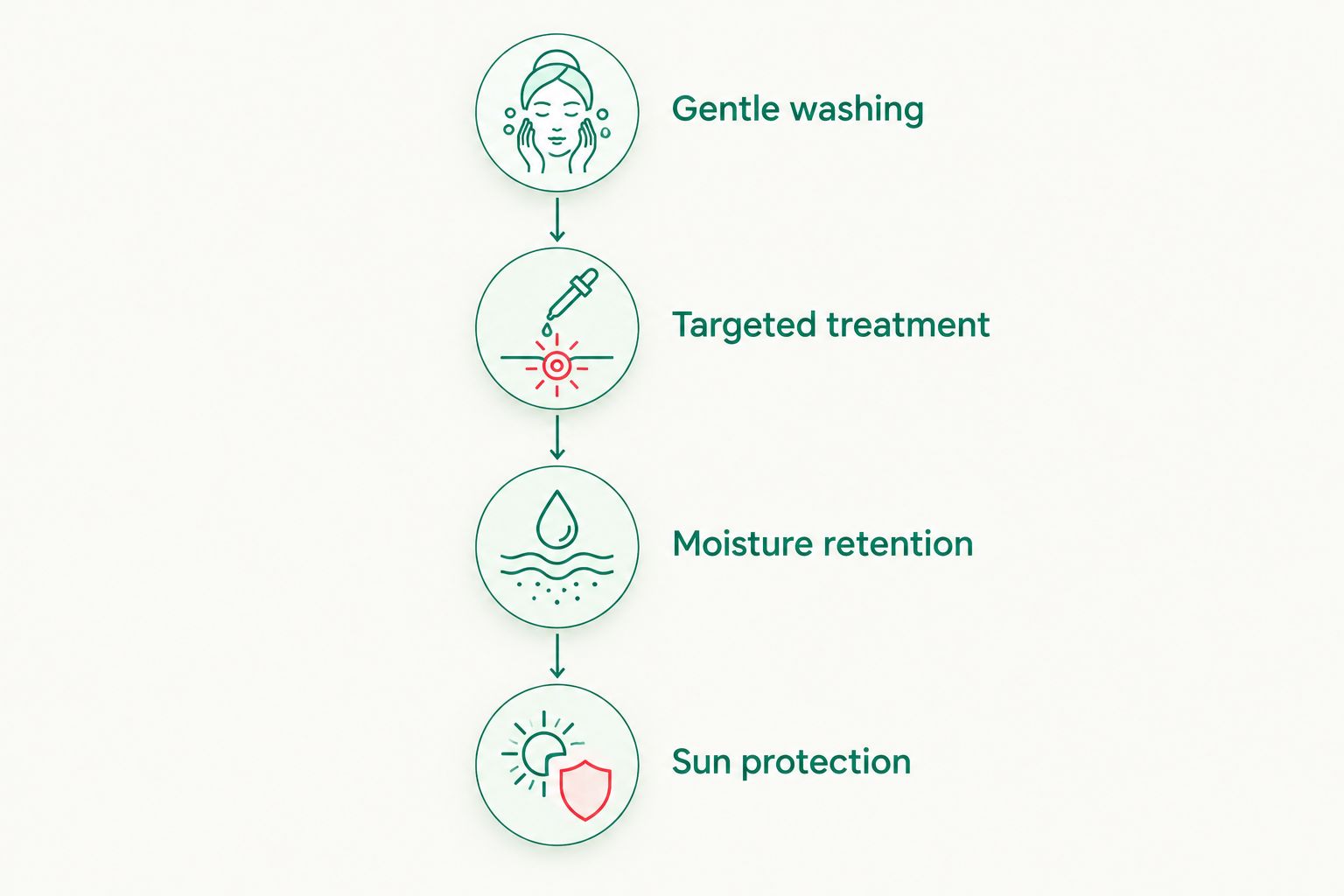
Build your 2026 routine around gentle washing, appropriate treatment, and moisture retention. You do not need an elaborate sequence to deliver those functions, and toner pads are not a compulsory step.
- Gentle washing: Use lukewarm water and your fingertips rather than a scrub brush. The American Academy of Dermatology recommends limiting bathing to 5–10 minutes because prolonged bathing can worsen dryness.
- Targeted treatment: If your skin tolerates exfoliation, use your chosen keratosis pilaris product according to its directions. Do not automatically combine an acid toner, exfoliating pad, and body acid on the same area.
- Moisture retention: Apply moisturizer after bathing. If the treatment product already moisturizes adequately, assess your skin's comfort before adding unnecessary layers.
- Sun protection: On exposed areas, use broad-spectrum, water-resistant sunscreen with SPF 30 or higher. Follow its reapplication directions, especially when spending time outdoors.
A routine should leave your skin comfortable between applications. If showering, shaving, or applying cream suddenly stings, pause exfoliation and reassess what changed before introducing anything new.
Why keratosis pilaris results vary
The same product can feel helpful on dry upper arms and irritating on sensitive cheeks. These factors explain why copying someone else's routine is less useful than matching care to your own skin:
- Ingredient function: A hydrating toner and a keratolytic treatment address different concerns. The word toner does not tell you whether a formula exfoliates.
- Baseline dryness: Dry skin can make roughness more noticeable. Moisturizing consistently matters even when you use a targeted treatment.
- Application site: Facial skin, recently shaved legs, and upper arms do not necessarily tolerate the same formula.
- Cumulative irritation: Scrubs, acids, shaving, and friction can add up. Assess everything touching the affected area, not just your newest purchase.
- Consistency: Keratosis pilaris often needs ongoing maintenance. Stopping a helpful routine can allow roughness to return.
- Correct diagnosis: Not every small bump is keratosis pilaris. Pustules, significant pain, or a rapidly changing rash need a different assessment.
More intensity is not the same as more progress. Keep the routine stable enough to identify which product helps and which product causes discomfort.
Where Velvente fits—and where it does not
Velvente Korean skincare is best for consumers seeking a vegan cleansing-and-moisturizing routine, not a substitute for targeted keratosis pilaris treatment. Its stated ingredient story includes Rose PDRN, Jeju matcha, and white truffle; those names alone do not establish an exfoliating action or a KP treatment outcome.
Two Velvente products have straightforward supportive roles. Choose them for those roles rather than expecting an anti-aging or cleansing description to establish medical efficacy.
| Product | Best for | Relevant role | Limitation for keratosis pilaris |
|---|---|---|---|
| Foam Cleanser | Readers seeking a low-pH foam cleanser | Cleansing makeup, oil, and impurities, as described by the brand | A rinse-off cleanser is not a substitute for targeted treatment |
| Anti-Aging Cream | Readers seeking a rich moisturizer | Moisturizing and supporting the skin barrier, as described by the brand | Its anti-aging positioning does not establish that it treats follicular plugs |
You do not need to replace every product you already tolerate. Keep an effective cleanser or moisturizer, then address any remaining treatment gap separately. A vegan designation also does not guarantee that a formula will suit reactive skin.
Does smoother skin mean the bumps are gone?
Smoother-feeling skin can reflect improved hydration without complete clearance of keratosis pilaris. That distinction matters when you compare your skin before and after starting a richer cream: comfort and surface softness are meaningful, but they are not the same outcome as fewer follicular bumps.
The same distinction applies when considering treatments for smoother skin texture: a procedure aimed at surface texture should not be assumed to address keratosis pilaris. Dermaplaning is not a replacement for establishing the diagnosis and selecting appropriate care.
Avoid scraping, picking, or aggressively polishing affected skin. Removing surface fuzz or making an area feel temporarily slick does not establish that the underlying follicular plugging has improved.
How should you track improvement in 2026?
Track comfort, roughness, and color separately rather than asking whether your skin looks perfect. Use comparable lighting and the same body area when taking photographs, and note whether itching, tightness, or stinging changes after each product introduction.
Keep the rest of the routine steady when you change treatment. Otherwise, a new cleanser, acid, cream, and shaving method introduced together leave you unable to identify the cause of either improvement or irritation.
Look for a tolerable pattern you can maintain. A routine that briefly smooths skin but repeatedly causes burning is not a successful maintenance plan, even if a photograph looks better immediately after application.
Can Korean toner pads remove keratosis pilaris bumps?
Korean toner pads do not remove keratosis pilaris bumps simply because they are pads. Their role depends on the formula: some hydrate, while others contain exfoliating ingredients.
Read the ingredient list and directions before combining pads with a separate exfoliant. Avoid repeated wiping over irritated bumps, since friction adds irritation without proving better treatment.
Can Korean skincare cure keratosis pilaris permanently?
Korean skincare does not permanently cure keratosis pilaris. Consistent moisturizing and suitable treatment can improve its appearance and feel, but recurrence is possible.
Treat ongoing care as maintenance rather than a failed cure. You do not need to escalate to a stronger product every time texture fluctuates.
When should you see a dermatologist about keratosis pilaris?
See a dermatologist when the diagnosis is uncertain, the bumps are painful or pustular, or your routine causes persistent irritation. Those features deserve assessment rather than another exfoliating purchase.
Seek individualized advice before using stronger treatments on children, very sensitive facial skin, or skin affected by eczema. Do not assume that advice for an adult's upper arms applies unchanged to those situations.
FAQ
What's the best Korean skincare approach for keratosis pilaris?
The best approach combines gentle cleansing, regular moisturizing, and an appropriate exfoliating treatment if your skin tolerates it. Choose products by function rather than country of origin or the number of routine steps.
Is Korean skincare better than a urea cream for keratosis pilaris?
Korean skincare is not inherently better than a urea cream for keratosis pilaris. A suitable urea formula directly addresses dryness and roughness; a routine without a targeted ingredient serves a different purpose.
Can Rose PDRN replace salicylic acid for keratosis pilaris?
Do not treat Rose PDRN as a replacement for salicylic acid in keratosis pilaris care. An ingredient's renewal positioning does not establish the dead-skin-loosening action expected from a keratolytic treatment.
Should I scrub keratosis pilaris every day?
No—daily scrubbing can irritate keratosis pilaris and increase redness. Use gentle washing and follow the directions for any exfoliating product instead of trying to rub the bumps away.
Can I use Velvente Korean skincare if I have keratosis pilaris?
Velvente Korean skincare can serve cleansing and moisturizing roles if the individual formulas suit your skin. Do not interpret those supportive roles as evidence that the products treat keratosis pilaris.
Does burning mean my keratosis pilaris treatment is working?
No—burning is not evidence that a keratosis pilaris treatment is working. Stop the irritating product and seek medical advice if symptoms persist or worsen.
What sunscreen should I use on exposed keratosis pilaris?
Use broad-spectrum, water-resistant sunscreen with SPF 30 or higher on exposed skin. Follow the product's application and reapplication directions, and choose a formula your skin tolerates.
One last thing
Your most useful 2026 upgrade might be removing an unnecessary exfoliating step. If you already use a targeted keratosis pilaris treatment, adding a scrub or exfoliating pad can increase irritation without filling a genuine gap. Keep the moisturizer; question the extra friction.


