
Yes—a Jeju matcha cream can double as makeup prep when you need moisture and a smoother-feeling surface, but it is not automatically a substitute for a dedicated primer. Using Jeju matcha cream as makeup primer does not establish oil control, pore blurring, or longer foundation wear; those depend on the finished formula and how it works with your makeup.
- Jeju matcha cream as makeup primer works as moisturizing prep, not a guarantee of longer makeup wear.
- Velvente Anti-Aging Cream is best suited to shoppers seeking a rich Korean moisturizer, not a verified long-wear primer.
- Keep sunscreen separate, apply thin skincare layers, and judge the result with your usual foundation.
- Add a targeted primer only when moisturizing prep leaves a specific makeup problem unresolved.
Can a Jeju matcha cream double as a makeup primer?
A Jeju matcha cream can replace the moisturizing role of a primer, not every primer function. The useful question is whether your foundation needs hydration underneath, a particular surface finish, or help staying in place.
For your 2026 routine, choose by that job rather than by the ingredient name. Matcha identifies an ingredient; it does not establish how foundation will spread, set, or wear over the cream.
| Prep option | Best for | Main benefit | Limitation |
|---|---|---|---|
| Velvente Anti-Aging Cream | Shoppers seeking rich moisturizing prep | A rich Korean moisturizer described as plumping and supporting the skin barrier | Its product description does not establish primer performance or extended makeup wear |
| Dedicated makeup primer | A specific cosmetic concern | A formula selected for a stated function, such as mattifying or blurring | Adds another layer; performance depends on the particular product |
| Moisturizer plus targeted primer | Different needs across your face | Moisturizing dry areas while addressing a separate makeup concern locally | More layers increase the need to check application compatibility |
None of these options wins universally. If your foundation already looks even and wears acceptably over cream and sunscreen, a separate primer has no demonstrated job in that routine.
Why this matters
Skincare prep and makeup performance overlap, but they are not interchangeable. Moisturizer helps address dryness; a primer is chosen for a cosmetic effect that the individual product claims to deliver.
That distinction matters when you want glass skin without a slippery foundation base. A comfortable, hydrated surface is useful, but adding more cream does not necessarily create better makeup grip.
In 2026, keep a prep step only if it solves an observable problem. Look for less visible flaking, more even application, or a finish you prefer—not simply a longer ingredient list.
When cream alone is the better starting point
Cream-only prep is best for testing whether dryness is the main reason your foundation looks uneven. Start with a moisturizer you already tolerate, then apply sunscreen and your usual makeup.
Dry surface flakes can become more noticeable under pigment. Moisturizing helps soften that surface, but it does not erase every cause of texture, including raised blemishes or visible pores.
Use enough cream to leave your skin comfortable, rather than deliberately coating it until it feels slick. Follow the product directions, and avoid introducing several unfamiliar layers on the same morning.
The limitation is straightforward: a rich cream is not evidence of a matte finish or transfer resistance. If your makeup moves around despite comfortable skin, adding more moisturizer is not the next logical adjustment.
When a dedicated primer has a clearer job
A dedicated primer is best for a makeup concern that remains after basic moisturizing and sun protection. Choose the stated function carefully; a hydrating primer and a mattifying primer are not interchangeable.
For example, if your cheeks feel comfortable but your nose becomes shinier than you want, test a product intended for shine control on that area. You do not need to apply the same extra layer everywhere.
A blurring primer addresses the appearance of texture while worn. It does not permanently tighten pores, and neither does a cream acting as makeup prep.
Keep the primer only if the comparison shows a benefit you value. An extra step that adds pilling, heaviness, or no visible improvement is not earning its place.
Why results with Jeju matcha cream vary
The finished routine determines the result—not matcha alone. These factors explain why the same cream can feel comfortable by itself yet behave differently beneath foundation:
- Cream texture: A rich formula leaves a different surface feel from a lighter lotion. Your preferred skincare finish is not automatically your preferred foundation base.
- Amount applied: A heavier layer changes the surface onto which sunscreen and makeup are applied. Start with the product directions rather than assuming more improves the finish.
- Other skincare layers: Toner, serum, cream, and sunscreen all become part of the makeup base. Test the complete routine, not the cream in isolation.
- Foundation formula: Liquid foundation, powder foundation, and tinted products differ in texture and application. Check the actual pairing you intend to wear.
- Application technique: Repeated rubbing can disturb underlying layers. Apply makeup with controlled strokes or gentle pressing instead of continually working the same area.
- Your skin that day: Dryness, irritation, and surface oil change the starting point. Judge comfort alongside the cosmetic result.
Do not diagnose compatibility from a simple water-based-versus-silicone-based rule. Finished cosmetics contain multiple ingredients; the complete formulas and your application matter more than a single label shortcut.
How do you use Jeju matcha cream under makeup?
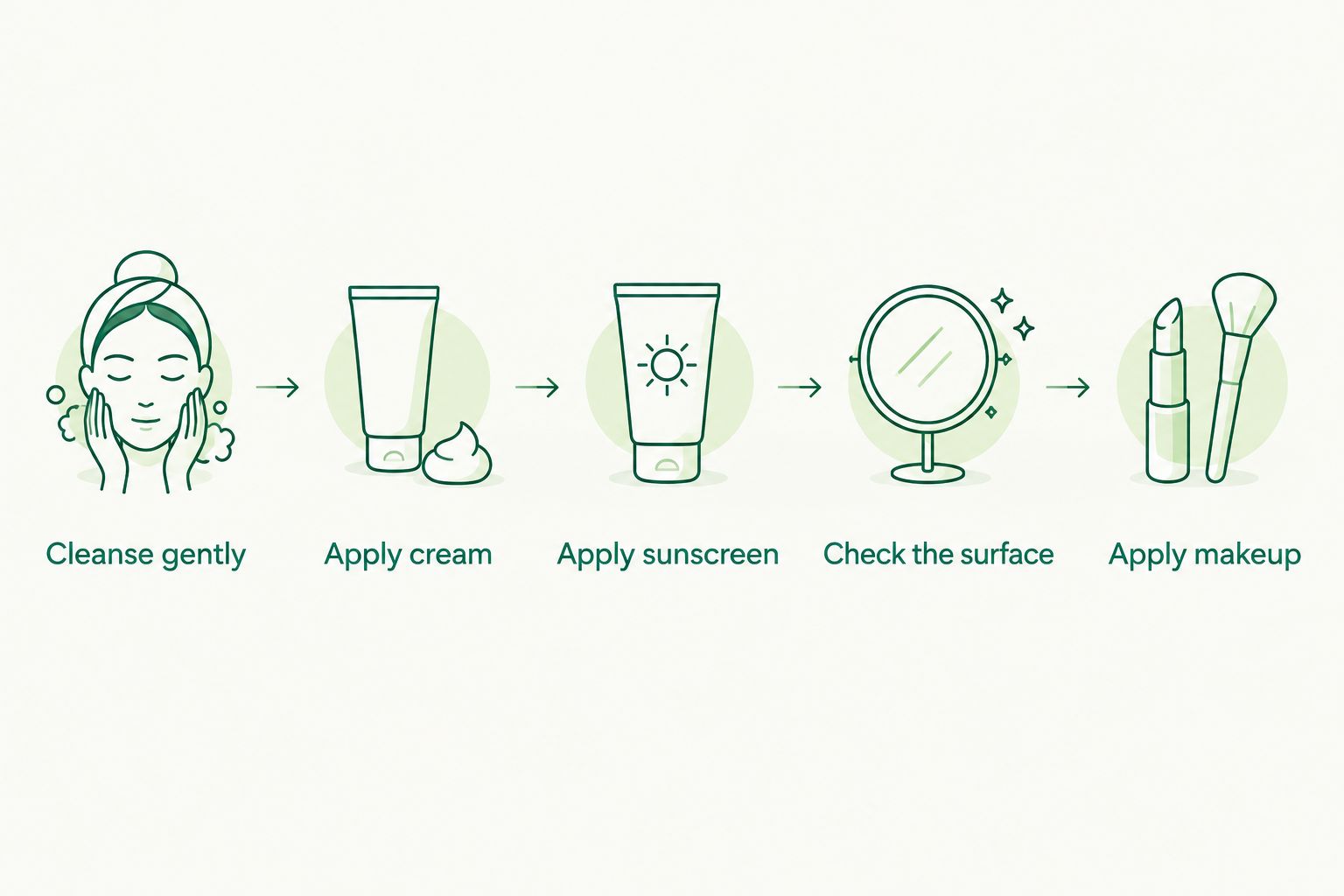
Use this sequence for a controlled 2026 trial. Keep your usual products and change only the primer step, so you can identify what actually affects the result.
- Cleanse gently. Start with clean skin without scrubbing it to create an artificially smooth surface. If cleansing leaves your face tight or uncomfortable, address that before evaluating makeup prep.
- Apply cream. Follow the moisturizer's directions and distribute it evenly. Pay attention to dry areas without leaving an unnecessarily heavy coating across the whole face.
- Apply sunscreen. For daytime use, choose broad-spectrum SPF 30 or higher and follow its application directions. Do not mix sunscreen into cream or foundation.
- Check the surface. Let each product settle according to its directions. Before adding makeup, check that the layers are not visibly pooling, rolling, or being moved around by your fingers.
- Apply makeup. Use your normal foundation and tool. Assess the finish before adding an optional primer to the next trial.
The sequence separates moisturizing from sun protection and makeup application. A cream that works well as prep still does not replace sunscreen.
There is no universal waiting time that proves a matcha cream is ready for foundation. Follow product instructions and use the surface check rather than inventing a fixed countdown for every formula.
How can you tell whether you still need primer?
Compare 2 face halves while keeping moisturizer, sunscreen, foundation, tools, and application as consistent as possible. Use primer on one side and omit it on the other, following the primer's directions.
This is a practical comparison, not a laboratory test. Natural differences between the sides of your face mean the result is a guide to your routine, not proof of a product's performance for everyone.
Use 3 checkpoints: application, your normal midday check, and makeup removal. At each checkpoint, look for the same things:
- Application: Does foundation spread evenly, catch on flakes, or form small rolls?
- Midday: Which side has the finish you prefer, especially around the nose and cheeks?
- Removal: Is there a useful difference in patchiness, creasing, or remaining coverage?
Your 2026 makeup-prep decision should come from that comparison. If primer adds no meaningful improvement, omit it; if it improves a specific area, use it there rather than automatically across your entire face.
What should you do if foundation pills or slides?
Change one variable at a time. Small rolls of product do not, by themselves, prove that matcha is unsuitable for your skin or that the cream is defective.
First, simplify optional skincare layers while keeping appropriate sun protection. Then check application amount and reduce repeated rubbing during makeup application.
If foundation slides, inspect whether you are leaving a heavier cream layer than you need for comfort. On the next application, follow the moisturizer's directions carefully and compare the result before introducing another new product.
Do not compensate by using less sunscreen than directed. If the sunscreen-and-foundation pairing remains unsatisfactory, test another compatible routine rather than sacrificing sun protection for the finish.
Stinging, persistent redness, or itching is a separate concern from cosmetic pilling. Stop using a product that causes irritation, and seek professional advice for persistent or significant symptoms.
Where does Velvente fit into makeup prep?
Velvente Anti-Aging Cream is best for shoppers seeking a rich Korean moisturizer rather than a verified makeup primer. Its supplied description identifies a Matcha PDRN formula with moisturizing, plumping, firming, tone-evening, and barrier-related claims.
Those skincare claims do not establish foundation grip, pore blurring, oil control, or wear duration. Evaluate Velvente as moisturizing prep with your own sunscreen and makeup; do not treat its ingredient story as evidence of primer performance.
This is the relevant trade-off: the rich formula fits a moisture-focused routine, but richness alone does not tell you whether you will prefer the finish under foundation. If you already own a well-tolerated moisturizer, test your current routine before buying another product solely to replace primer.
Does matcha make foundation last longer?
Matcha alone does not establish longer foundation wear. That claim requires evidence for the finished cream used with makeup, not simply evidence about an ingredient's skincare properties.
In your 2026 routine, separate immediate cosmetic performance from longer-term skincare goals. A smoother-looking application today is not proof of skin renewal, and an anti-aging claim does not establish transfer resistance.
Can you skip sunscreen when cream replaces primer?
Broad-spectrum SPF 30 or higher remains a separate daytime recommendation when cream replaces primer. A matcha ingredient claim does not establish sun protection.
Apply sunscreen according to its label, and do not dilute it by mixing it into moisturizer or foundation. Keep the protective step even when you simplify the rest of your makeup prep.
FAQ
Can I use Jeju matcha cream as makeup primer every day?
You can use a well-tolerated Jeju matcha cream as daily moisturizing prep, following its directions. Daily use does not guarantee primer-like grip or longer makeup wear; check the finish with your usual sunscreen and foundation.
Is Jeju matcha cream better than a makeup primer?
Jeju matcha cream is not universally better than a makeup primer. Cream addresses moisturizing needs, while a dedicated primer should be selected for a specific cosmetic function that your routine still needs.
Will matcha cream blur my pores under foundation?
Matcha cream does not automatically blur pores under foundation. Moisturizing can improve the appearance of dry surface texture, but ingredient names do not establish a blurring effect.
How long should I wait after cream before applying makeup?
Follow the cream and sunscreen directions rather than a universal waiting time. Check that the layers have settled and are not visibly rolling or moving around before applying foundation.
Can I mix foundation directly into my matcha cream?
Layering is the clearer way to assess how your matcha cream and foundation work together. Mixing changes the foundation's coverage and finish; never mix sunscreen into the combination.
Does Velvente Anti-Aging Cream replace a long-wear primer?
Velvente Anti-Aging Cream is described as a rich moisturizer, not a verified long-wear primer. Use it for moisturizing prep and test whether a separate primer adds a visible benefit.
Do I still need sunscreen under makeup?
Broad-spectrum SPF 30 or higher remains a separate daytime recommendation under makeup. Follow its application directions even when your moisturizer doubles as makeup prep.
One last thing
The best primer replacement is sometimes no replacement at all. If moisturizer, sunscreen, and foundation already give you comfortable skin and a finish you like, removing an unnecessary layer is the useful result.
Before an important occasion, repeat your successful combination rather than introducing a new cream or primer. Keep skincare goals separate from makeup promises, and let the finished face—not the matcha label—decide.


