
PDRN serum for surgical scars is not an established treatment for flattening or fading a surgical scar, and research on medical PDRN does not prove that a cosmetic serum delivers the same results. In 2026, prioritize your surgeon’s wound-care instructions, silicone after the incision has fully closed when recommended, and sun protection; keep cosmetic serums off open or incompletely healed incisions.
- PDRN serum for surgical scars is not a replacement for surgeon-directed scar care.
- Medical PDRN research does not establish that cosmetic PDRN serums flatten surgical scars.
- Silicone and sun protection serve different purposes: scar management and prevention of additional discoloration.
- Velvente Korean skincare belongs in routine cosmetic care, not treatment of an open surgical incision.
Can PDRN serum help fade surgical scars?
Do not choose a PDRN serum as your primary surgical-scar treatment. A cosmetic formula can provide hydration, depending on its ingredients, but hydration is not evidence that it remodels scar tissue or prevents a raised scar.
Ingredient tolerance also matters. The distinction between ordinary skin sensitivity and postoperative wound care is essential when reading about Rose PDRN and sensitive skin: a product tolerated on intact skin is not automatically appropriate for an incision.
| Option | Best for | Main benefit | Limitation |
|---|---|---|---|
| Cosmetic PDRN serum | Optional skincare on intact skin after clearance | Hydration, depending on the complete formula | Not an established surgical-scar treatment |
| Silicone gel or sheets | Closed scars when your clinician recommends silicone | Established noninvasive scar-management option | Requires consistent use; results vary |
| Broad-spectrum sunscreen | Healed, exposed skin | Helps prevent additional UV-related discoloration | Does not flatten raised scar tissue |
| Clinician-led treatment | Raised, symptomatic, or otherwise troublesome scars | Treatment selected for the actual scar type | Requires assessment and carries treatment-specific risks |
These options are not interchangeable. Sunscreen addresses UV exposure, silicone addresses scar management, and cosmetic skincare addresses surface care. Your scar can need more than one approach, but the order and timing belong in your postoperative plan.
Why this matters
A surgical scar is not simply a dark spot. Its appearance can reflect pigment, blood vessels, collagen organization, tension, or a combination of these factors, so a product that makes surrounding skin look smoother does not necessarily change the scar itself.
For a 2026 skincare purchase, separate the promise of better-looking skin from the evidence needed for scar treatment. The practical question is not whether an ingredient sounds regenerative; it is whether the finished product has been studied for your type of scar and is appropriate at your stage of healing.
Treat the incision according to its healing stage, not the language on a serum label. Starting an unnecessary product too early adds irritation risk without establishing a scar benefit.
What PDRN research does—and does not—tell you
PDRN, or polydeoxyribonucleotide, has been studied in medical settings involving tissue repair and wound healing. That research needs to be interpreted by formulation, delivery method, treatment setting, and outcome—not by the ingredient name alone.
A medical preparation administered under clinical supervision differs from a cosmetic serum applied to intact skin. The route of delivery matters, and a finding about wound closure is not automatically a finding about the final color, height, or width of a surgical scar.
Before treating a scar claim as meaningful, ask:
- Was the study on the finished product or only on an ingredient?
- Was the preparation applied topically, injected, or delivered another way?
- Were participants being treated for surgical scars, another wound type, or general skin aging?
- Did researchers measure scar appearance and symptoms, or a different healing outcome?
- Was there a comparison group that helps separate treatment effects from natural healing?
For evaluating claims in 2026, this is the decisive distinction: biological activity does not establish a visible surgical-scar benefit from a retail serum. Plant-derived and animal-derived ingredients also cannot be assumed to have identical clinical evidence because their marketing uses similar terminology.
Why surgical-scar appearance varies
Scar appearance depends on more than your skincare routine. These factors help explain why two people using the same product can have very different outcomes:
- Healing stage: A newly closed incision and a mature scar are different treatment situations. Early redness does not describe the final result.
- Scar pattern: A flat discolored line, a raised hypertrophic scar, and a keloid require different assessment and treatment decisions.
- Location and tension: Movement and pulling across an incision influence how a scar develops. Skincare cannot remove mechanical tension.
- Individual healing history: A personal history of raised scars or keloids matters when planning prevention and follow-up.
- UV exposure: Sunlight can increase discoloration in healing skin. A serum does not replace physical coverage or appropriate sunscreen.
- Complications: Infection, delayed closure, or a reopening wound changes the priority from cosmetic care to medical review.
Bring these details to your follow-up visit. A clear description of what bothers you—color, thickness, tightness, itching, or pain—helps your clinician choose a relevant intervention rather than a general skincare addition.
How should you care for a surgical scar before adding a serum?
Follow your surgical team’s instructions before introducing cosmetic skincare. Different procedures use different dressings, adhesives, closure methods, and restrictions, so a universal start date is not appropriate.
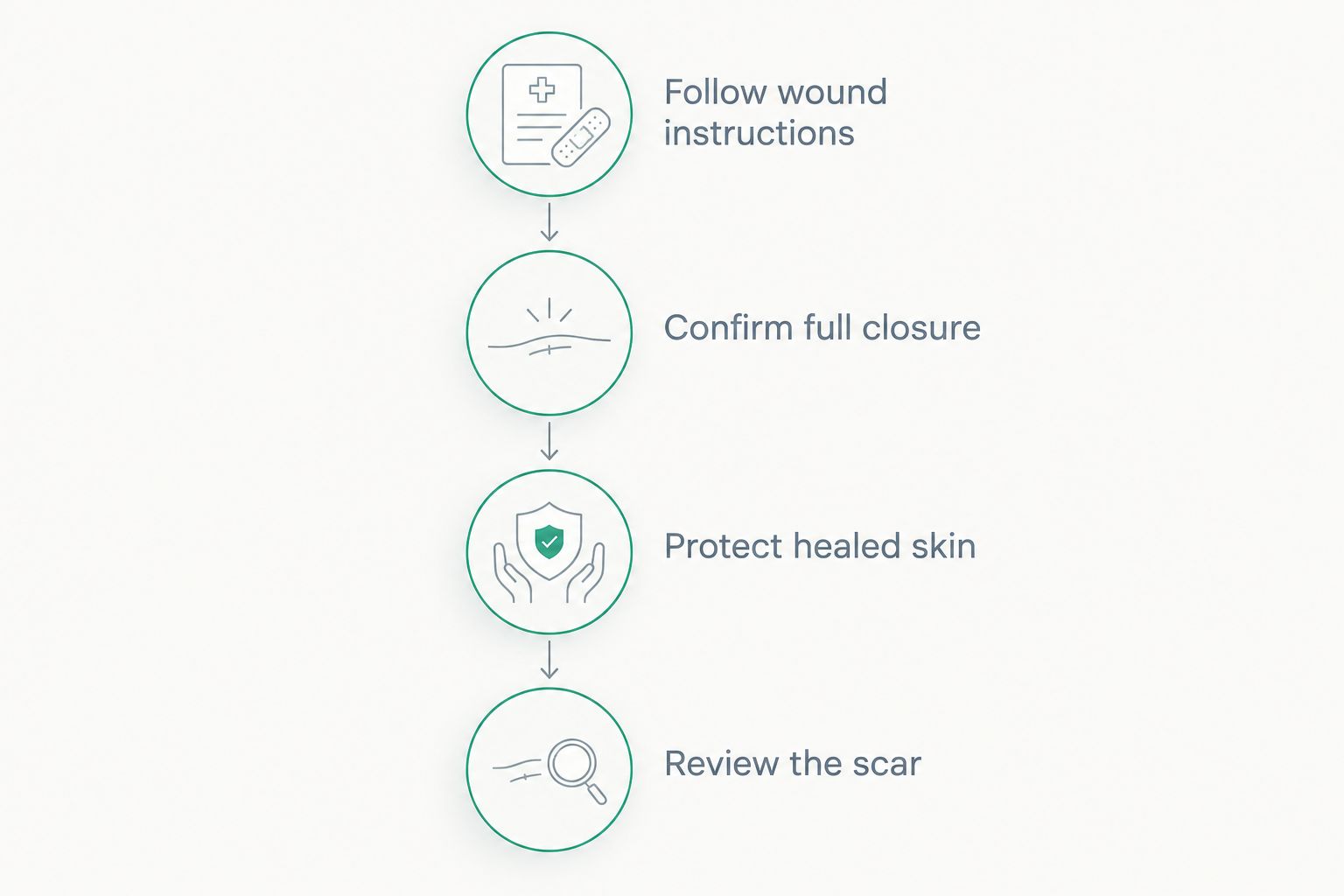
Follow wound instructions
While an incision is open, draining, crusted, or still being managed with postoperative dressings, use only the care your team recommends. Do not apply cosmetic PDRN serum beneath adhesive strips, over surgical glue, or into a wound unless your clinician specifically directs it.
Avoid scrubbing or trying to remove crusts. More manipulation is not better scar care, and toner pads, facial brushes, or exfoliating products do not belong over a healing incision.
Confirm full closure
Ask your clinician whether the incision is fully closed and ready for scar products. Looking dry on the surface is not a substitute for postoperative clearance, particularly if you still have tenderness, drainage, or an area that keeps reopening.
If silicone is recommended, ask which format suits the location and how to use it. Do not layer a serum beneath silicone unless the product instructions and your clinician permit that combination; additional layers can interfere with adherence.
Protect healed skin
The American Academy of Dermatology recommends broad-spectrum sunscreen with SPF 30 or higher to help reduce red or brown discoloration after a wound has healed. On exposed, healed skin, follow the sunscreen label and reapply at least every 2 hours outdoors, including after swimming or sweating as directed.
Clothing offers another way to limit exposure. Do not put sunscreen into an open incision, and do not treat a high SPF as permission to ignore your surgeon’s advice about covering the area.
Review the scar
Continue scheduled follow-up rather than waiting for a cosmetic product to solve a changing scar. Ask about increasing thickness, persistent symptoms, or growth beyond the original incision boundary.
For your 2026 care plan, photographs taken in similar lighting can help you describe changes at appointments. Do not judge progress from a freshly moisturized photograph against a dry-skin photograph: surface shine can make a scar look temporarily different.
When does a surgical scar need professional treatment?
A scar that becomes increasingly raised, extends beyond the original wound, restricts movement, or causes persistent discomfort needs assessment. A serum cannot establish whether you have a hypertrophic scar, a keloid, an adhesion, or another postoperative problem.
Contact your surgical team promptly for spreading redness, increasing warmth, pus, fever, worsening pain, or reopening. Those signs call for a wound review, not a stronger cosmetic routine.
For a closed scar, a dermatologist or surgeon can discuss options such as silicone, injections, laser treatment, or revision when appropriate. Each option has limitations and risks; the correct choice depends on the scar and your medical history.
Why acne-scar procedures are not a surgical-scar template
Indented acne scars and a linear surgical scar do not represent the same problem. Discussions of treatments for acne scars often involve peels or microneedling, but those procedures should not be transferred to a recent incision without specialist assessment.
Do not use home microneedling to force a PDRN serum into a surgical scar. Creating additional injury can introduce infection and irritation, and a cosmetic serum is not necessarily formulated for delivery through punctured skin. Increasing penetration does not establish safety or effectiveness.
Where does Velvente fit into a post-surgery routine?
Velvente Korean skincare is best for consumers seeking a cosmetic routine, not a surgical-scar treatment. The range includes toner pads, a foam cleanser, and a cream; none should be treated as permission to replace your postoperative instructions.
For intact skin after clearance, Velvente’s Anti-Aging Cream is a rich moisturizer positioned around hydration, firmness, and tone. Its relevant role here is cosmetic moisture care—not a demonstrated ability to flatten a surgical scar or prevent a keloid.
The practical benefit of Velvente is a routine built around ordinary skincare needs. The limitation in this context is equally important: anti-aging and skin-renewal positioning does not establish surgical-scar treatment efficacy. In 2026, choose postoperative products according to clinical suitability, not ingredient prestige.
You do not need to buy a full routine to care for a scar. If your existing moisturizer is comfortable and your clinician approves it, adding another cosmetic product is optional.
How long does a surgical scar take to settle?
Scar maturation takes months, and changes can continue for 12 months or longer. NHS scar guidance describes fading and flattening as gradual processes; a short cosmetic trial cannot reliably separate a product’s effect from normal maturation.
That does not mean you should ignore a worsening scar while waiting. Keep follow-up appointments and ask for review when the scar becomes more raised, painful, tight, or otherwise concerning.
Can I use PDRN serum once the stitches are out?
Stitch removal alone does not establish that a cosmetic PDRN serum is appropriate. Ask whether the skin is fully closed and whether your surgeon has restrictions related to glue, dressings, irritation, or the procedure itself.
Is silicone better than PDRN serum for a raised surgical scar?
Silicone is an established scar-management option; cosmetic PDRN serum is not an equivalent substitute. Ask your clinician whether silicone suits your scar, especially if you have a history of keloids or notice increasing thickness.
FAQ
Can PDRN serum erase a surgical scar?
No cosmetic PDRN serum should be expected to erase a surgical scar. Scar appearance depends on the injury, healing process, and scar type, and treatment aims to improve rather than guarantee removal.
Can I put PDRN serum on a fresh incision?
Do not put cosmetic PDRN serum on a fresh or open incision unless your surgical team specifically directs it. Follow the prescribed wound-care plan instead.
What sunscreen should I use on a healed surgical scar?
Use broad-spectrum sunscreen with SPF 30 or higher on healed, exposed skin, following your clinician’s advice. Reapply at least every 2 hours outdoors and according to the label after swimming or sweating.
Does plant-derived PDRN prove the same benefits as medical PDRN?
No, a plant-derived cosmetic ingredient does not automatically inherit the clinical evidence of a medical PDRN preparation. The formulation, delivery method, study population, and measured outcome must match the claim.
Can I massage a surgical scar with PDRN serum?
Only begin scar massage when your surgical team clears it. Ask whether massage is appropriate and which product to use; a serum does not make early massage safe.
Should I stop a serum if my healed scar stings?
Stop using the serum if it causes stinging, burning, or a rash, and contact your clinician if symptoms persist or worsen. Irritation is not evidence that scar remodeling is happening.
Can an old raised surgical scar still be treated?
An old raised surgical scar can still be assessed for treatment. A dermatologist or surgeon can discuss suitable options and realistic limits based on the scar’s features.
One last thing
A softer-feeling scar is not necessarily a flatter scar. Moisturizer changes surface hydration, while meaningful scar assessment also considers height, width, color, symptoms, and function.
Before adding any PDRN serum in 2026, ask your surgeon one specific question: what feature of this scar are we treating? That answer gives you a better next step than another promise of skin renewal.


