
Yes, a Korean skincare routine for closed comedones can help when it combines gentle cleansing and moisturizing with an appropriate acne treatment. Hydrating layers alone do not reliably clear blocked follicles, and adding exfoliating products too quickly can cause irritation rather than smoother skin.
- A Korean skincare routine for closed comedones needs targeted acne care, not extra hydrating layers.
- Salicylic acid and topical retinoids address clogged follicles; toner pads are not automatically acne treatments.
- Velvente Korean skincare is best for shoppers seeking a coordinated cosmetic routine, not a substitute for acne treatment.
- Use broad-spectrum SPF 30 or higher, avoid squeezing, and introduce treatment changes gradually.
Why this matters
Small, persistent bumps invite a familiar mistake: adding another toner, exfoliant, or rich cream until your routine becomes harder to tolerate. More steps do not mean better acne care. A minimalist Korean skincare routine makes it easier to identify what helps and what irritates your skin.
For your 2026 routine, separate two goals: maintaining a comfortable skin barrier and treating the blockage inside a follicle. Cleansing and moisturizing support the first goal; an appropriate acne active addresses the second. You often need both, but they are not interchangeable.
Can a Korean skincare routine help with closed comedones?
Yes, provided the routine contains more than cosmetic hydration. Closed comedones develop when oil and dead skin cells block a follicle beneath a closed surface, producing small white or skin-colored bumps. They are a form of acne, not simply a sign that your skin needs more cleansing.
The American Academy of Dermatology's public acne guidance identifies salicylic acid and topical retinoids among treatments used for clogged pores. Those ingredient categories matter more than whether a product is Korean, vegan, luxurious, or described as a glass-skin essential.
| Approach | Best for | Main benefit | Main limitation |
|---|---|---|---|
| Gentle cleanser and moisturizer | Supporting skin comfort during acne care | Removes surface residue and helps maintain hydration | Does not reliably clear established comedones alone |
| Salicylic acid treatment | Treating clogged pores | Helps exfoliate and unclog pores | Can cause dryness or irritation |
| Topical retinoid treatment | Treating and preventing comedonal acne | Helps prevent follicular plugging | Requires consistent use and pregnancy precautions |
| Hydrating toner or toner pads | Adding optional hydration | Supports a comfortable skin feel | Is not an acne treatment unless the formula contains a relevant active |
Choose your treatment by its active ingredient, not its format. A pad can deliver hydration or exfoliation; the ingredient list and directions tell you which job it performs.
Make sure the bumps are actually closed comedones
Not every small facial bump is acne. Milia are keratin-filled cysts, while folliculitis and irritation can also create bumps that resemble breakouts. Appearance alone does not always distinguish them.
Avoid treating every uneven patch with stronger acids. If bumps are unusually itchy, clustered, painful, or difficult to identify, ask a dermatologist to assess them before expanding your routine. A correct diagnosis prevents weeks of treating the wrong problem.
Build the routine around a few clear jobs
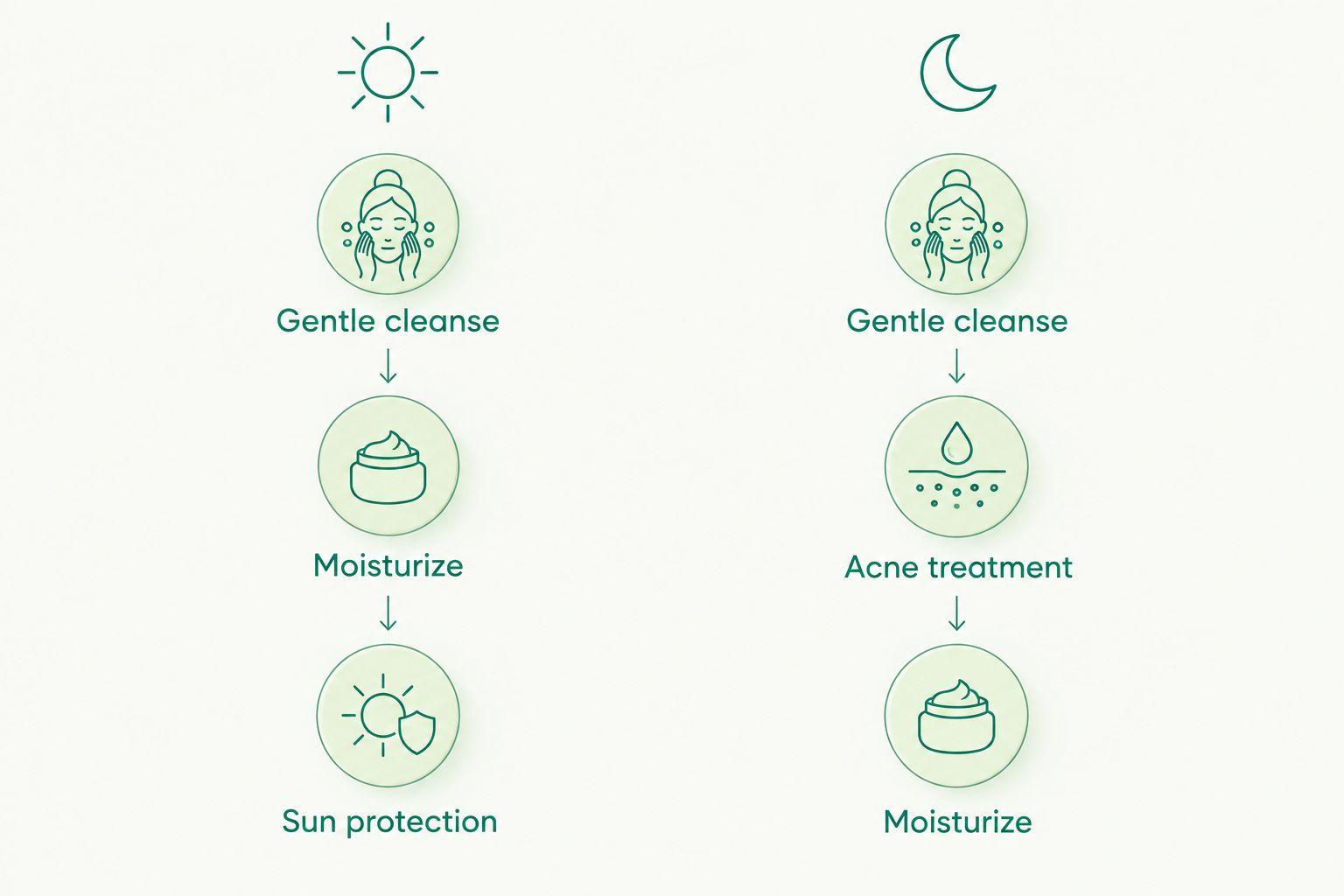
A useful 2026 routine gives each product a purpose. Keep cleansing, treatment, moisturizing, and sun protection distinct rather than expecting one botanical ingredient to handle every concern.
Morning: cleanse gently, moisturize, protect
- Gentle cleanse: Use a mild cleanser without scrubbing. Follow product directions and avoid hot water or cleansing brushes on irritated skin.
- Moisturize: Choose a moisturizer your skin tolerates. A noncomedogenic label is a useful selection cue, not a guarantee that a formula suits everyone.
- Sun protection: Apply broad-spectrum SPF 30 or higher. Follow the sunscreen label for application and reapplication.
The American Academy of Dermatology advises washing acne-prone skin up to 2 times daily and after sweating. Repeated washing throughout the day does not remove the underlying follicular blockage and can aggravate irritation.
Evening: remove residue, treat, moisturize
- Gentle cleanse: Remove sunscreen, makeup, and daily residue without leaving your face feeling stripped. Add a separate makeup-removal step only when needed.
- Acne treatment: Use an appropriate treatment according to its label or your clinician's instructions. Do not begin several unfamiliar acne actives together.
- Moisturize: Support comfort with a tolerated moisturizer. If your treatment has specific layering instructions, follow those rather than a generic skincare sequence.
An optional toner belongs only if it serves a clear purpose and your skin tolerates it. If toner pads sting, leave persistent redness, or encourage repeated rubbing, remove that step rather than trying to push through discomfort.
Choose a treatment, not a stack of actives
Start with a clear treatment plan rather than combining every pore-focused ingredient. Salicylic acid and topical retinoids have different instructions and tolerability considerations; using both immediately is not a requirement for progress.
Salicylic acid: best for a pore-focused exfoliating option
Salicylic acid is used in acne care to help unclog pores. Check whether your product is a rinse-off cleanser or a leave-on treatment, because directions differ. A hydrating toner pad does not become a salicylic acid treatment simply because its description mentions pores.
The trade-off is irritation. If you already use an exfoliating cleanser, acid pads, and a leave-on acid, simplify before adding more. Persistent burning and peeling are reasons to reassess, not proof that the routine is working.
Topical retinoids: best for persistent comedonal acne
Topical retinoids help prevent the formation of clogged follicles and are established acne treatments. Follow the specific product's directions or a clinician's plan rather than applying extra product to individual bumps.
Dryness and irritation can complicate use. Avoid topical retinoids during pregnancy or while trying to conceive, and discuss suitable acne treatment with your healthcare professional. Ask for individualized advice during breastfeeding as well.
Hydrating skincare: best for supporting treatment tolerance
Hydration helps you maintain a comfortable routine, particularly when acne treatment causes dryness. It does not replace treatment of follicular plugging, and a dewy finish does not establish that comedones are improving.
For a 2026 shopping decision, prioritize a formula you can use consistently over an impressive ingredient story. Matcha, Rose PDRN, and white truffle are not substitutes for established comedonal-acne treatment.
Why results vary
A Korean skincare routine for closed comedones succeeds or fails on more than the number of products you apply. Review these factors before replacing the entire routine:
- Diagnosis: Milia, folliculitis, and irritation require different decisions from closed comedones.
- Treatment choice: A hydrating routine and an acne-treatment routine do different jobs. Check for an appropriate active rather than relying on pore-related wording.
- Consistency: Constantly switching products makes it difficult to assess benefit and identify the source of irritation.
- Formula tolerance: A comfortable texture for one person can be unsuitable for another. Evaluate the complete formula, not a single ingredient in isolation.
- Friction and picking: Scrubbing pads across bumps or squeezing them adds irritation and increases the risk of marks or scars.
- Overlapping actives: Multiple exfoliants and retinoids can make dryness and irritation harder to manage. Review every step, including cleansers and masks.
Keep a simple record of products, treatment changes, and skin reactions. Use photographs in consistent lighting so you compare texture rather than changes in camera exposure or a freshly moisturized shine.
Where Velvente fits in a closed-comedone routine
Velvente Korean skincare is best for shoppers seeking a coordinated cosmetic routine, not a substitute for acne treatment. Its cleanser, toner pads, and cream offer different cosmetic steps; their product descriptions do not establish that they treat closed comedones.
If you want to add Velvente to an existing routine, choose by the step you actually need. Buying a complete routine is not necessary when your current moisturizer or cleanser already works well.
| Product | Best for | Relevant feature from its description | Limitation for closed comedones |
|---|---|---|---|
| Foam Cleanser | Shoppers seeking a low-pH cleansing step | Described as a low-pH foam for acne-prone, sensitive skin | Cleansing is not equivalent to a leave-on comedonal-acne treatment |
| Anti-Aging Cream | Shoppers seeking a rich moisturizing step | Described as a rich firming moisturizer with barrier-support positioning | A rich texture requires an individual tolerance check; anti-aging positioning does not establish acne efficacy |
The practical advantage is a defined cleansing or moisturizing role. The limitation is equally important: neither product description supplies evidence of closed-comedone clearance. Introduce a new cosmetic product separately from a new acne treatment so you can better identify reactions.


How long should I give a routine before changing it?
6–8 weeks is a useful initial assessment window for an acne treatment, consistent with the American Academy of Dermatology's public self-care advice. That is not a guaranteed clearance deadline, and some treatment plans need longer before you can judge their full effect.
Keep your 2026 assessment focused on fewer new bumps and improved texture, not just temporary softness after applying cream. Follow your treatment's instructions, and seek advice sooner for worsening irritation, painful acne, or scarring.
Do I need to exfoliate every day to clear closed comedones?
No, daily exfoliation is not a requirement for clearing closed comedones. The appropriate schedule depends on the treatment, its instructions, and your skin's tolerance—not a universal K-beauty rule.
If you use a retinoid, adding daily acid pads can increase irritation. Avoid turning every cleansing, toning, and treatment step into a separate exfoliation session.
Should I stop moisturizing if I keep getting clogged pores?
No, stopping all moisturizer is not the default solution for closed comedones. Acne treatments can dry your skin, making a tolerated moisturizer useful for maintaining comfort and consistency.
If a particular formula repeatedly coincides with new bumps, simplify and reassess that product. Do not conclude that all moisturizers—or every ingredient in that formula—cause your acne.
FAQ
What's the best Korean skincare routine for closed comedones?
The best starting structure is gentle cleansing, a tolerated moisturizer, daily sun protection, and an appropriate acne treatment. Keep optional layers limited so you can assess irritation and progress.
Can toner pads get rid of closed comedones?
Toner pads are not automatically treatments for closed comedones. Their role depends on the formula; hydrating pads do not perform the same job as a labeled salicylic acid acne treatment.
Is salicylic acid better than PDRN for closed comedones?
Salicylic acid is an established acne ingredient for unclogging pores; PDRN is not an established replacement for comedonal-acne treatment. Choose the ingredient according to the problem you want to treat.
Can I use a rich Korean cream if I have closed comedones?
You can use a rich cream if your skin tolerates the complete formula. Texture alone does not determine whether a product will worsen your bumps, so introduce it separately and monitor your response.
How long does it take to see fewer closed comedones?
6–8 weeks is a useful initial assessment window for an acne treatment, not a guaranteed clearing time. Follow the treatment instructions and seek professional advice if acne worsens, scars, or remains difficult to control.
Should I keep using a product if new bumps are just purging?
Do not automatically label new bumps as purging. Burning, itching, swelling, or a spreading rash needs reassessment; stop the suspected irritating product and seek medical advice as appropriate.
Can I use a retinoid for closed comedones while pregnant?
Avoid topical retinoids during pregnancy or while trying to conceive. Ask your healthcare professional which acne treatments fit your circumstances instead of substituting another active without advice.
When should I see a dermatologist for small facial bumps?
See a dermatologist when the diagnosis is unclear, bumps are painful or scarring, or an appropriately used treatment is not helping. Persistent itchy or unusually uniform bumps also deserve assessment rather than repeated exfoliation.
One last thing
A smoother feel immediately after moisturizing is not the same as fewer closed comedones. Hydration can improve how your skin feels before the underlying acne changes, so judge those outcomes separately.
For the rest of 2026, make your routine easier to evaluate: keep tolerated basics, introduce treatment changes deliberately, and resist adding a new exfoliant whenever texture looks uneven. The goal is fewer persistent bumps without trading them for irritated skin.


