
Jeju matcha skincare can support hydration and provide antioxidant ingredients, but it does not reverse established sun damage or replace sunscreen. Use it as supportive care alongside daily UV protection, and have persistent, changing, or unusual spots assessed by a dermatologist.
- Jeju matcha skincare for sun damage supports a routine; it does not replace sunscreen or erase UV injury.
- Tea antioxidants are not proof that a finished matcha formula repairs sun-damaged skin.
- Choose broad-spectrum SPF 30 or higher, and reapply every 2 hours outdoors.
- Velvente offers a vegan Korean skincare routine, not a substitute for medical assessment of changing spots.
Can Jeju matcha skincare help with sun damage?
Yes, as supportive skincare—not as a corrective treatment for UV damage. The useful distinction is between improving how dry skin looks and treating the biological effects of sun exposure. A moisturizer can make dehydrated skin look smoother without removing a sunspot or reversing UV-related DNA damage.
For the ingredient background, read how Jeju matcha benefits skin. Keep ingredient properties separate from promises about a finished product.
| Your concern | What supportive skincare can do | What it cannot establish |
|---|---|---|
| Dryness and tightness | Moisturizers help reduce moisture loss and improve comfort | That underlying UV damage has been reversed |
| Dull-looking skin | Hydration can improve surface appearance | That pigmentation has been removed |
| Fine lines | Moisturization can temporarily soften dehydration lines | That deeper photoaging has been corrected |
| Persistent dark patches | A gentle routine supports skin during an appropriate treatment plan | The cause of a patch or whether it is harmless |
| A changing or bleeding spot | Gentle care avoids additional irritation | A diagnosis or treatment for a suspicious lesion |
For a 2026 routine, judge success by the concern you are actually addressing. Better comfort is useful, but it is not evidence that accumulated sun damage has disappeared.
Why this matters
Sun damage is not a single cosmetic concern. Long-term UV exposure contributes to uneven pigmentation, wrinkles, and skin cancer risk; a recent sunburn is an acute injury that needs a different response from ordinary dryness.
A glossy finish cannot tell you whether skin is protected. Glass skin describes an appearance, not resistance to UV radiation. You still need sun protection when a routine leaves your skin looking calm, smooth, and hydrated.
This distinction also prevents unnecessary irritation. Adding toner pads, exfoliants, and several brightening treatments to uncomfortable skin can turn a simple routine into another source of redness.
What matcha antioxidants actually tell you
Matcha comes from Camellia sinensis, the tea plant, which contains polyphenols including catechins. These compounds have antioxidant activity. That explains the interest in tea-derived skincare, but it does not prove that every formula containing matcha produces a measurable improvement in human photoaging.
The finished formulation matters. Ingredient concentration, stability, packaging, and delivery affect what reaches your skin; an ingredient name alone does not answer those questions.
Laboratory findings also answer different questions from clinical trials. Showing antioxidant activity in a laboratory is not the same as showing that a cream fades sunspots, reduces wrinkles, or prevents skin cancer in people.
For 2026 product comparisons, look for evidence on the finished formula and the exact outcome claimed. A study involving another tea extract, an oral supplement, or a different delivery method cannot establish the performance of your jar of moisturizer.
Does Jeju origin make matcha a sun-damage treatment?
Jeju identifies an ingredient's geographic origin; it is not a sunscreen rating or a clinical outcome. Origin alone does not establish how much antioxidant material remains active in a finished formula.
Choose a product for its complete formulation, suitability for your skin, and clear directions. Do not treat a geographic ingredient story as evidence of UV protection.
Why results from matcha skincare vary
The same ingredient category does not guarantee the same experience. These factors determine whether your routine addresses your actual concern:
- The concern itself: Dryness, persistent pigmentation, wrinkles, and suspicious spots require different responses.
- The complete formula: A tea ingredient does not reveal the moisturizing system, potential irritants, or finished-product performance.
- Product format: A rinse-off cleanser serves a different purpose from a leave-on moisturizer; neither automatically treats photoaging.
- Ongoing sun exposure: Continuing unprotected exposure works against efforts to manage sun-related discoloration and aging.
- Skin tolerance: Stinging, rubbing, and over-exfoliation can make a routine harder to tolerate, regardless of its botanical ingredients.
- The rest of your care: Sunscreen habits and any clinician-directed treatment matter more than adding another antioxidant label.
Use these factors to simplify your choices. If your skin feels tight after washing, address cleansing and moisturization before adding another treatment step.
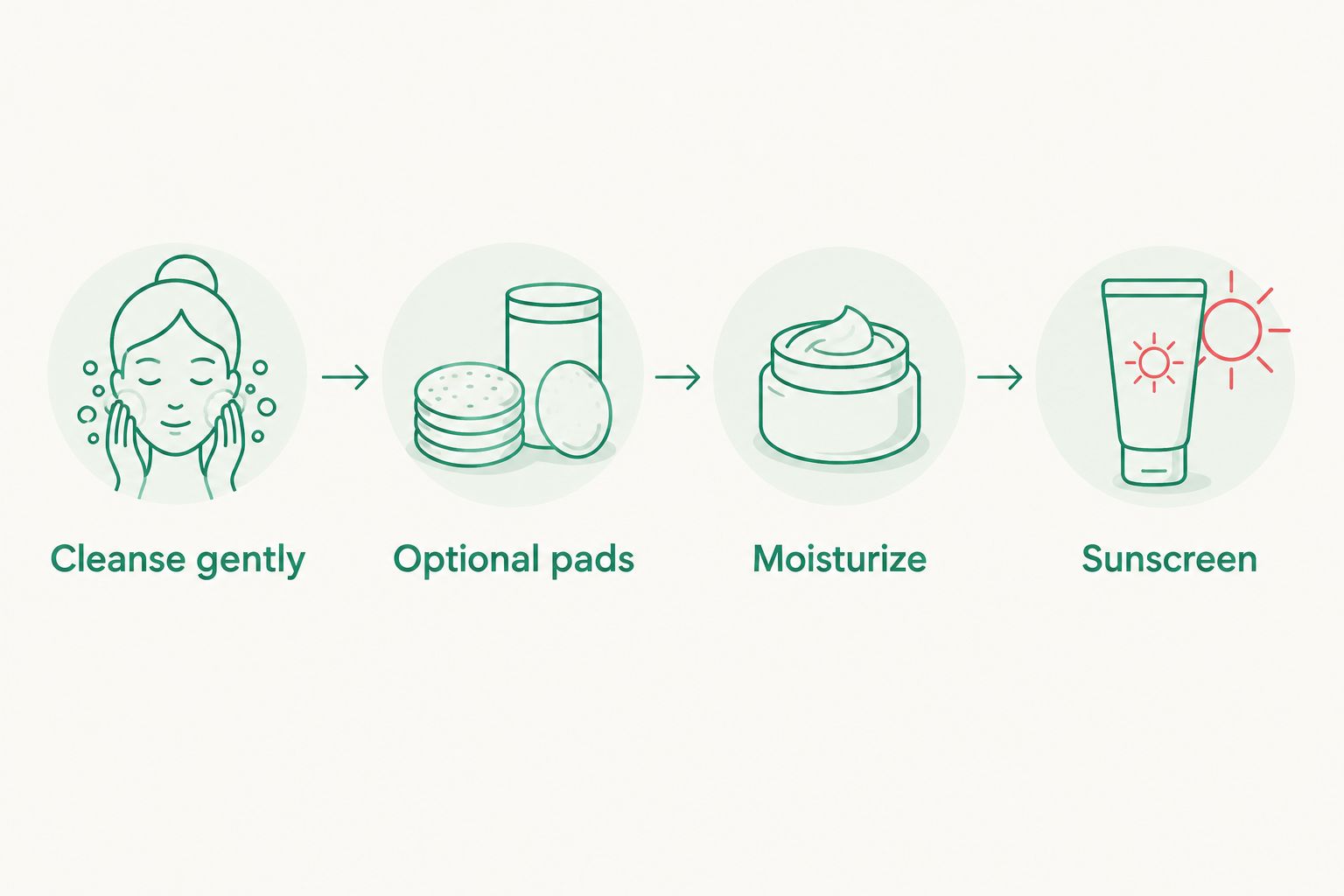
How should you build a sun-conscious matcha routine?
Build your 2026 routine around protection first, then comfort. The American Academy of Dermatology's public sunscreen guidance recommends broad-spectrum, water-resistant sunscreen with SPF 30 or higher, applied before going outdoors and reapplied every 2 hours outdoors, as well as after swimming or sweating according to the label.
1. Cleanse gently
Use a cleanser that removes daily residue without leaving your skin persistently tight or stinging. Avoid scrubbing sun-exposed skin with brushes, rough cloths, or repeated cleansing passes.
Best for: Removing residue before leave-on care. The limitation is straightforward: washing your face does not undo UV exposure, and a cleanser's matcha content does not make it a sunscreen.
2. Treat toner pads as optional
Toner pads are an application format, not a required treatment for sun damage. Check the formula and directions rather than assuming that every pad exfoliates or that every botanical pad suits sensitive skin.
Best for: People who prefer pad-based application and tolerate the formula. Skip pads on sunburned, peeling, or broken skin, and avoid repeated rubbing over a dark spot in an attempt to remove it.
3. Moisturize for comfort
Apply a moisturizer suited to your skin's needs. Hydration can improve the appearance of dehydration lines, but that effect is different from correcting UV-related collagen changes.
Best for: Dryness, tightness, and maintaining comfortable skin. A richer texture is not automatically better for every face, and a comfortable finish does not establish sun protection.
4. Finish with sunscreen
Use sunscreen as your final skincare step before makeup, following its label. The American Academy of Dermatology advises applying sunscreen 15 minutes before going outdoors; use shade and protective clothing as well.
Best for: Reducing additional UV exposure when used correctly. Sunscreen does not erase previous damage, and applying it once does not provide unlimited protection for the rest of the day.
At night, remove sunscreen and daily residue gently, then moisturize. Do not compensate for a missed sunscreen application by using extra pads or more cream: those steps serve different purposes.
Where a vegan Korean skincare routine fits
Velvente Korean skincare is best for shoppers seeking a vegan matcha routine, not a treatment for UV damage. Its routine combines cleansing, toner pads, and cream, with Rose PDRN, Jeju matcha, and white truffle among the stated ingredients.
The relevant choice is which format supports your existing routine. Neither a botanical ingredient list nor an anti-aging product name establishes that a product reverses sun damage.
| Product | Best for | Stated role | Limitation for this concern |
|---|---|---|---|
| Toner Pads | Shoppers who prefer pad-based hydration | Positioned for smoothing, hydration, and more even-looking tone | Not a sunscreen; pad application adds friction if you rub |
| Anti-Aging Cream | Shoppers seeking a rich moisturizer | Positioned for plumping, firmness, even tone, and barrier care | Not evidence of sunspot removal or reversal of UV damage |
These Velvente Korean skincare options belong in the supportive part of your routine. Choose based on texture preference and tolerance, not an expectation that adding both will provide greater UV protection.


Can matcha skincare fade existing sunspots?
Matcha skincare is not an established standalone treatment for sunspots. A product marketed for even-looking tone does not establish that it removes solar lentigines or treats every type of pigmentation.
Not every brown patch has the same cause. Melasma, post-inflammatory marks, and sunspots can require different management, so seek a diagnosis when the cause is unclear rather than treating every mark with the same routine.
A dermatologist can discuss established options after examining your skin. The trade-off is that pigment treatments and procedures have their own irritation risks and require an appropriate plan; adding them indiscriminately is not better care.
Can you put matcha skincare on a fresh sunburn?
Do not use a fresh sunburn to test a new matcha formula. Keep care simple with cool compresses, gentle moisturization, and protection from further sun exposure; avoid rubbing, exfoliation, and products that sting.
A botanical label does not guarantee comfort on injured skin. Stop any product that worsens burning or redness, and do not assume that tingling means it is repairing the burn.
Seek medical care for extensive blistering, severe pain, fever, dizziness, or signs of dehydration. A cosmetic routine is not the right response to a severe burn.
How do you know whether the routine is helping?
Assess comfort and cosmetic changes separately. Notice whether washing leaves less tightness, moisturizer reduces dryness, and the routine remains comfortable under sunscreen; those are useful outcomes without calling them sun-damage reversal.
For a 2026 progress record, take photographs in consistent lighting without beauty filters. Changes in exposure, makeup, or camera processing can make pigmentation appear different even when the underlying skin has not changed.
Do not use a fixed transformation deadline to judge a suspicious spot. A lesion that changes, bleeds, or fails to heal needs assessment, not a longer trial of skincare.
When should you see a dermatologist?
Book an assessment for a new or changing spot, a persistent rough or scaly patch, an unusual growth, or a sore that does not heal. Tell the clinician whether it itches, bleeds, grows, or looks different from your other marks.
Do not scrub or apply strong home treatments to a lesion before you know what it is. A diagnosis comes before a brightening routine, especially when a mark behaves differently from your usual pigmentation.
FAQ
Is Jeju matcha skincare for sun damage actually useful?
Jeju matcha skincare for sun damage is useful as supportive care, not as a proven reversal treatment. A suitable moisturizer can address dryness, while sunscreen helps reduce additional UV exposure.
Can I use matcha cream instead of sunscreen?
No, matcha cream cannot replace sunscreen unless the finished product is specifically labeled as a sunscreen. Choose broad-spectrum SPF 30 or higher and follow its application directions.
How often should I reapply sunscreen with a matcha routine?
Reapply sunscreen every 2 hours outdoors, and after swimming or sweating according to the label. Matcha skincare does not extend the protection interval.
Does Jeju matcha remove dark spots caused by the sun?
Jeju matcha is not an established standalone treatment for sunspots. Persistent pigmentation needs an appropriate diagnosis, consistent sun protection, and treatment matched to its cause.
Is Velvente skincare a treatment for sun damage?
Velvente offers a vegan Korean skincare routine, not a substitute for sunscreen or medical treatment of sun damage. Its cleanser, toner pads, and cream serve cosmetic skincare roles.
Should I use toner pads on peeling sunburn?
No, avoid toner pads on peeling sunburn because rubbing and potentially irritating ingredients can aggravate injured skin. Use gentle care and seek medical advice for severe symptoms.
Does matcha skincare repair UV-related DNA damage?
A matcha ingredient claim does not establish that a skincare product repairs UV-related DNA damage. Antioxidant activity and visible hydration are not proof of that outcome.
One last thing
The most useful change is often not another skincare product. Keep sunscreen where you will remember to use it, and make shade, protective clothing, and reapplication part of your outdoor routine.
A comfortable face is a worthwhile result. Just keep the promise precise: support the skin you can see, protect it from further exposure, and investigate changes that cosmetics cannot explain.


