
Yes, Rose PDRN toner pads can be used before makeup when the product directions allow leave-on use: remove the pad, let the remaining essence settle, then apply moisturizer, sunscreen, and makeup. The caveat is formula compatibility—PDRN alone does not tell you whether the finished product will feel tacky, pill, or work with your foundation.
- Can PDRN toner pads be used under makeup? Yes—use them before moisturizer and sunscreen, not over foundation.
- Velvente Toner Pads are a vegan hydration option; their finish under your foundation still needs a wear test.
- Remove the physical pad before applying makeup, and follow the label rather than an invented waiting time.
- Keep sunscreen in your morning routine; toner pads do not replace sun protection or guarantee longer makeup wear.
Can Rose PDRN toner pads be worn under makeup?
Yes—the skincare left by a suitable leave-on toner pad can sit beneath makeup; the pad itself cannot. Treat the application as skin preparation, not as a primer or a setting product. Check the label first because toner pads differ in ingredients and directions.
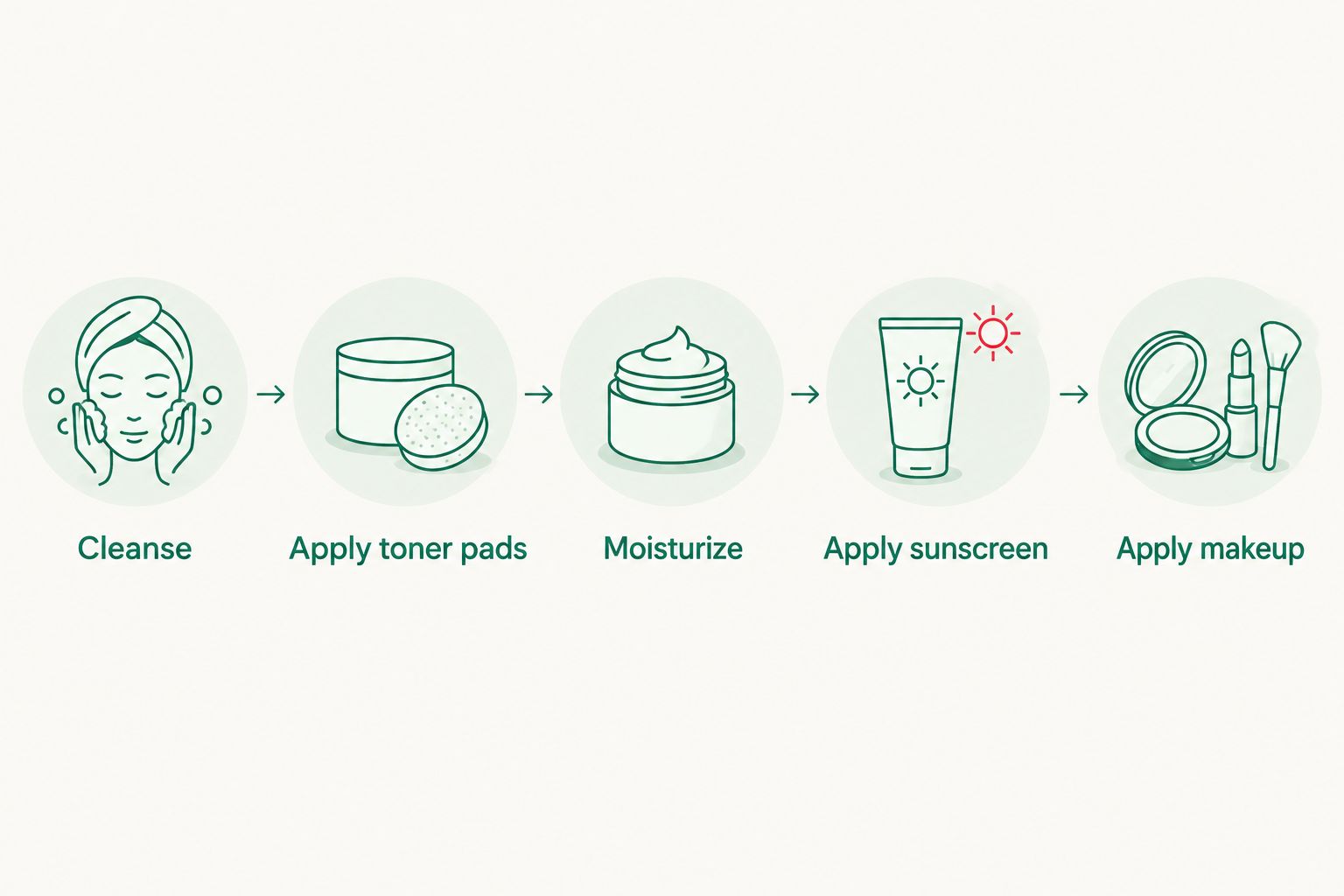
For your 2026 morning routine, use this order rather than layering pads over finished makeup. The separate guide to layering Korean skincare toner pads into a routine covers where the step fits beyond makeup preparation.
- Cleanse. Begin with clean skin and rinse away any cleanser completely.
- Apply toner pads. Follow the product directions, avoid unnecessary friction, and remove the pads before continuing.
- Moisturize. Apply a moisturizer suited to your skin, without leaving a heavy layer that your next products struggle to sit on.
- Apply sunscreen. Follow the sunscreen label for application and allow its film to set before makeup.
- Apply makeup. Use your usual foundation or concealer and check whether the layers stay smooth.
The practical test is the surface, not a stopwatch. If essence is still visibly pooling or moving across your face, you are not ready for the next layer. If the routine stings, stop rather than covering the reaction with foundation.
Why this matters
A skincare formula and a makeup formula have different jobs. Hydration prepares the skin surface; foundation adds coverage. A product can suit your skincare needs without improving the wear of every foundation you own.
Separate those decisions in 2026: first assess comfort, then assess makeup compatibility. A smooth result does not prove anti-aging activity, and a pilling result does not identify PDRN as the cause. Judge the complete routine rather than assigning every outcome to the ingredient on the front of the package.
Which skincare step belongs under your makeup?
Toner pads and cream are different steps, not interchangeable versions of the same product. Choose them by the job you need them to do, then check how the full routine wears.
| Option | Best for | Role before makeup | Benefit described for the product | Limitation |
|---|---|---|---|---|
| Velvente Toner Pads | Shoppers seeking vegan, hydrating toner pads | A toner step before moisturizer and sunscreen | Described to hydrate, smooth, and even tone | Makeup grip, transfer resistance, and wear time are not established by those claims |
| Anti-Aging Cream | Shoppers seeking a rich firming moisturizer | A moisturizing step before sunscreen | Described as a rich formula that plumps, firms, and supports the barrier | A rich moisturizer is not a primer; check its finish with your sunscreen and foundation |
Velvente Toner Pads are best for shoppers seeking vegan, hydrating Korean toner pads—not a guaranteed makeup primer. The useful distinction is what the product is designed to do versus what you still need to test with your own cosmetics.
Neither step is mandatory simply because you wear makeup. Keep a toner-pad step if your skin tolerates it and you prefer the result. Do not add it solely to chase longer foundation wear without checking whether it helps your routine.
Why results under makeup vary
The relevant variables are the complete formulas, their application, and your skin's response. Use these factors to troubleshoot instead of assuming every Rose PDRN product behaves alike.
- Finished formula. The full ingredient list matters more than the presence of PDRN alone. A named ingredient does not establish a product's texture or makeup performance.
- Amount left on the skin. A visibly wet or heavy surface is different from a settled layer. Follow the label without adding repeated applications for extra glow.
- Other skincare layers. Toner essence, moisturizer, sunscreen, and primer all contribute to the final surface. Assess the combination you actually wear.
- Application technique. Repeated rubbing introduces friction. Apply makeup gently rather than working the same area until the skincare begins to roll.
- Skin condition. Comfortable skin and irritated skin need different decisions. Burning, persistent redness, or itching is a reason to stop, not a sign to add coverage.
- Makeup formula. A foundation's finish and behavior are separate from a toner pad's skincare claims. Test the exact foundation rather than assuming compatibility across your collection.
Do not diagnose compatibility from water-based or silicone-based labels alone. Those shortcuts do not describe the entire formula or predict every layered result.
How do you prevent pilling after toner pads?
Simplify the routine and change one variable at a time. Pilling is the visible rolling or balling of product on the skin; it is not proof that dead skin is coming off or that an ingredient is working.
Start by checking whether you followed each product's directions. Avoid adding extra toner essence, extra cream, and an unfamiliar primer on the same morning. That makes the source of a poor result harder to identify.
For a useful 2026 wear check, keep your cleanser, moisturizer, sunscreen, and foundation consistent. Compare a familiar routine without toner pads against the same routine with the toner-pad step on a separate day. Record what changes without treating a personal comparison as a clinical test.
Check specific areas: around the nose, between the brows, and along any dry patches. Look for rolling product, uneven coverage, excessive slip, and discomfort. Those observations are more useful than deciding that a finish looks vaguely less polished.
Do not reduce sunscreen below its label directions to make the other layers behave. Adjust optional skincare or makeup instead, and remove a combination that repeatedly fails.
How long should you wait after toner pads before makeup?
There is no universal waiting time for every Rose PDRN toner pad and foundation combination. Follow any timing on the product label, then let each layer settle before adding the next.
Avoid borrowing a fixed waiting period from a different product. The amount applied and the rest of your routine affect the surface you are working with. Visible wetness, persistent tackiness, and rolling product tell you more than an unsupported minute count.
Sunscreen has its own instructions. For daytime wear, choose broad-spectrum sunscreen with SPF 30 or higher, consistent with American Academy of Dermatology public guidance, and follow its label rather than treating the toner-pad step as sun protection.
Should you use toner pads before a primer?
Use toner pads before moisturizer and sunscreen; apply a makeup primer afterward if you use one. A toner pad is a skincare step, while a primer is selected for a makeup-related purpose such as changing the surface finish.
Do not assume you need both. If your usual makeup applies well without primer, adding another layer creates another combination to assess. If you already rely on a primer, test the toner pads with that familiar product before changing anything else.
A skincare glow and a stable makeup base are not identical goals. You want a finish that feels comfortable and accepts makeup evenly, not the wettest possible surface.
Can you use Rose PDRN toner pads on sensitive skin before makeup?
Sensitive skin needs a tolerance check before a makeup compatibility check. Vegan ingredients and botanical origins do not guarantee that a finished product will suit everyone, and foundation should not hide a reaction during your first use.
American Academy of Dermatology consumer guidance recommends testing a new skincare product on a small area 2 times daily for 7–10 days, using the product as directed. Follow that approach before full-face use; a home test does not diagnose an allergy or guarantee future tolerance.
Make your first full-face trial on a day when you can remove the product if needed. Avoid testing several unfamiliar skincare products together. If irritation develops, stop use; seek medical advice for a persistent or significant reaction.
For your 2026 makeup routine, keep a clear boundary between skincare and treatment. Do not apply toner pads to broken or recently treated skin unless the product directions and your treating clinician support that use.
How do you check whether toner pads actually help your makeup?
Define success before you try them. A useful result is comfortable skin and makeup that applies as well as, or better than, your usual routine—not an assumption that adding a premium ingredient must improve everything.
Use a short checklist:
- Comfort: Does the skin remain free of stinging, itching, and new irritation?
- Application: Does foundation spread evenly without rolling the layers underneath?
- Finish: Do dry-looking patches appear less noticeable, stay unchanged, or become more obvious?
- Wear: Does your makeup behave acceptably during your normal activities?
Keep notes under similar conditions, including the same foundation and application tool. Different lighting, a new primer, and a different foundation can make comparisons misleading.
If the toner-pad step adds discomfort or consistently worsens application, leave it out of your morning routine. Consider evening use only if the product directions permit it and your skin tolerates it. There is no benefit in forcing a skincare step into the wrong part of your day.
FAQ
Can PDRN toner pads be used under makeup every day?
PDRN toner pads can fit a daily pre-makeup routine only when the product directions support that frequency and your skin tolerates it. Start with the label, not an assumption that more frequent use produces better makeup.
Do I leave the toner pads on while applying foundation?
No—remove the physical toner pads before applying foundation. For a leave-on formula, follow the directions for the remaining essence, then continue with moisturizer and sunscreen.
Do Rose PDRN toner pads replace makeup primer?
Rose PDRN toner pads do not automatically replace makeup primer. They serve a skincare role, and their ingredient claims do not establish makeup grip, pore-blurring performance, or longer wear.
Should I rinse my face after using toner pads before makeup?
Follow the toner pad's label: leave-on products and rinse-off products require different handling. Do not rinse a leave-on formula simply because you plan to wear makeup unless its directions tell you to.
Can I put toner pads over foundation to refresh my skin?
Use toner pads on clean skin rather than over finished foundation. Contact and wiping can disturb makeup, so keep the toner-pad step in your preparation routine.
Does PDRN guarantee that my foundation will not pill?
PDRN does not guarantee a pill-free foundation application. The finished skincare formulas, amounts applied, sunscreen, makeup, and application technique all matter.
Do I still need sunscreen after Rose PDRN toner pads?
Yes—Rose PDRN toner pads do not replace sunscreen. For daytime protection, choose broad-spectrum SPF 30 or higher and apply it according to its label before makeup.
One last thing
Do not sacrifice a comfortable, protective routine for a more complicated makeup base. For your 2026 routine, keep the toner-pad step only if it earns its place through tolerance and a finish you prefer.
The most useful check happens before foundation: look for a settled surface and comfortable skin. If either is missing, fix the preparation rather than trying to cover the problem.


